Why I Accept the Authority of the Catholic Church

One of the big concerns I had as a non-Catholic was that Catholics don’t believe in Sola Scriptura, or Bible Alone theology. Catholics accept the Authority of the Catholic Church on interpretation of the Bible, and to discern other Truths important to the faith though Tradition and the Magisterium.

I now view the Authority of the Church as the lens through with I view Scripture. And making sure that lens contains Truth is very important indeed. Which is why I don’t place my trust in myself. Because I don’t have to, and, I suggest, was never meant to in the first place.

What is Essential?

When I was Protestant, I enjoyed the idea that: “In the essentials, unity; in non-essentials, liberty; in all things love.” And now, as a Catholic, I still appreciate the sentiment. However, at some point during my conversion journey, I started asking these questions: Who decides what is essential? What gives them the authority to do so? Who decides what isn’t essential? What if we think something is a non-essential, that actually is an essential?

Case in point. There are some churches that believe infant baptism is essential. Others that believe adult or “believers” baptism is essential. Still others that don’t believe baptism is essential at all. Who is right? How can we be sure?

Most people, when they are talking about essentials, in essence, mean the Gospel. Which, is pretty much agreed upon by everyone. But, we can’t even agree on the implications of this essential. Some believe in Once Saved Always Saved… that you can’t lose salvation once you convert. Others believe that you have free will and could genuinely convert, but then choose to genuinely reject God at a later point in life. Again, who is right and how do we know?

I started thinking that all this hubbub about essentials and non-essentials goes against our common understanding that Absolute Truth is important. Is some Truth worth more than others? Did God allow any part of Scripture to be written where he was like… “meh, this part isn’t that important?” And, if its all important… why are we so keen on tiering the value of different Truths? And, how do we know we are weighting them correctly?

A Simple Message

I’ve also heard it said many times that people over complicate things when it comes to the Gospel. That it’s a really simple message, and is easy to understand.

In many ways I still agree with this. The Gospel, for example, was explained to me as a young girl. I understood it, and was able to accept it with my childlike, yet still very valid, faith.

But, as simple as the Gospel message is on the surface, I think it is also important to remember that we are talking about a God who is infinite. That compared to God, our minds work like babies. And that though, yes, many aspects of the Gospel and also the Bible as a whole can be understood by most with relative ease, the Bible is actually not a ‘simple’ book.

And what I mean by that is, yes, we can get a lot out of the Bible through personal study. And as Christians we should be in personal study, frequently. But, like any great book ever written, what you can garner from a surface-level understanding and what you can garner as you peel back the many layers are two different things.

And the Bible has many, many complex and beautiful layers.

And how do we ensure we are understanding those layers as they were meant to be understood? Herein begins my exploration of the problems involved in not having an authority.

Peeling Back the Layers

A few examples:

If we do not understand Jewish culture and practices, we could possibly misunderstand some things in Scripture. Specifically… we can read about the Last Supper in the Gospels, and have a decent, basic sense of what went on that night. However, we miss out on the deeper meaning of what Jesus was doing if we do not understand Judaism, as Jesus’ actions in the Last Supper were ripe with meaning for his disciples… who were all Jews. They would have understood Jesus’ actions and words in a much deeper way, simply because they understood the culture they were living in. It was a given for them. For us, 2,000 years removed from the Jewish culture of Jesus’ day… we are in danger of missing a lot.

If we do not understand the literary forms used in the Bible, we could misinterpret things. What was meant to be historical, what was meant to be allegorical, what is poetry, what is parable, what is symbol, what is fact? If we don’t understand the original language, and the specific meaning of the words Jesus chose… then we could be interpreting things wrong. John 6, and the Bread of Life Discourse is a prime example of this. Catholics use John 6 to substantiate our belief in the True Presence of Jesus in the Eucharist. Those who don’t subscribe to this belief, might argue that Jesus wasn’t being literal. That he was using symbolism. But, when you look back at the original language, and the reaction the people who heard Jesus speak had to what he was saying… it is very hard not to understand that Jesus meant what he said. Literally. We are reading the Bible in English, and sometimes imperfectly translated from the original languages. And therefore, if we don’t understand Greek and Hebrew… we, on our own, might be interpreting things incorrectly. (And which English translation are we to use anyway?!)

The same applies if we don’t understand the politics and history of the times in which books of the Bible were written. So many times books of the Bible relate to the historical context of the times. They mean certain things for certain people at a certain time in history. We can learn from and apply the purposes of many of these things to our world and life today, but we cannot assume that context is irrelevant. Again, we can lose meaning, or conclude meaning incorrectly if we are going at this on our own.

This was a difficult pill for me to swallow. Looking back, I think I didn’t want to believe that I couldn’t figure out the whole Bible on my own. Or that it wasn’t okay for me just to pick a theologian I liked and trust their interpretation. I had grown up believing that it was simple, and that I didn’t need an authority. Initially, realizing that I was wrong was difficult.

The Fallacy of Individual Interpretation

Most Christian people I speak with would agree that God has a specific intention and purpose for every word that he has, through human beings guided by the Holy Spirit, written in Scripture. That there is Absolute Truth. Yes, either God intended “This is my body” to be literal, or figurative. Not “either or” and definitely not both.

So, how do we know who has it right?

I believe I am paraphrasing a famous theologian and Catholic convert Dr. Scott Hahn when I say that I believe God is loving. And that a loving God wouldn’t leave us with an inerrant Bible, but only broken means to interpret it.

Most Christian, non-Catholic people that I speak with also firmly believe that the Holy Spirit guides Christians to interpret Scripture correctly.

But… with our general assent that God did, in fact, have a meaning in mind for what he allowed in the Bible, and the absolute fact that there are over 30,000 Christian denominations worldwide… we can only conclude one of two things.

1- That the Holy Spirit actually isn’t guiding us all to individually interpret things correctly… because this Christian believes in Calvinism, and this Christian believes in Arminianism. Because this Christian believes in believers baptism, and this Christian believes in infant baptism. Because this Christian believes in ordaining women, and this Christian does not. Because, because… If the Holy Spirit is genuinely guiding all those who are genuinely seeking him through their own personal interpretation of things… why are so many Christians coming to so many different conclusions? If this is the case, God gave us a Bible, and didn’t give us any way to know for certain what he meant! That doesn’t sound very loving to me.

2- The other option is Jesus never intended for us as individuals to carry the weight of correct interpretation on our shoulders at all. This would be the Catholic perspective. Catholics don’t believe that Jesus left us only a Bible. Which, he actually, definitely didn’t do, because the New Testament wasn’t even a thing for quite a while after Jesus’ life on earth. No, he didn’t leave us just a Bible. We believe he left us a Church. And that Church has been granted the discernment of the Holy Spirit through the ages, to correctly interpret the Bible.

Here’s Why

1 Timothy 3:15 states: “This is the church of the living God, which is the pillar and foundation of the truth.” Here’s a good article on the matter, but in essence, historically, prior to very recent Christian history, no one believed we should interpret the Bible individually. It was accepted and believed that Jesus promised the Holy Spirit would guide The Church to discern truth. The Church he himself established.

I don’t really think it’s that much a stretch for this to make sense. Christians believe that the Bible is inerrant. That God used dozens of authors, over hundreds and hundreds of years to give us an infallible book. God also gave the Church the Holy Spirit, with dozens of Popes over hundreds and hundreds of years to help the Church interpret that book infallibly.

John 16:13 says that when the Holy Spirit would come, He would guide us into all truth. Not just truth on the essentials (whatever those are determined to be), not just some of the truth, but all of it. He planned, from the very start, to give us a means to interpret Truth accurately.

We All Assent To Authority

Regardless if someone is Catholic or Protestant now, everyone assents to the authority of the Catholic Church on some issues.

For example… the Trinity is never mentioned in the Bible. Not once. But, interestingly enough, I was at a small group at my old Protestant church prior to my conversion, and the leader not only admitted that the Trinity isn’t in the Bible, but he acknowledged that we’ve trusted the Church to correctly form that doctrine for us. Now, I don’t think he was meaning to specifically reference the Catholic Church… but at the time the doctrine of the Trinity was formalized…. there was no Protestant Church. It was just Catholics everywhere. So, for all of us Christians that believe in the Trinity, we are assenting to the authority of the Catholic Church on that matter.

We also trust the authority of the Catholic Church with the Creeds of our faith. And we trust the Catholic Church to determine the Canon of Scripture (though Luther did have a few books removed during the Reformation… which in itself is another post).

At what point did God decide that submitting to the authority of the Church He established was no longer the way to do things, and that it was now up to the individual Christian to discern for him or herself what was true? I argue that He didn’t.

I honestly believe, based on the issues that Luther contended with at the time of the Reformation, and given the landscape of Christianity today- Luther would be Catholic. The issues he contended with aren’t issues anymore. He was right- the Church did need reforming at the time. And it did, most certainly, reform. And through it all, sound interpretation of our faith has been preserved. Even in times when there has been a corrupt Pope, or a heresy popping up, nothing doctrinally has been altered to the detriment of Truth. The bad Pope’s didn’t change things. The heresies were called out for what they were and snuffed out. Just like with the writing of the Bible, God is using fallible people to help preserve Infallible Truth.

Conclusion

The long and short of this post is to explain some of the reasoning behind why I accept the Authority of the Catholic Church.

I still read my Bible. Every day (much thanks to Lent for helping me solidify this discipline). But, when something comes up that I’m not sure about, I know where to go. There was just this sort of rabbit hole for me when I was Protestant that became very concerning. I was seeing people even within my own Church have different opinions on different issues in Scripture. How were they to know who was right? They may have taken their concern to the Pastor… well how were they to know the Pastor was interpreting things correctly? The Pastor might refer to a commentary or expository writing on that particular issue… but how were they to know that the author of that writing was interpreting things correctly? And on and on it goes… I’ve come to the conclusion that without a Pope, through whom the Holy Spirit works to protect Church teaching in matters of faith and morals, everyone is kind of their own. And that based on Scripture, that isn’t what Jesus was setting us up to be.

That’s why, ultimately, I saw no other way forward than to accept the Authority of the Catholic Church. Because I believe there is Biblical evidence that Jesus established a Church, and that He promised the Holy Spirit would preserve that Church in all Truth. And because I believe God keeps his promises.

– Lorelei

P.S. If you found this post interesting, and would like to read more on This Catholic Family… hit up that follow button on the top left of our page, or follow us on Facebook. We’d love to have you back again!

P.P.S. We’d love to hear your thoughts/comments on this or any other post. And thank you so much for reading!

Purchase Lorelei’s Books Here:

Catholic 101: Talking With Our Hands. The Sign Of The Cross In And Around The Catholic Mass

Many aspects of Cathoicism, especially the Sacraments, are meant as a way for us to experience God both spiritually and physically. The idea is that God knows we are a body/soul composite, and therefore has given us the Sacraments for the benefits of both of these parts of our being. In the Sacrament of Reconciliation, for example, we are able to audibly hear that God forgives us. It is a spiritual truth, that we are able to experience using one of our physical senses.

So, to, the Sign of the Cross is another physical/spiritual combination. There are many levels of depth to this gesture, and this article will only cover the surface. Here is how and why we use the Sign of the Cross in and around a Catholic Mass.

What’s The Deal?

Well, simply put, the Sign of the Cross is a way that we acknowledge the Trinity. It’s a way for us to acknowledge our faith, and its a way that we both remember what Jesus did and who God is. It’s a physical sign of our faith in Christ. In fact, since all Christians believe in the Trinity, there is no reason why the Sign of the Cross would need to be limited to only Catholics. And it isn’t. Many Orthodox Christians, as well as Anglicans and Lutherans, also use this symbol.

Before and After Mass, At The Font

If you’ve ever been inside a Catholic church, you may notice little baptismal fonts at the front of the aisles as you enter the sanctuary. Or, some Catholic churches have the big baptismal fonts where they actually baptize people back at the entrance instead of on the altar.

As we enter the sanctuary, we dip 2 fingers in the font and make the sign of the cross over ourselves. We use 2 fingers to help remind us that Jesus was both God and Man. We make the Sign of the Cross with the waters of our baptism to renew our baptismal covenant. In essence, it reminds us of our baptism, and the grace that God has given us through it, and helps to build us up to continue to live our faith out in our lives.

Setting Aside A Holy Time

We begin and end Mass by making the Sign of the Cross together, as a congregation. This is a way that we set aside our time with an intention to focus on God. In Catholic homes, we also begin and end any time of prayer with this sign for the same reason. We bookend time set specifically aside for God with the Sign of the Cross.

During The Gospel, A Variation

There are several scripture readings during Mass. We stand before the Gospel Reading, for reasons explained here. And, just prior to the Gospel being read, we make the sign of the cross with our thumb over our foreheads, over our lips, and over our heart.

The reason for this is that we want to remember, always, to keep the Gospel in our thoughts, and on our lips when we speak, and in our hearts, always.

The Heart of the Matter

As with anything, if we simply go through the motions and do not engage our hearts in what we are doing, then the benefit of our actions is greatly reduced. You could make the Sign of the Cross until you were exhausted, but if you were just going through the motions, the purpose and intention of this gesture won’t be fully realized.

That’s why it is so important that Catholics engage their hearts when utilizing all these beautiful tools of our faith. And, when we do, it makes Mass, and our faith lives outside of Mass, that much more meaningful.

-Lorelei

Purchase Lorelei’s Books Here:

Catholic 101: Make up your minds already! The sitting, standing, and kneeling of Mass

Kneel. Up. Down. Up. Down. Kneel. Up. Down. Up. Whew! Non-Catholics attending a Catholic Mass think a lot of things about the different postures Catholics take. Things like “Oh, up we go again.” And “Why are we kneeling?” And “Is it wrong if I kneel with my butt still on the seat, especially if I’m not sure why I’m kneeling in the first place?” I know non-Catholics think these things, because when I was a non-Catholic, those were my thoughts. I had no idea what was going on, or why. I just tried to keep up.

Now, as a Catholic, one of the things I’ve grown to appreciate about Mass is how each and every. single. thing. has significance. Every single movement, posture, word spoken, and thing done means something. The more you understand about what is going on in a Mass, the more you are able to appreciate its beauty. Which is why this post focuses on the “why” of the sitting, standing, and kneeling of a Catholic Mass.

The Sitting

Sitting is a posture of listening. Catholics sit for the first reading (often from the Old Testament), the Psalm (often actually sung), and the second reading (New Testament, not from the Gospel). We also sit for the offering, and the homily (sermon). We sit, ready to hear and receive. We sit to listen.

The Standing

For Prayer: Standing has been a posture of prayer for Jewish people since before the time of Jesus. Standing during prayer is also seen throughout different parts of the Bible. So, as Catholics, we continue to utilize this posture for prayer today. Some examples of when we stand during Mass for prayer: When we pray the opening prayer (led by the Priest) say The Lord’s Prayer (as a congregation), and the Prayers of the Faithful (the prayer requests for the congregation).

For the Creed: We stand as we say in unison what Christians have believed from the earliest times, in the form of the Nicene or Apostles Creed. We stand to affirm our unity and our beliefs together as Christians.

For the Gospel: Standing is also a sign of respect. We have many readings from the Bible during Mass, but we stand for the Gospel out of particular respect, since these are the words and deeds of Jesus himself.

For the Procession: We stand at the beginning and end of Mass, also as a sign of respect as the celebrant (Priest or Bishop who is celebrating the Mass) processes in to begin the Mass, and processes out once the Mass has ended.

The Kneeling

When we enter Mass, we genuflect, where we bend and touch one of our knees to the floor. We are humbly acknowledging Jesus in the tabernacle, in the Eucharist. Catholics believe that Jesus is fully present, body, blood, soul and divinity in the Eucharist, which is Holy Communion. We believe when Jesus said “This is my body,” that he meant it literally. Jesus is veiled behind the appearance of bread and wine, but His presence is fully and truly there. This is something that the very earliest Christians believed, and continue to believe right through to the present day in Catholicism. So we acknowledge that by genuflection.

Here’s a great video by Fr. Mike Shmitz, further explaining the reason for genuflection as we enter for Mass.

Kneeling is a posture of respect and adoration. Another time when we kneel is during the preparation for and before/after reception of the Eucharist (The Body and Blood of Christ in Holy Communion). We kneel, again, because we believe Jesus is fully and truly present in Communion. If you believed you were literally in the presence of Christ himself, falling to your knees would be a natural thing to do- probably even falling flat on your face. So, we always kneel during this part of Mass, and we remain kneeling until the elements are put back away in the tabernacle, and the tabernacle is closed.

Conclusion

Well, at least you now know that we Catholics aren’t just confused about what we do with our bodies during Mass. 🙂 And this was just a very basic description of what we do with our bodies as a whole. There are a host of other movements that the congregation and the celebrant do each Mass that carry additional meaning.

How we move our body affects and reflects the state of our mind. Slouching, for example, can be a reflection of someone’s sadness, or lack of confidence, or shyness, or it can move someone in that direction. While standing tall with one’s shoulders back can be a reflection of pride, or confidence, or bravery. And, even if you aren’t feeling brave, for example, but you take a posture of bravery, it can help get you there. The postures of Mass can, likewise, reflect your state of mind, or it can help put you in the right one.

Also, both inside and outside of Mass, bodily changes of posture just for the sake of moving aren’t super helpful to anyone. If you are sitting, standing and kneeling during Mass at all the right times, but your heart isn’t in it, or you are distracted, or not focusing on the reason why you are in a particular posture, then you lose the benefit of what the postures are meant to accomplish. But if you come into Mass and you genuflect towards the tabernacle, because you are humbly acknowledging Christ’s presence there, and if you sit, intent on listening with your mind, body, and soul, and if you stand, heart focused on prayer, and if you kneel acknowledging the presence of your Savior, then, then, you’ve got something.

As in all of the structures within Mass, and within Catholicism as a whole, there are so many tools to help move your heart, mind, and soul closer in relationship with Jesus. But you can’t just go through the motions. And if you truly engage, and accept and embrace the meaning behind what you are doing, the graces and joys and richness available to you in Mass and in the Catholic Church are immensely beautiful, and only bring you nearer to your Savior.

-Lorelei


Purchase Lorelei’s Books Here:
Catholic 101: Leading Worship and Catholic Mass

I, Lorelei, have been a part of leading worship at church since I was about 12 years old. I’m 30 now, so 18 years. There are few things I can say I’ve done that long! Walking, riding a bike, eating copious amounts of chocolate in various forms, maybe. But not much else.

Now, being Catholic, I am still helping lead the music, but my role now looks a lot different than it did before my Confirmation. I wanted to write a little bit about what leading worship looks like in the Mass as part of my Catholic 101 series.

Part of what I adapted to in becoming Catholic, is a difference in the structure of the service itself. Most of the churches I’d ever attended prior had a similar structure. There would be between 2 and 6 songs during the service. Most of them would be at the very beginning. There would be an offertory song, and sometimes, a song at the end. Sometimes my church was so small I sang along to actual pre-recorded music by the original singers. Sometimes my church was large enough that we had a full band accompanying the vocalists. But the overall structure was pretty much the same.

Our current parish has a choir that sings every other Sunday, and then the other weeks are filled in by a “Cantor.” This is my new role. I lead the music through the Mass, accompanied by a pianist. The Cantor is very busy during the service.

cantor.jpg
When the Cantor raises his/her arm it means its time for everyone to join in!

Here’s how it breaks down.

Pre-Service. 

Before Mass begins, I sing a song of my choosing. Usually I try and find something that sort of goes with the theme of the readings, and so far I’ve opted for some more contemporary songs that might not be in the hymnal, but that are still theologically solid.

Opening Hymn.

This is a song welcoming everyone to Mass, and the Priest processes to the altar during this song. Interestingly, during Mass, we don’t always sing through the entire hymns. When we see that the Priest is ready to move on, we wrap up the verse/chorus we are currently singing, and the song ends.

Glory to God.

This is a sweet hymn we sing early in Mass for most of the liturgical year. We don’t sing it during Advent because we are anticipating Jesus’ birth, and we also don’t sing it during Lent, as we lead up to the celebration on Easter. The Glory to God dates back to somewhere between the 1st and 3rd Centuries A.D. and is composed of only quotes from the Bible. The first words, for example, are what the Angels sang at the birth of Christ (Luke 2:14). There are 3 verses, each sort of focused on one aspect of the Trinity. It’s really beautiful. If you want to learn more about the Glory to God, check out the link here.

Responsoral Psalm.

There are 4 readings during Mass, as I talk about in my 5 Cool Facts About Catholic Mass post. The Psalm “reading” is actually sung. The Cantor sings the refrain, and the congregation repeats. Then the Cantor “reads” the rest of the Psalm by singing, going back to the refrain throughout.

Gospel Acclamation.

We sing some Alleluia’s before the Gospel reading for the day. The only time we don’t do this is during Lent, where we save our Alleluia’s for the celebration of Easter.  The acclamation is a welcoming and thankfulness of the Gospel, which contains the words and deeds of our Savior, Jesus. The Gospel is indeed something to celebrate and be thankful for!

Offertory Hymn.

This part is the same as all the other churches I’ve had the privilege to lead worship at. A hymn is sung while the offering is being taken, and also, during Mass, while the bread and wine are brought up to the altar for Holy Communion.

Liturgy of the Eucharist.

liturgy-ministers-communion-formation-days.jpg

This is the central part of any Mass. The priest prepares the bread and wine for Communion. There are many sung components to this Liturgy, where the Cantor leads the congregation to join in song.

The one component I’ll focus on is the sung “Holy, Holy.” This is before the Priest says the Words of Institution that Jesus said during the Last Supper “This is my body… etc.” It’s a song proclaiming the Holiness of God. The text comes from Isaiah 6, Matthew 21, and Psalm 118. The idea is that we are joining in song with all the angels and Saints in their unending hymn of praise. Which is very cool.

The lyrics of the song are:

“Holy, holy, holy, Lord God of Hosts, heaven and earth are full of your glory. Hosanna in the highest. Blessed is he who comes in the name of the Lord. Hosanna in the highest. “

It’s a beautiful hymn of praise that ushers us into the celebration of Holy Communion, or, as we Catholics call it, The Eucharist.

Communion Hymns

Depending on the size of the congregation, one or more Communion Hymns will be sung. These are usually chosen to go along with the theme of the readings and the homily for that Sunday. Here is a link to one of my absolute favorite Hymns (contemporary version). A cool side note is that many, many Catholic hymns are taken straight from The Bible and put to music.

Based on Isaiah 6:8. Here I Am Lord.


Closing Hymn

We join together in song once more at the end of Mass, as the Priest processes out. The closing hymn is often a call to live out our faith and share the Gospel.

A couple other things.

Due to the structure of Mass, and how there is a lot of music throughout the service, there isn’t a lot of down time for the Cantor! (Or choir if they are leading the singing that day.) Also, you are sitting or standing off to the side, the entire time, versus when I was leading worship at my previous churches, where you would leave the stage/altar area, and then sit in the congregation for most of the service. Since I’m a new Catholic, I’m always paying extra close attention to what comes next- it’s not second nature for me yet :). Also, during different seasons of the liturgical calendar, the Mass “setting” may change. For example, during Lent, this is particularly noticeable during the Liturgy of the Eucharist, which is where the Priest prepares Holy Communion. The music is more somber during Lent, and more joyful during other seasons, like Advent.

Overall, I’m very thankful for all the opportunities I’ve had over the years to lead worship during church services, in all their different structures and settings. Hopefully this is helpful to people looking to understand what all the music means in a Mass, and how it contributes to the service.

Until next time!

Lorelei

Purchase Lorelei’s Books Here:

Catholic 101: 5 Cool Facts about Catholic Mass

This letter is free for you to read, but it wasn’t free for me to produce. If you’re interested in supporting the work of This Catholic Family, I would be honored if you would prayerfully consider upgrading your subscription. Or, you can always buy me a coffee here.

For some, Mass is a beautifully rich time of spiritual reflection and growth. For others, Mass is confusing! Sit, stand, sit, stand, kneel stand. Lots of sayings and responses that are difficult to follow along with if you aren’t Catholic.

So, in light of a desire to shed some light on Mass, here are 5 cool Mass Facts that you may not have known.

1- Mass is modeled after the book of Revelation

4717e1a4!h.300,id.2107,m.fill,w.jpg

I think there is this stereotype that Mass is  antiquated, or ritualistic. However, interestingly, much of the content of Mass is based on the book of Revelation, which is a book all about the future, and of that which is to come. For example, each Mass we sing the “Holy, Holy, Holy,” which is straight out of Revelation 4:8. The idea is we are joining in with those in heaven in their unending hymn of praise. So that’s a real profound moment, if you think about joining in singing the same song those in heaven are singing, and the connection between the physical and the spiritual that is occurring. And that’s just one tiny example. You can do an entire study on Revelation and the Mass. The more you know, the more amazing Mass becomes.

2- There are 4 Scripture readings throughout Mass,and the readings are the same globally. 

Outdoor_Mass_Tanzania_642px.jpg
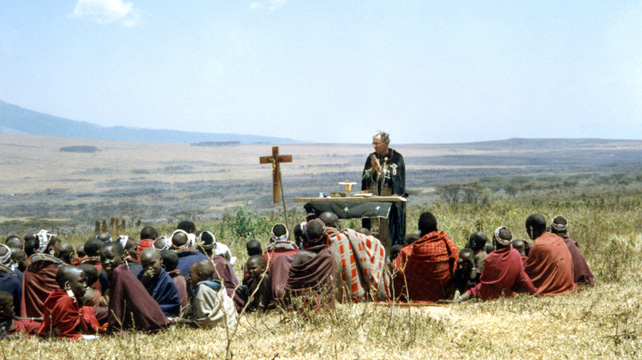
Outdoor Mass in Tanzania.

There’s a lot of Bible each Mass. First, there is often an Old Testament reading (except during the season of Easter, when we read through the whole book of Acts.) Then, there is a Psalm, except instead of it being read, the Psalm is typically sung. Which is cool because the Psalms are originally songs. So, in the Mass we put them to music, and it’s sung responsorally, where a lead singer, or cantor, sings part of it, and the congregation joins in throughout. After that, there is a New Testament reading. And, finally, we conclude with a reading from the Gospels. Often, there is a theme that connects many of the readings, and there are studies available to further dig into the readings of each week. Also, the Catholic readings cycle over 3 years, throughout which, if you are attending daily Mass, you’ll have read through pretty much the entire Bible! And finally, the readings are the same globally. So each Mass, I am hearing the same readings as Catholics in my own town, in Minnesota, Africa, Europe… everywhere! This is cool because I can discuss something about the readings with JP’s family or a friend of mine from a different parish, and we all have heard the same Scripture each week.

3-We say the Creed every Mass. 

Nicaea_icon.jpg

Christians have shared a creed, or set of beliefs since the earliest days of Christianity. The Nicene Creed was formalized in 325 A.D. It’s a series of “I believe” statements, and is a beautiful, easy to understand representation of Universal Christian teachings. Every single Mass, we stand up together and state our beliefs corporately. That’s a cool moment- publicly affirming your beliefs among others who are affirming the same.

4- Mass is offered every day. 

chalice paten.jpg

Anyone looking to attend Mass can find one any day of the week, often offered at different times in different parishes. An interesting thing about this is if you think about time zones, and that daily Mass has been a global practice since the days of the Early Church, there is pretty much a Mass being offered somewhere continually on Earth at all times… and has been for… well a really long time!

5- The Making Present of the Last Supper. 

Leonardo_da_Vinci_-_Last_Supper_(copy)_-_WGA12732.jpg
The real one. Not the painting. 🙂

Catholics believe Communion is more than just are representation, or symbol, or what Jesus did in the Upper Room. And Catholic belief on Communion actually goes wayyyy back into Jewish culture and history. Historically, when Jewish people celebrated the Passover of Moses’ day, they didn’t believe they were just symbolically representing what happened; they believed they were participating in a “making present” of that actual one time historical Passover event. That they too, somehow, mysteriously, were also participating in the Passover of Moses. In Mass, we believe that Communion is a “making present” of Jesus’ Last Supper with His disciples. That we, too, are participating, mysteriously, in that one time event. There are a lot of connections to Judaism in Catholicism and in Mass as well. This is only one of them.


I hope you’ve found these 5 Cool Facts about Mass interesting, at least, and educational at most! I know I didn’t get to all the sit, stand, kneel stuff in this post- but I can write about that another time. There’s a lot of meaning behind each of those postures as well.

Until next time!

-Lorelei

Purchase Lorelei’s Books Here: