This letter is free for you to read, but it wasn’t free for me to produce. If you’re interested in supporting the work of This Catholic Family, I would be honored if you would prayerfully consider upgrading your subscription. Or, you can always buy me a coffee here.
I am over seven years past my Catholic confirmation, and I did not really know much or think much about the relics of the Saints until recently. JP and I had been listening to The Exorcist Files, a great podcast that is engaging catechesis on the experiences of an official Catholic exorcist and the theology behind spiritual warfare and the demonic. The Priest, Fr. Carlos Martins, is also known as “The Relic Guy,” and in one episode, he shared how the relics of the Saints can be a useful tool in combating demons as they can cause demons considerable distress.
This prompted me to want to learn more about relics!
What Are Relics?
In brief, a relic of a Saint is either part of a Saint’s body, or something they owned, or something they touched. There are three degrees of relics:
1st Class Relics: These are parts of the body of a Saint (bone or flesh, for example)
2nd Class Relics: These are possessions that the Saint owned.
3rd Class Relics: These are objects that have been touched to a first or second class relic, or they can be objects that the Saint touched.
An interesting tidbit is that every Catholic church should have at least one relic inside the main altar! Might be worth checking with your local parish Priest to see if he knows whose relic your parish has.
Biblical References to Relics
I was also very interested to learn that there are many examples of relics being objects that God uses for His glory in several instances of the Bible. In 2nd Kings 13:20-21, we see a man being buried. He is cast into the grave of Elisha and upon touching Elisha’s bones (a first class relic), the man revives.
In Acts 5:15-16, people go out onto the streets hoping that even Paul’s shadow will fall upon them so they can be healed.
In Acts 19:11-12, handkerchiefs and aprons that Paul had touched (3rd class relic) were taken off to people who were sick or possessed and they were healed.
There are others, but even those three passages show us that God sometimes uses relics as a tool in healings. The relics themselves are not magical, nor do they have any power on their own, God is the one who heals, but his grace can reach us through the Saints in a mysterious way.
How We Ended Up With A Relic of St. Anthony
My kids love to bring home items from the “Free to Take” table at our parish. This often means we’re coming home with prayer cards, or pictures of the Divine Mercy, or little trinkets from religious organizations that send out things in the mail. One day this summer, I was rifling through a drawer in our kitchen that contained many items from the “Free to Take” table, and I found a relic of St. Anthony preserved inside a metal frame!
Imagine my surprise! Now, the relic is a very small piece of fabric, and is very likely a 3rd class relic- something that has been touched to a first or 2nd class relic, but it’s still really cool! We ask St. Anthony for prayers to God for things that we’ve lost pretty often, so it seems especially fitting that I“found” this relic that was right under our noses for a while!
Do Relics Matter?
At the end of the day, any healing or good that comes to us in this world is from God, but I do think it’s pretty awesome that God uses holy men and women, and even sometimes the objects that they owned or touched, to be a vessel for His grace. It’s another way to take something spiritual and to connect it with our tangible experience here on earth. Remembering the Saints and their lives and how they followed God so closely is becoming more and more of an inspiration to me as time goes on.
Hello and welcome to our new series, “Ask a Catholic!” This is a spot where you can ask us anything about Catholicism, and we are happy to answer. I’ve been looking forward to this so much, especially since so many of my friends are Protestant/Evangelical. Firstly, as a way to reduce the misunderstandings between us. And second, as a place to invite dialogue in a world that sorely needs it.
And so, to our first question we shall go!
Question #1: “I’m happily Evangelical. I’m not sure I see the relevence of learning about Catholics at this point in my walk of faith.”
This is a great question, and a wonderful place to start.
I was thinking about it this morning, and I found an analogy that might be helpful. In many ways, I think declining to learn about the Catholic Church, or avoiding it, or even just assuming we understand it enough to know it isn’t for us, is sort of like a child refusing to get to know its mother. The idea of that seems so silly. Of course a child will want to know its mother- as much as he or she can know about her, probably! Because, for one, she is where that child came from. And second, who she is will greatly shape and impact that child for the rest of his or her life.
I think the same is true about the story of our Christian faith and how it grew since its beginning.
As someone brought up in various branches of Evangelicism, my idea of a church was often a relatively plain building or sanctuary that also functioned as an auditorium, or a performance hall, or even a basketball court in some occasions. My idea of church was an opening prayer, a series of songs, an offering…all of which led up to a sermon that was the sort-of pinnacle or focus of the service. Then another prayer and possibly another song at the end.
As I came into adulthood I started to wonder what the early Church looked like…what were there services like? Did we hold the same beliefs? Retain any of their traditions? And if we didn’t, when and why did we give them up? Did our American Evangelical Christianity look anything like Christianity looked like for the generations that immediately followed the life of Christ on earth? And if it didn’t, should it? I began to suspect that whatever it looked like, early Church couldn’t possibly have been an auditiorium-style sanctuary with projectors, and stage lights, concert-style emotion-driven music, and a pastor-centered service.
Then I realized that the people in these places-these auditioriums with the performance heavy services were the same people I had been listening to and believing for years, mostly passively, when it came to what Catholics believed and taught. And the thing was, for a group of people so certain that Catholics were wrong on so many issues, none of them could tell me what the early Church looked like once I started to ask.
So, on one hand, I had pastors and fellow church and small group members telling me what Catholics believed and how wrong they were compared to Evangelicals on a number of things:
“Catholics believe you can earn your salvation, Catholics worship Saints, Catholics have an unhealthy devotion to Mary, Catholics believe you can’t just go to God with your sins, Catholics are so devoted to tradition that they go through the motions and don’t have a personal relationship with Jesus, Catholics added books to the Bible, Catholics don’t believe in Bible Alone and obviously Bible Alone is the truth, they don’t believe in Once Saved Always Saved and obviously Once Saved Always Saved is the truth, Catholics think you can earn your salvation by works.” Just to name a few.
Then, on the other hand, I also had this vague understanding that the early Christian Church-from Jesus until the Reformation…was Catholic.
I started to wonder if somehow not all of the things I had been taught or had come to believe about Catholics were true, or even if they were, if they were maybe incomplete in some way.
And it all comes back to this. The child knowing its mother. If we don’t understand Catholicism, then we don’t truly understand the history of our Christian faith.
We don’t understand where we came from.
The Missing Years
Christianity didn’t appear in a vaccum, with hipster pastors and rock music and stage lights, even though that was my experience of Christiany- it was what I had known my whole entire life. Some of the churches I went to were very humble, just a couple of singers adding their voices to a cassette tape through the speakers. Others were much more highly produced, and some even recorded songs and sold CD’s of original music. But I had fallen into the mistake of thinking that because it was all I had known, that that was all it ever was. Pre-Reformation Christianity had been explained to me in vague terms like ‘indulgences’ and ‘Luther’ and ’99 thesis nailed to a door,’ even though our faith had existed for 1500 years prior to that. It was like we had the Bible, and then we skipped right ahead to the Reformation.
What on earth had gone on in between? What did the earliest generations after Jesus do and believe? How did they structure their life and practice of faith?
No one at the Baptist/Calvinist church we were attending at the time could tell me. I wondered if it could even be known? If it could, I felt very strongly that I needed to know it. There had to be something incredibly precious and sacred about those early Christians and the way they lived their faith. I felt like they had something to teach me, and the fact that I had grown up in an modern, Americanized bubble of Christianity no longer served as an excuse.
Our History Matters
There’s a joke among Catholics that to study Church history is to cease to be Protestant. I harbor no illusions that my little posts here and there will send people running to the Catholic Church. But I do hope for this: For anyone with whom I’ve garnered any bit of trust, I hope you’ll read this series. If for nothing else than to better understand a part of our shared Christian faith that was there since the start.
I think we all only have something to gain from a better, clearer understanding.
And that, my friends, is how we begin the “Ask a Catholic” series. Feel free to email us a question for the series, or drop it on our Facebook page or at the bottom of this post. We’ll answer as soon as we can!
-Lorelei
Purchase Lorelei’s Books Here:
Lorelei is the author of creepy, magical, hopeful stories for children. Her debut, The Circus of Stolen Dreams, released in 2020. Her second book, a magical retelling of The Secret Garden, released in 2022. Both are available for purchase wherever books are sold.
This December marks the five year anniversary of the first time I ever went to Mass by choice.
I had been to Catholic Masses before…as a baby, for my own baptism and that of my brother. I had been to funeral Masses. A few weddings. I had begrudgingly and awkwardly joined JP’s very devout family at Mass when we visited them so as not to cause ripples.
But there was something very different about the first time I decided I wanted to go to Mass, the first time I chose it for myself.
The Pre-Conditions
First of all, the conditions to led me, a once anti-Catholic evangelical, to seek out a Catholic Mass in the first place.
I had gone from a very fervent young Christian, to a disillusioned young adult inside the walls of various Protestant churches over a number of years. I was struggling to reshape the faith of my childhood into something with the depth required for my adult experiences. My own journey of faith began as a strong believer when I was a child and teen, but transitioned to a life as a near-agnostic in my early 20’s. That shift called into serious question the Protestant doctrine of “Once Saved Always Saved” because my own experience proved that one can start out with true belief but deny it later on. Our foray through a variety of denominations brought me to doubt individual interpretation of Scriptiure- if it’s that clear, why do all these churches disagree on issues both big and small? I grew weary of the hyper-emotional structure of worship, and the expectation that I developed equating a good church service with feeling emotionally fulfilled.
To top it off, no one could tell me what the early Church looked like, just as I was beginning to suspect that the Americanized version of Protestant Christianity wasn’t it. I wasn’t sure if what I was looking for even existed, and if it didn’t, I didn’t think I could remain in good conscience a sola-scriptura, once-saved-always-saved, American Protestant for much longer. Or, if this was all that Christianity was, I didn’t know if I would remain a Christian at all.
Cue me, sitting on my sofa, realizing that among these and many other things, I was possibly starting to think like…gulp…a Catholic. I hungered for a connection to the history of my faith. I wanted something deeper than an emotionally-driven experience could offer. I wanted sound theological depth.
I didn’t really know how to bring this up to JP because I had persuaded him away from actively practicing his Catholic faith early in our marriage. But I sprung the question on him one snowy night in downtown Racine while we were out at dinner. I asked, simply: “Do you want to go to Mass?” Shocked, JP shared with me that he had been praying for our unity in private, and had himself felt like he was being led back to the Catholic Church.
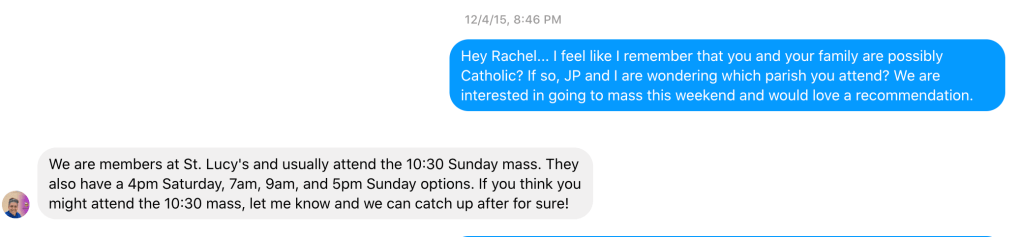
We got home from dinner and I sent a message to one of my friends, who I suspected might be Catholic:
The Mass Itself
Two days later, on December 6th, JP and I led our (then) two children through the doors of St. Lucy Parish in Racine, Wisconsin for the 10:30 Mass. Even though I had been to Masses here and there, I didn’t really know what to expect, and I wasn’t entirely sure what to do throughout the different components. But, on that Sunday, my experience in a Catholic church that early Sunday in December was markedly different from any Mass I had been to before.
I had chosen to be there. And, at last, my heart was open to what I might find.
I don’t remember a ton of specifics, other than the distinct feeling that if what I was looking for existed anywhere at all, it likely existed here. The very Church I had sometimes ignored and other times argued against, certain that it was filled with irrelivant, extranneous, anti-Biblical teachings, now might just be my only chance to remain in the Christian faith.
I do remember that there were many families with young children sitting altogether in the pews, which impacted me because at the church we went to a the time, we sent our kids to Sunday School in different rooms. I remember that there wasn’t any sense at all that this service was designed to cater to me, another marked contrast to the hip coffee-house, welcoming committees of the Protestant churches we had recently attended. The music was traditional. The components themselves were somewhat foreign, and yet oddly familiar too. I caught in them some echoes of the fragments that Protestant churches have held onto- Scripture readings, an act of contritian, Communion. But here, inside the Catholic Mass, they weren’t fragments of some lost, greater whole. I remember trying to piece together how it was I grew to be so anti-Catholic in the first place, when it was clear I knew so little about it.
The Aftermath
My friend met us after Mass and, after expressing my continued interest, she helped us get connected with RCIA at St. Lucy’s. We enrolled immediately. Inside the walls of that little RCIA room, I asked every question my heart had been wrestling through, knownig that I had to leave everything on the table. Based on what I had seen in multiple Christian churches over nearly 30 years, if the answers couldn’t be found in the Catholic Church, then they probably couldn’t be answered by anyone, and the Christian faith was a sham. One week later, we attended my last church service at the Protestant Church we had been a part of. I have many friends who love Jesus who remain Evangelical, but I could no longer look at it the same way as I once had.
And the rest, as they say, is history. That early December night, where the snow fell like wisps of cotton outside the restaurant window, when I asked JP if he wanted to go to Mass, was less than four months away from the day I’d stand in front of a full Cathedral in St. Paul Minnesota. Easter Vigil, 2016, when I was confirmed into the Catholic Church.
Protestant churches do a really good job of making new guests feel welcome. They greet you, connect you with a small group, offer you donuts and coffee. They give you great concert-quality music and an inspiring message. My first intentional visit to a Catholic Mass didn’t contain any of those things to the same extent I had been used to before. But I didn’t need any of that to be drawn in to the Catholic Church, at least not once my heart was open to it. The Mass drew me in, not with bells and whistles and trends and the promise of friendship with other people like me. It drew me in with beauty, and history, and, above all, rock-solid Truth.
-Lorelei
Purchase Lorelei’s Books Here:
Lorelei is the author of creepy, magical, hopeful stories for children. Her debut, The Circus of Stolen Dreams, released in 2020. Her second book, a magical retelling of The Secret Garden, released in 2022. Both are available for purchase wherever books are sold.
Her lace and ribbon white dress is hanging in the closet next to her veil. It is waiting.
The Eucharist rests in the tabernacle behind the altar of our beautiful church, St. Rahael the Archangel. It is waiting.
I’ve never been a person who does well when things don’t go as planned. I’ve gotten better as I’ve grown older, but I still like to know what to expect. And I like things I can count on. Our family has been spared some of the more devastating effects of the pandemic thus far, but today was one of the harder ones for the family, and for Felicity in particular.
Today was supposed to be Felicity’s First Holy Communion. She is waiting.
What We Miss
I was 30 years old before I received my First Holy Communion. But for almost all of that time, I didn’t know what I was missing. I viewed communion as a symbol, something to help us remember a long ago event that was important to the foundation of the Christian faith.
Felicity understands differently, at a much earlier age than I did. And so she felt the delay of receiving her First Communion in a significant way.
For anyone who does not share our Catholic faith and might be wondering why this such a big deal, here’s a little bit of background on what we believe.
The Eucharist, or Holy Communion is the source and summit of our Catholic Faith. It is the centerpiece, the main event of every Mass. The readings, the songs, the prayers, they all lead up and point toward the Eucharist, where we believe Jesus is truly and fully present.
We take John 6 literally, and we believe Jesus instituted the Eucharist at the Last Supper. And that he conferred authority to his disciples to do the same. And that they conferred their authority to their disciples. And so on and so on until we reach the men serving as Priests today.
We believe Holy Communion is a miracle. And that Christ is truly present in it- body, blood, soul and divinity. It is a Sacrament. It confers immense grace.
So while we are away from Mass, we don’t eat crackers and juice at home. Because we don’t believe Communion is a symbol of an event that happened a long time ago. We believe that when we participate in Mass, we slip outside of time and, in a mysterious way, are joining in with the very first Communion Jesus shared with his disciples, and in Jesus’s one time sacrifice on the cross.
For Those Who Wait
There are so many who have had to wait for things during this time, and we are praying for all those who are feeling the ache of waiting for something dear to their hearts. We pray for those who long for the Sacraments, and those who don’t have access to them as often as we usually do here where we live.
In lieu of First Communion, Felicity and I went to have an ice cream cone together, and just talked for a bit about the day. Then we drove to church and looked at the flowers, and said hello to Jesus from outside. We know He is with us in our hearts, but there is something so very, very precious to a Catholic who not only can receive Jesus spiritually, but also physically and tangibly through the Eucharist as well.
The uncertainty of the timing of when it will be Felicity’s turn weighs on me as her mother as I feel her disappointment today. But Jesus waited 30 years for me to find my way home, and much longer for many others. I’m certain we can bear the burden of waiting for a much shorter amount of time to receive him in this special way.
Sending prayers for all those who are delayed in receiving any of the precious Sacraments, and for all those who are impacted by the virus, in big ways and small.
I think we’ve all seen or heard someone make a joke about “Catholic Guilt” at one point or another.
This article explores what Catholic Guilt is, really. And if it’s actually funny. Or, on the other hand, if it a misrepresentation of something meant for our good.
What is Sin?
It’s important to get on the same page about sin before we even attempt to talk about this issue. Let’s turn to the Catechism to get our definition.
1849Sin is an offense against reason, truth, and right conscience; it is failure in genuine love for God and neighbor caused by a perverse attachment to certain goods. It wounds the nature of man and injures human solidarity. It has been defined as “an utterance, a deed, or a desire contrary to the eternal law.”121
1850 Sin is an offense against God: “Against you, you alone, have I sinned, and done that which is evil in your sight.”122Sin sets itself against God’s love for us and turns our hearts away from it.Like the first sin, it is disobedience, a revolt against God through the will to become “like gods,”123 knowing and determining good and evil. Sin is thus “love of oneself even to contempt of God.”124 In this proud self- exaltation, sin is diametrically opposed to the obedience of Jesus, which achieves our salvation.125
(emphasis mine)
Using this definition, I often break down the idea of sin to conclude it is any time where I choose to serve myself rather than another. It’s desiring my perceived good over my actual good. It’s refusing to love. And in refusing love, I am refusing God because God is Love itself.
Sin wounds my relationship with God, because I’m actively rejecting Him. It hurts my soul. It makes me sick.
When I think about sin now, I think about any one of us, if we gave in freely to our own passions, distorted from God’s good intent, might even find ourselves on earth in our own sort of personal hell.
Sin is serious business. But, thankfully, that’s not the end of the story.
My Protestant Practice
Before becoming Catholic, I didn’t spend a lot of time thinking about the ways I rejected or blocked God (Love) out of my life. Some of the churches I attended would have a moment for such reflections. But it was usually just that, a moment. And, to be honest, in those moments I most often thought “meh- I think I’m doing pretty good, comparatively speaking.” I shake my head at my past self now. And I’m still not exactly sure who I was comparing myself to… those convicted of crimes against humanity? The people in pews beside me, as some sort of holiness version of keeping up with the Joneses? Just the general sense that, in the grand scale of humanity, I was doing okay?
And then the service would move on and I would move on and I continue along my merry way. I knew I could ask God for forgiveness, but as someone who had come from a Once Saved, Always Saved tradition (for much of my life), I didn’t have an ingrained sense that my confession mattered. I had ‘invited Jesus into my heart’ as a child. And if you are Once Saved, Always Saved, then the moment you say that prayer, it’s a done deal.
Now, you can read more about how I learned that perspective didn’t fit with my actual life experience in my Coming Home Network conversion story by clicking here, but suffice it to say, I had accepted Jesus as a child, then possibly crossed over into rejecting Him as a young adult before I made my way back through the Catholic Church.
I learned through that journey that my choices do matter. They have eternal impact. And yes, everything good I do is by the grace of God, but I’m not an automaton. God can work through me to show his love and healing to this world, but He needs my yes to do it.
And so I’d better pay attention to the areas in my life where I’m letting Love in, and also to the areas in my life where I’m not.
The Value in Examining Our Conscience
I worry about the fading of the concept of confession in general as the trees of Christian separation continue to branch farther and farther away from their historical roots. And I have personally found immense value in examining my conscience on a regular basis, followed by a good Confession.
But first, what is an Examination of Conscience?
An Examination of Conscience is a beautiful exercise we do as Catholics, where we take stock of our lives and our heart. We spend time praying about and thinking about the areas where we are letting God (Love) lead the way, and the areas where we are turning from Him (Love) and choosing to serve ourselves first. We take an honest look at where we are being selfish, or prideful, or fearful, or careless, or impatient, or any number of things.
There are many ways to examine our conscience. Click here for a link to some excellent resources that walk you straight through the entire process.
But we don’t just leave it there when we’re done. We aren’t meant to just acknowledge our shortcomings and sit around feeling bad about ourselves. We know we have the ability to make a change. We can grow in virtue and holiness. We can turn our “No” to God, into a resounding “Yes.”
Once we have examined ourselves, we are ready to make a Confession.
Confession is so many things. But one thing it is not. It is not a rote recital of our wrongs just for the sake of checking an item off a list.
It is a Healing Sacrament. And for good reason.
When we go to Confession, we sit before a Priest, who is standing in place of Jesus for us. We share with him those struggles we identified in ourselves. And we receive, not only God’s forgiveness to us, but we also receive penance, our medicine to help heal the wounds created by our sin.
We leave Confession with the Grace of God to continue to say yes to Him. And if and when we fail, we know Confession is always there, to help us right our path. To help us to learn to love others better than we could on our own. To help sanctify us, and to flood us with God’s Amazing Grace so we can effectively live as His hands and feet.
Back to Catholic Guilt
Nothing about the Catholic Church desires for us to hobble around, eternally burdened by our shortcomings. And long story short, anyone who has been haunted by Catholic Guilt in their life, has taken these beautiful practices meant for our own good, for our own healing, and for whatever reason, allowed them to become distorted.
When I’m carrying some burdens inside my heart, I might know it’s time to go to Confession. So I just set up a time and go. I know I want to let as much of God (Love) into my life as possible, and if I can be honest with myself about when I’m not doing that, then I can experience healing and let His Grace help me make different choices.
There’s a huge difference between the conviction we need to make something right, and then doing something to heal what we’ve broken, and the notion of “Catholic Guilt.” Guilt, when left to its own devices and void of the connection to healing, can turn us inward and makes us focus dangerously on ourselves. And when we focus on ourselves, we are entering a realm that is unhealthy for our souls. We are entering the realm of sin.
So, no, Catholic Guilt isn’t funny. It’s actually probably a sign that someone has experienced pain in some form or another inside the Church, and have not yet found their way to the healing. If we know people who struggle with this, or who have left the Church because of it, it is so vital that we live Grace in our own lives. Forgiveness in our own lives. The joy of healing in our own lives.
We have the opportunity to be an example to those who misunderstand our faith, to those who are seeking, and to those who might be confused. Let us be an example of the Church’s beauty as we seek, more and more each and every day, to choose Love.
-Lorelei
Purchase Lorelei’s Books Here:
Lorelei is the author of creepy, magical, hopeful stories for children. Her debut, The Circus of Stolen Dreams, released in 2020. Her second book, a magical retelling of The Secret Garden, released in 2022. Both are available for purchase wherever books are sold.
Two years ago this Easter Vigil, I entered the Catholic Church. Here are 10 things I found helpful when approaching my own Confirmation. I hope they are helpful to any of you out there who will be Confirmed this year! Several of the items on this list are helpful for us all to remember, no matter how many years we have been a part of the Catholic faith.
1. Go to Confession
This is a good idea for anyone as we come up to Easter. Let us make sure we are turning towards God in our lives, with our choices and our heart, so we are ready to receive Him and celebrate the joys of Easter Sunday. Let us bring our struggles before God, and let him help us change. Let us get right with our God.
2. Go to as Many Services as You Can
The days leading up to Easter Sunday can be a profoundly spiritual experience for someone entering the Catholic Church. If you can attend the Triduum services, that is amazing. It helps put our faith into context as we approach this most significant celebration. It gives you time to pray, to connect with God, and to prepare your heart.
3. Look Around
When you stand in front of the congregation on Easter Vigil in the moments after you are anointed with oil and confirmed into the Catholic Church, take a moment to look around you. Take a moment to appreciate that you are in full union with the Church established by Jesus himself 2,000 years ago. The Church that has remained connected to its history and its source through apostolic succession. You are connected, in the most powerful way on earth, to the roots of your Christian faith.
4. Take Pictures
I am so thankful to have pictures from the night of my Confirmation. I can just see the joy on my face. It takes me right back there, right back to that moment when I knew I was finally, and fully home- as much as I am going to be before heaven. Whatever your path to get here, it’s worth recording and remembering and celebrating. It’s a hugely significant moment in your life. Document it.
Yay Catholic!!!
5. Reflect
When my own Confirmation approached, I took some time to look back and was so, so thankful for all the bits and pieces along the way that led me to find peace, and Truth, and such a firm foundation. So, take some time. What was your path like to get here? Was it smooth, difficult? Did you wrestle through doubts or did you walk a path of peace? Where do you see God’s hand leading you? Who were the people who helped you along the way? How would you tell your story? However you got here, it’s beautiful. It’s amazing. Give it the weight it deserves, and be sure to give thanks.
6. Get Connected with Other Converts
One of the things that helped me the most,both when things were good and when things were difficult in my transition to the Catholic Church, was being connected with other converts. Regardless of how similar or different our backgrounds were, I found I had so much in common with those who walked the path before I did, in so many ways. This gave me encouragement and strength. It still does to this day. This connection can take many forms. I read stories of converts in books like Journey’s Home. I joined the Coming Home Network, which provides resources, articles, and community online and in print for those of us making our way back to Rome. Watch Journey Home episodes on EWTN. Keep an eye open for other converts in your parish. We all share a common bond. Let’s continue to walk alongside each other even after Confirmation.
7. Go Big
One of the most fun things for me around the time of my Confirmation was getting caught up on my Catholic “Swag.” I was so excited to receive some Rosaries. We got a Mary statue for our backyard. Bought some books on the Saints. Put up a legitimate crucifix in our home. Holy water font. Had things blessed by a priest. I gotta be honest, the weeks leading up to Easter still get me excited and I just bought this Nerdy Catholic Tee (not making fun of it- that’s what the company is called!)
My lovely, but cradle Catholic husband asked me what on earth that meant. When we become Catholic, we call it Crossing the Tiber. And this shirt is awesome. So, if you are feeling inspired, add some of those items to your own life and home. They are tools to help us keep our faith in our hearts and minds at all times. They are tools to help us reflect, remember and pray. And, at least in my case at the time, I had some serious catching up to do.
8. Study up on Easter Vigil
Friends, if you have never been to an Easter Vigil service before. It is amazing and beautiful and symbolic and The. Best. It is also long. It will help so much if you can take some time to understand what is happening and why at each part of the service. Here’s a primer on the USCCB website. I found I was able to embrace the beauty of the Catholic Church once I understood what it was. You will be able to get the most out of the service if you do too.
9. Be Patient
If you are already connected to your parish community- great! If you don’t yet feel connected, I encourage you to keep pressing on. Sometimes it takes time to get to know people in a Catholic parish. This is a huge, global church. Depending on the background you are coming from, and depending on the parish you attend, many things might be different from what you’re used to. There might not be an active home/small group structure, there might not be donuts and coffee after Mass. But there will be people there that you will connect with. It might just take some more time. Two years in, JP and I have found some very dear friends in our parish, and in the Catholic community in our town. We recognize people at Mass on Sunday and stay for a bit and chat. It didn’t happen overnight, but somewhere between year 1 and year 2 we got there. We weren’t feeling lonely anymore. Not only do I now know I’m spiritually home, but going to Mass actually feels like home in the way of the fact that our parish family is there with us too. Be patient. Connection will come.
10. Celebrate!
Whether you will be alone with your sponsor at Mass on Easter vigil, or if there will be pews filled with people who have come alongside you on that day, Confirmation is something to celebrate. Celebrate in whatever way is right for you. A dinner before Mass, some time in Adoration, taking a walk, announcing it to the world. Stay true to yourself, but celebrate. Celebrate the beauty of Easter, the beauty of our faith, and the beauty of crossing the bridge into full unity with the Catholic Church.
-Lorelei
Purchase Lorelei’s Books Here:
Lorelei is the author of creepy, magical, hopeful stories for children. Her debut, The Circus of Stolen Dreams, released in 2020. Her second book, a magical retelling of The Secret Garden, released in 2022. Both are available for purchase wherever books are sold.
This letter is free for you to read, but it wasn’t free for me to produce. If you’re interested in supporting the work of This Catholic Family, I would be honored if you would prayerfully consider upgrading your subscription. Or, you can always buy me a coffee here.
They’re so Short!
Something that was always strange to me as a Protestant attending Mass was how short Catholic sermons are. Well, technically we call what happens when the Priest speaks after the gospel reading a homily, but homily isn’t a word seen too often outside the Catholic realm.
The priests seemed to have varying degrees of preparation in their message, and it varied from a minute to about ten minutes at most. It varied greatly in level of depth. Sometimes it was more an encouraging word than a message at all.
I thought, what’s the deal with this?
At every single non-Lutheran Protestant Church I attended, there was a sermon. And the sermon was comparatively long. 20 minutes was normal. Some could go over 30. If the sermon was good, I left church feeling challenged and uplifted. If it was just okay, I might have been disappointed.
Expositional Preaching vs. The Homily Objective
There is a big movement right now in the non-liturgical Protestant realm towards expositional preaching. Where a pastor delves deep into a passage of scripture, often going through entire books of the Bible in an extensive sermon series. The pastor delves into the historical, cultural context, along with the original language and preaches on what he or she concludes after that extensive study.
This makes sense in the Protestant world because in Protestant churches, the sermon is the pinnacle of the service. Everything, the music, the offering, the reading (if there is one before the sermon itself), builds up to the sermon. The sermon is, structurally, the main event.
The homily, on the other hand, is meant to be an application of the readings for the day.
More in-depth study of the Bible is available to Catholics, (and should be used!), in a variety of different formats. There are Bible Studies, books, and video and online resources for in-depth delving into scripture. The readings for each day are thematically connected, and resources are readily available each day from a variety of different sources that delve into the readings. It’s been amazing to learn how connected the Old Testament is to the New via utilization of these resources. Here’s a link to one.
But the Mass isn’t ever going to be a place for lengthy, expositional study of Scripture.
But why???
Simply put, in a Protestant service, everything builds up to the sermon.
But in Catholic Mass, everything builds up to something else.
The Eucharist
Christian Mass, and living the Christian faith, from the time of the earliest Christians, focused heavily on Holy Communion. Another word we use for that as Catholics is The Eucharist. The earliest Christians called it that too.
In many Protestant Churches, communion is served once a month, or twice a month in some instances, but this wasn’t always the case in the history of our faith.
As a Catholic, though we need to be in attendance on Sundays, there is actually Mass held every single day. And at every single Mass, the Eucharist is there.
The preparations for the Eucharist begin in concrete form after the prayers of the faithful.
Then, the liturgy of the Eucharist begins and takes us to the completion of the Mass.
Why is that important?
It’s important because Catholics, like the early Christians, believe Christ is truly present in Holy Communion. We believe we actually receive Jesus: body, blood, soul and divinity when we receive the Eucharist.
We believe this is one of the most intimate ways we can interact with our Creator while we walk on this earth. We believe there is grace there. We believe receiving the Eucharist on a regular basis helps strengthen our walk of faith, helps unite us to other Christians, and that, among other things, it helps us turn our hearts to God. We believe that just as Jesus took the form of a man, that he is with us still, in the form of bread and wine. That he instituted the Eucharist at the Last Supper. That he meant what he said in John 6.
When we kneel before the Eucharist, we kneel before our Savior.
Weirdness
As someone who grew up in a Protestant world, the things I just wrote would have been weird and offensive.
Communion was merely a symbol in my Protestant realm. It was more casually passed out, and more casually received. I ultimately concluded that this Catholic practice was so weird to me because it was unfamiliar. But just because I had never heard of something before, didn’t mean it wasn’t true. Imagine someone living a Pagan existence in a remote location of the world. The Gospel would sound pretty strange to them at first. But that doesn’t mean it isn’t true.
When deciding where my faith would land, I researched a lot of things extensively. Especially this. And I found only solid evidence that the earliest Christians, those closest to Jesus held that exact same belief as the Catholic Church about Holy Communion. That belief as Communion as a symbol was considered heresy. This may not be the case everywhere, but the churches we attended didn’t delve regularly into Church history. Especially not Church history on the Christian beliefs surrounding Communion.
I’ll probably dive more into this in another post, but if it was good enough for Jesus’ disciples, and their disciples after, and on and on through apostolic succession, then it was good enough for me.
Conclusion
So that’s why Catholic sermons, or homilies, are so short. Some are longer than others, and some Priests spend more time crafting them than others do. But Priests are really busy guys. They spend time visiting the sick, and being instruments of grace through the sacraments.
Besides, the sermon isn’t the main event. Jesus is. And, long homily or not, he meets us there, every single Mass, loving us and offering to us himself in the bread and the wine.
Lorelei is the author of creepy, magical, hopeful stories for children. Her debut, The Circus of Stolen Dreams, released in 2020. Her second book, a magical retelling of The Secret Garden, released in 2022. Both are available for purchase wherever books are sold.
As a Protestant, worship took on many forms. But corporate worship in the context of a church setting was typically an emotional experience.
The worship leaders, of which I was one, sang sometimes with eyes closed, hands raised, voice impassioned and face exuding feeling.
There was this connotation that in sincere worship, one felt something. We were reaching out to God in song. Sometimes we smiled, sometimes we cried, but we wore our emotions on our sleeves. Worship music was, in many cases, tied to an outward expression of feeling.
In America, this is how Protestant worship often functions. Not in all denominations, as there are several denominations that follow a more liturgical structure to the service, but in enough that it has become a common Protestant norm in many cases.
The Catholic Mass
Contrast that with the worship we see during Catholic Mass. There’s a stereotype that has become aimed at those more traditional services, but I think especially towards Catholics in regard to the sincerity of Catholic worship.
Part of this comes from the fact that the Mass is more structured. Things happen every single time in the same order. If we switched things up or changed things around or added to it or left things out, it wouldn’t be the Mass. It’s the same every time out of necessity. The Mass knows what it is. Christians have been celebrating the Mass since the beginning of our faith. It doesn’t change.
Also, in Mass, people are kneeling, sitting, and standing, saying things at the same time, and in general, we don’t look or sound too excited.
So the question becomes: If we don’t look the part, are we engaged in worship?
Gather round, my friends, whilst I tell you a story.
When I was a worship leader in the Protestant Church, particularly during the period of my life where I was questioning my faith, I looked the part. I raised my hands at the right times, I crunched my face up, I closed my eyes, I smiled. All at the right times, all designed to give the impression of impassioned worship.
Each time I did that, I hoped to draw others in to impassioned worship as well, regardless of how I was feeling. But there were times when I was singing those words and doing those things when I didn’t even think I believed in God. Or at least not a personable God as Christians know him.
And no. one. knew. it. At that time, I was too scared to tell anyone I was having serious doubts. I was too scared to step down, even though I knew I should, because I knew I would have to answer the inevitable “why’s?” that would follow.
I was, quite literally, putting on a show. Not to bring glory to myself, but to cover the darker reality that was hiding underneath.
Today, when you see me at Mass, my face is probably, more often than not, neutral. My hands are not raised in the air unless I’m inviting the congregation to join in while singing as a cantor.
But, even though outwardly I am less emotional and more stoic, my heart is much closer to God while I worship during the Mass than it was in those months of doubt and darkness when I appeared otherwise to everyone around me.
So, Which Is It?
Is it possible that the things we recite in Mass sound so boring and our faces look so stoic because our hearts really aren’t engaged? Sure. I’m sure there are people in each Mass whose hearts are far from God. But I spent a decent amount of time looking the part in a public position in my Protestant church, and my heart was far from God too.
When I go to Mass, I still have a lot to learn. But there are many things I know and appreciate. I know when we are quoting Revelation when we sing. I know the meaning of the Creed and believe it with all my heart. I know why we kneel, sit, and stand when we do. Those postures all help put my heart in the frame of mind for prayer, for listening, and for worship.
And sometimes, quietly, and to myself, I wipe a tear from my eye during Communion as I am so moved by God’s love for humanity. You just probably won’t see it, because you’ll be in quiet contemplation and prayer yourself.
The point of this is to say worship does not necessarily have to be tied to an emotional experience. And we shouldn’t be so quick to judge those who connect with God in a different way than we do. And we can’t assume that just because a person looks a certain way, or looks like they are feeling a certain thing, that they are. And we can’t assume that just because a person looks disengaged, that he or she is.
So no, Catholics, are not just going through the motions. We worship through the liturgy. And our worship looks different than the Protestant Churches in America who express their love for God with outward feeling and passion. God cares about our hearts. Not about how high we raise our hands or how much we bounce up and down with a worship song.
I’ve found such peace in worshipping through the Mass. And I will never again trade calm sincerity for false fervor.
-Lorelei
Purchase Lorelei’s Books Here:
Lorelei is the author of creepy, magical, hopeful stories for children. Her debut, The Circus of Stolen Dreams, released in 2020. Her second book, a magical retelling of The Secret Garden, released in 2022. Both are available for purchase wherever books are sold.
In my Protestant life, I held a lot of default positions that I had never given much thought. One of my main default positions was that the Catholic Church was, at least in some very important ways, wrong.
I had this default because of growing up where I did, and how I did. I didn’t even think about it. I didn’t even know the reasons I rejected Catholic teaching, I just believed they were wrong based on things people said to me over the years. It was the view I was taught. But I realized, as I found myself restless in my faith, that just because I grew up with something was not enough of a justification for me to assume it as correct.
It was an important step for me to acknowledge the default position I learned, but it was also important not to assume that default position is I held was necessarily the right one.
Below are some of my Protestant default positions, and then the questions I started asking to allow myself to be more fair and balanced in determining from what viewpoint I was going to approach my faith.
I believed that if there was Truth out there, my taking an honest and fair evaluation of my default positions would lead me closer to it. Truth need not fear an inquiring and honest heart.
The List
Default 1
The Catholic Church is in error.
Questions: What valid justification do I have to not give the Catholic Church a fair and objective examination? Is it possible my lack of knowledge about what the Catholic Church teaches is impacting my opinion of it? What gaps do I have in my own understanding of the development of my Christian faith that has informed this belief?
Questions: Why does the Protestant Bible have 7 less books than the Catholic Bible? Where in history did that happen? Which books were removed, and for what reason? Did those who made those changes have the authority to do so?
Questions: God gave us an infallible book- wouldn’t he have given us a means to interpret it correctly? Is it fair to assume that it isn’t important to God if the Truths of Scripture are known accurately by Christians. Or is it important? And if it is, who has a claim to interpretive authority that can be backed by the history of the Christian faith as well as the scriptures?
Questions: What do Catholics mean when they use the word prayer in this context? Do they mean the same thing I mean when I use the word ‘pray?’ Are those in heaven aware of those of us on earth? And if they are aware, why don’t I ask those who have gone before me and are now in heaven to pray for me?
Questions: Where is the evidence for Sola Scriptura in scripture? The Bible is an authority but is there anywhere in Scripture that claims it to be the final and ultimate authority? What did the earliest Christians do before the New Testament was written and before the canon was confirmed? What does the Bible have to say about the role of the Church and Tradition?
Default 6
Worship should be relevant to the culture.
Questions: What role does church history and traditional Christian practices have in the church today? What value could be found in practicing our faith in a manner similar to the earliest Christians? And what have we lost in the name of cultural relevance?
Questions: What did the early Christians attribute to Mary and why? How can I justify the differences in my view of Mary and the view of Mary of the historical church- including certain views held by Luther and Calvin? Is my discomfort with these teachings due to their falsehood or due to the fact that I am too far separated from the beliefs of the historical Christian Church?
A Default of Ignorance
I found, in my exploration, that I was so entirely ignorant of Catholic teaching because of these original default positions. But I was also ignorant of the history of our faith and what the earliest Christians professed to be true.
Once I opened myself up to the possibility of a different position than the default I had grown up with, I was both surprised and not surprised. Each and every default I had against the Catholic Church turned out to be a misconception. Something I misunderstood or understood incompletely. And once I opened a small crack in the door to the idea to give that which I thought was so wrong a fair shot, I was overwhelmed with depth and truth. Logic and consistency. The beauty of a combination of the thoughts of many, many Christian souls who had gone before me. And I found myself on my way to living a life of gratitude and peace within the Catholic Church.
-Lorelei
Purchase Lorelei’s Books Here:
Lorelei is the author of creepy, magical, hopeful stories for children. Her debut, The Circus of Stolen Dreams, released in 2020. Her second book, a magical retelling of The Secret Garden, released in 2022. Both are available for purchase wherever books are sold.
I recently came across a group of men from the Reformed Church we left to become Catholic who were gathered at our local Starbucks. They were discussing theology, and didn’t notice I was sitting next to them for several minutes while they talked about things like “once saved, always saved,” TULIP, and other Calvinist doctrine. It was interesting to listen in on this discussion on some of the very issues that led me from that church and into a life as a passionate Catholic.
This is a group of men who are adamantly Sola Scriptura. But they left the coffee shop that day, not with Bibles in hand, but with thick-as-the-Catechism sized copies of Systematic Theology by Wayne Grudem clutched to their chests.
Is Anyone Sola Scriptura?
The belief in the sufficiency of Scripture, wherein one believes Scripture is sufficient to tell us all we need concerning the theological truths God desired to reveal to mankind, can only be believed to be true in light of accurate interpretation. Even to a non-Catholic it has to be, at the very least, Scripture + accurate interpretation.
The longer I look into these issues, the more I am convinced of the impossibility of truly being Sola Scriptura. Even the men from that Reformed Church, implicitly, are living out their faith through the interpretive lens of Grudem and his Calvinist interpretation of Scripture.
Now, this practical reality does not stretch as far as to encompass a Protestant substitute for the Catholic belief in Tradition and the Magisterium – and of course a Calvinist, for example, would say that even Grudem’s words are not infallible. But it does indicate heavily an implicit acknowledgement that Scripture requires an interpretive authority. We need to look at Scripture through some sort of lens. The importance of the accuracy of that lens cannot be understated because if we have a Bible, but can’t interpret it correctly, then we are in big trouble. And we can’t interpret it correctly on our own.
Who Do We Trust?
Even the strongest adherents to Sola Scriptura caution against a “Me, God and the Bible” approach to scriptural interpretation, though for many Protestant Christians, this is essentially what Sola Scriptura has become as denomination after denomination has diverged since the origins of the Reformation. What necessarily results is thousands upon thousands of Christians who are divorced entirely from any authoritative source, and they themselves become their own interpretive authority.
Others realize that we can’t divorce Scripture from its historical and cultural context, nor can we divorce it from the intent of the original authors, or the meaning of words in the original written language.
For those Christians, the question becomes: Who do we trust? How do we sift through the myriad of opinions on this section of Scripture or that? If the Bible is sufficient, how do we know what it is actually saying to the world? We are left on our own, or on the recommendation of our pastors, or the books of Christian authors and theologians like Grudem, Tim Keller, and others to help guide us in, what we hope, is the truth.
The “Ordinary Believer”
Reformed theologian Robert Godfrey writes: “The Protestant position, and my position, is that all things necessary for salvation and concerning faith and life are taught in the Bible clearly enough for the ordinary believer to find it there and understand it.”
But is this what we practically see in the Church? How does sufficiency come into play with issues that are clearly addressed in the Bible, but differences in interpretation lead people to different conclusions? Take baptism, for example. Are we meant to baptize infants, or should we only baptize those old enough to make an independent profession of faith? It’s clearly addressed in Scripture, but we cannot agree on a meaning. Or what about Holy Communion? Is the bread and wine truly the Body and Blood of Christ, or is it meant to be a symbolic representation of the same? It’s addressed in Scripture. But what does it mean? We cannot understand these things unless we have an interpretive source we can trust.
I do agree that the “ordinary believer” can find what he/she needs to know to understand the basics of the gospel and salvation in the Bible. My 5-year-old can understand that foundation. She knows we have sinned, and Jesus died for us and rose again so we can be with Him. She knows we need to live for God. All things we can find and understand at a basic level in Scripture. But, I don’t agree that all things necessary concerning faith and life are clear enough for the ordinary believer to find it and understand it. The “ordinary believer” does not have a thorough enough understanding of the historical and cultural context of Scripture, nor does he/she have an understanding of the original language of Scripture to understand all things necessary concerning faith and life.
A Protestant Christian living in America with an ESV translation of the Bible will come to some different interpretive conclusions than a Protestant theologian who has access to and understands the original languages of the text. This is why it isn’t a matter of whether or not we need an authoritative interpretive source. It’s a matter of in which interpretive source we place our trust.
The Ultimate Question
Even if a Protestant claims their interpretive source is fallible, they still need to rely on an interpretive source. And it will be the one they think holds most closely to the truth. A truth determined by their own best understanding of how to approach Scripture.
And, in my final months as a Protestant, the ultimate question for me wasn’t whether or not I believed Sola Scriptura. My ultimate question became which interpretive source has the greatest biblical, historical, and logical claim to truth.
When I acknowledged that the Bible requires a trustworthy interpretive source, I didn’t know it then but I was a few months away from receiving the Sacrament of Confirmation in the Catholic Church. I have not found any authoritative person or source to even come close in terms of historical and cultural context, original intent, logical coherence and consistency, and theological and philosophical depth. It is my hope that we as Catholics can truly appreciate the gift we have in the authoritative interpretive teachings of the Church. I also hope that my Protestant brothers and sisters will begin an intentional search to begin to ask the question of who they trust to interpret Scripture accurately, and that they acknowledge the importance of the answer to that question. And when they make those inquiries, I hope they give the Catholic Church an equal chance among the other options out there.
I know it’s changed everything for me.
Purchase Lorelei’s Books Here:
Lorelei is the author of creepy, magical, hopeful stories for children. Her debut, The Circus of Stolen Dreams, released in 2020. Her second book, a magical retelling of The Secret Garden, released in 2022. Both are available for purchase wherever books are sold.





 My lovely, but cradle Catholic husband asked me what on earth that meant. When we become Catholic, we call it Crossing the Tiber. And this shirt is awesome. So, if you are feeling inspired, add some of those items to your own life and home. They are tools to help us keep our faith in our hearts and minds at all times. They are tools to help us reflect, remember and pray. And, at least in my case at the time, I had some serious catching up to do.


 This Catholic Family: Catholic Womanhood, Family, and Conversion