My Experience on EWTN’S The Journey Home

A few weeks back, I hopped on an airplane and headed to Columbus, Ohio to film an episode of ETWN’s The Journey Home, hosted by Marcus Grodi.

I was met at the airport by Scott Scholten and his wife Barb. Scott produces and directs the show, and they also have a special B&B apartment in the basement of their home to host many of The Journey Home’s guests.

I had read other articles about people who had been on the show, and was very excited to see the famous “Guest Book,” where many notes and signatures from guests of the program reside. It was a surreal moment adding my name to that list, especially considering that two years ago, I was closer to leaving Christianity entirely than I was to becoming Catholic.


And let me tell you this, the Scholten’s are experts at hospitality. I was so blessed to be able to stay in their incredibly comfortable accommodations. Every little detail was attended to, and I was made to feel like a member of their extended family.

1511189820655
There was also a Mother Angelica mug, out of which I just had to drink my evening tea 🙂

We had lovely conversation over dinner and breakfast the next morning, and then it was off to Mass at this beautiful, quaint, historical Catholic church near the Coming Home Network headquarters, where we would film the show.

I caught sight of Marcus Grodi in the back of the church and we made a quick wave ‘hello’ to each other during the giving of the peace. I knew from my hosts as well as other guest posts about the show that Marcus doesn’t spend much time with guests before the filming begins. He wants to get to know each guest and his/her story for the first time genuinely during the taping.

1511192397074
They filmed 2 shows this day, back to back. I was up first.

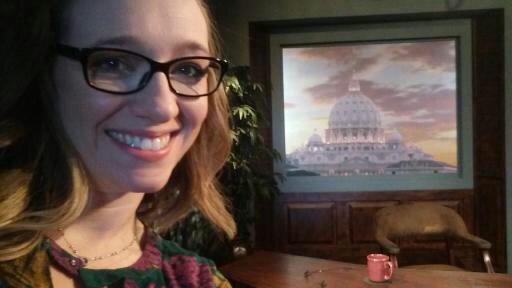
Walking onto the set was also very surreal. I had seen this set before in the shows I had watched. There were some people who were very important and encouraging to me on my faith journey who had sat on the same side of the desk I would sit on soon. Scott Hahn, Jennifer Fulwiler and Steve Ray were a few that immediately came to mind. But there are many others.

1511189832287
Well hello there, Mr. Desk.

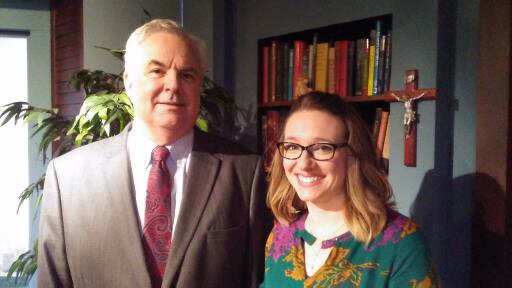
The show used to be filmed live, and still tapes as though it is. There are no re-do’s, just a 2 minute break in the middle. It was a bit intense to think about at first, but everyone is so kind and welcoming. I was definitely on high alert and excited, but once we started filming it felt more like a conversation. I didn’t forget about the cameras and people in the shadows of the lights, but Marcus Grodi is a very gracious host, and it was easy to tell him my story.
1511192017588.jpg

He listened so well. I don’t remember everything I said, but I do remember there were a couple of things he brought up at the end to help a point I had mentioned earlier come full circle. He asked great questions to help me elaborate on some things. You can tell Marcus is a pro. I told my story pretty much from birth to life after conversion, and felt like the time flew by. We then answered a couple of email questions, filmed a short promo, and that was it!
1511198741529

After filming, some of the Coming Home Network folk took me and the other guest out to lunch, then it was back to the airport and home again. It was a whirlwind, but one I will never forget.

I also don’t think it will ever cease to amaze me that my story is now counted among those that made a huge difference to me as I prepared to enter the Catholic Church, and even still after. Those stories were a lifeline as I wrestled through questions, dealt with loneliness and difficulty in the transition from our Protestant Church, and as I rejoiced in the Truth I had found resided within the Catholic faith.

I hope you will have the chance to watch my Journey Home. It airs Monday, December 18th, 2017 at 8pm Eastern/ 7pm Central on EWTN. If you don’t have EWTN, you can live stream it here online.

Encores will air:

Tuesday, December 19th, 1am Eastern

Friday, December 22nd, 1pm Eastern

Or Watch the whole episode below!

My written conversion story is also featured in the Coming Home Network’s newsletter this month, and can be found here.

-Lorelei

Do you have any questions about my conversion story? Or whose conversion stories have impacted you in your faith walk?

Purchase Lorelei’s Books Here:

7 Misconceptions I Held About The Catholic Church Before Becoming Catholic

The Default of The Catholic Church Being Wrong

In my Protestant life, I held a lot of default positions that I had never given much thought. One of my main default positions was that the Catholic Church was, at least in some very important ways, wrong.

I had this default because of growing up where I did, and how I did. I didn’t even think about it. I didn’t even know the reasons I rejected Catholic teaching, I just believed they were wrong based on things people said to me over the years. It was the view I was taught. But I realized, as I found myself restless in my faith, that just because I grew up with something was not enough of a justification for me to assume it as correct.

It was an important step for me to acknowledge the default position I learned, but it was also important not to assume that default position is I held was necessarily the right one.

Below are some of my Protestant default positions, and then the questions I started asking to allow myself to be more fair and balanced in determining from what viewpoint I was going to approach my faith.

I believed that if there was Truth out there, my taking an honest and fair evaluation of my default positions would lead me closer to it. Truth need not fear an inquiring and honest heart.

The List

Default 1

The Catholic Church is in error.

Questions: What valid justification do I have to not give the Catholic Church a fair and objective examination? Is it possible my lack of knowledge about what the Catholic Church teaches is impacting my opinion of it? What gaps do I have in my own understanding of the development of my Christian faith that has informed this belief?

Default 2

The Catholic Bible has books that are not canonical.

Questions: Why does the Protestant Bible have 7 less books than the Catholic Bible? Where in history did that happen? Which books were removed, and for what reason? Did those who made those changes have the authority to do so?

Default 3

We all pretty much believe the same thing- the differences aren’t important.

Questions: God gave us an infallible book- wouldn’t he have given us a means to interpret it correctly? Is it fair to assume that it isn’t important to God if the Truths of Scripture are known accurately by Christians. Or is it important? And if it is, who has a claim to interpretive authority that can be backed by the history of the Christian faith as well as the scriptures?

Default 4

Praying to Saints is wrong

Questions: What do Catholics mean when they use the word prayer in this context? Do they mean the same thing I mean when I use the word ‘pray?’ Are those in heaven aware of those of us on earth? And if they are aware, why don’t I ask those who have gone before me and are now in heaven to pray for me?

Default 5

Sola Scripture– Bible Alone

Questions: Where is the evidence for Sola Scriptura in scripture? The Bible is an authority but is there anywhere in Scripture that claims it to be the final and ultimate authority? What did the earliest Christians do before the New Testament was written and before the canon was confirmed? What does the Bible have to say about the role of the Church and Tradition?

Default 6

Worship should be relevant to the culture.

Questions: What role does church history and traditional Christian practices have in the church today? What value could be found in practicing our faith in a manner similar to the earliest Christians? And what have we lost in the name of cultural relevance?

Default 7

Catholics focus too much on Mary

Questions: What did the early Christians attribute to Mary and why? How can I justify the differences in my view of Mary and the view of Mary of the historical church- including certain views held by Luther and Calvin? Is my discomfort with these teachings due to their falsehood or due to the fact that I am too far separated from the beliefs of the historical Christian Church?

A Default of Ignorance

I found, in my exploration, that I was so entirely ignorant of Catholic teaching because of these original default positions. But I was also ignorant of the history of our faith and what the earliest Christians professed to be true.

Once I opened myself up to the possibility of a different position than the default I had grown up with, I was both surprised and not surprised. Each and every default I had against the Catholic Church turned out to be a misconception. Something I misunderstood or understood incompletely. And once I opened a small crack in the door to the idea to give that which I thought was so wrong a fair shot, I was overwhelmed with depth and truth. Logic and consistency. The beauty of a combination of the thoughts of many, many Christian souls who had gone before me. And I found myself on my way to living a life of gratitude and peace within the Catholic Church.

-Lorelei

Purchase Lorelei’s Books Here:

A New Catholic Reflects on the 500th Anniversary of the Reformation

500 Years

500 years ago some crazy business went down in the world of Christianity. And this Halloween, the 500th anniversary of that business, which we refer to as the Protestant Reformation, will be celebrated by some and mourned by others.

As someone who, just a year and a half ago, crossed the Tiber to become Catholic from a pretty solid Protestant background, all this hubbub about the 500th anniversary of the Reformation brings a lot of thoughts and feelings to the forefront for me as well.

I want to preface this article by saying that I have many amazing Christian friends who are Protestant. I love you all, and there is so much I look up to and respect about your faith. But the Reformation anniversary is hard for me, and my writing here details the reasons why my stomach sinks when I see posts celebrating what happened 500 years ago.

It’s the other side of the coin.

The Good Stuff, In Context

In some ways, I’m glad for parts of what happened. The Church did need some reforming at the time, and I believe that reform indeed occurred within the context of the Catholic Church. Some things were brought to light. Changes were made. Good changes. God changes. There is an excellent series by the Coming Home Network on the Reformation, and it touches on the components of the Catholic Church at the time that were in need of reform, along with many other social and cultural components that led Christianity to the brink of what became this massive division. It’s well worth a read.

I’m also thankful for the Catholic/Lutheran communications in recent years that are reopening the dialogue between us and paving the way for potential future reunification.

Sadness

But the rest of me feels sad about it all. About all the other repercussions. The unintended ones. The ones that are still sweeping through our world to this day.

I’m sad that so many of my Protestant brothers and sisters today are disconnected from the history of the Christian Church, with the exeption of some of the liturgical and high church denominations. There are many who can’t describe what worship looked like for the early Christians. The Protestant branch of the Christian church has, in some cases, moved so far from its roots that children being brought up in some Protestant denominations won’t even think that understanding those things is even a relevant question. We tread on dangerous ground when we forget our religion’s own Jewish beginnings, how those who lived in the time of Jesus practiced their faith, and those in the generations immediately following. When we forget the example set for us by those at our roots in the name of cultural relevance and keeping up with the times.

I’m sad that Luther is looked upon as a hero, but his very, very Catholic side is underplayed or ignored. On what authority can we say Luther had some things right, but not others? That his Protestant views were right, but his Catholic views were somehow errant leftovers from his Catholic days? The Reformation itself had absolutely nothing to do with some of his most Catholic views, including his beliefs about Mary and the True Presence (though his application of this belief became an area of division). Those things weren’t called into question until after Protestantism was born, until the church had continued to move far away from any authoritative source, eventually leaving thoughts on Mary to a few songs during advent and a statue in a nativity, and the foundational Christian belief in the Eucharist to Communion as merely a symbol.

Even John Calvin held some surprisingly, and often overlooked, Catholic views.

I’m also sad that Bible Alone Protestants don’t take issue with Luther’s interpretive addition of “alone” to the Bible when it speaks of being saved by faith. “Sola Fide” was not a thing until Luther himself made that interpretive decision and added that word. Was Christianity wrong on that until Luther came around? That’s a pretty big thing to have erroneous doctrine on for over 1,000 years if it’s true. And on what authority did Luther make the claim that all those years of Church history were wrong, but his own personal interpretation was right? I know there is a solid Biblical case for an authoritative source for interpretation, but I can’t find a strong Biblical argument that says each man is his own interpreter of scripture. God didn’t promise to preserve individual Christians in all truth- he promised to preserve the Church (John 16:13).

I’m sad that 30,000 plus denominations have split off since the Reformation and that this division was something Luther himself took issue with during his lifetime, writing:

“This one will not hear of Baptism, and that one denies the sacrament, another puts a world between this and the last day: some teach that Christ is not God, some say this, some say that: there are as many sects and creeds as there are heads. No yokel is so rude but when he has dreams and fancies, he thinks himself inspired by the Holy Ghost and must be a prophet”(citation: De Wette III, 61. quoted in O’Hare, The Facts About Luther, 208.)

I’m sad that few of my Protestant brothers and sisters think it important to seek out the answer to whether Holy Communion is a symbol or the real presence of Christ (the sacrament Luther refers to above). That belief was held firmly by Christians from the time of Jesus until after the Reformation, and is still held by Catholics today. The Bread of Life Discourse in John 6 is, I believe, a challenge for anyone who views communion as a symbol. It’s an important question. A very important one. I know, growing up Protestant, that the True Presence is a completely foreign concept to many who live their entire lives only having been taught that it’s symbollic. It’s sad to me, and again affirms the problem of a Christian denomination being so entirely cut off from the historical roots of our faith.

I’m sad that misconceptions about Catholicism abound. By the end of this month, 10,000 people will have visited This Catholic Family’s blog in 2017. A small dent, joined with the work of many, many others, hopefully can help put honest yet loving faces to this faith that doesn’t need to be so much of a mystery.

So if you have questions. I’m Lorelei. I’m very Catholic. I love to talk about it. I know my faith, and read my Bible, and worship only God, and pray to God in Jesus name, and believe I am saved by God’s Amazing and beautiful Grace alone. I also love Confession, and have Holy Water in my home, and believe in the True Presence, and pray the rosary, and believe that my decisions in this life matter and speak to the state of my soul. Do you have questions about those things? Ask them. I’m so happy to answer.

And finally, I’m sad that this year, division is going to be celebrated.

Jesus said that they may be one (John 17:21).

Not 30,000+.

One.

-Lorelei

Purchase Lorelei’s Books Here:

How This Catholic Family Approaches Mass With Young Children

Many Families, Many Approaches

There are as many ways to manage a family with young children at Mass as there are families that attend. Many people will have something different that works for them. I’m always on the lookout for ideas and have read several articles on what age appropriate expectations are, as well as articles with ideas on how to engage kids in our Catholic faith, both during Mass and throughout the week.

These articles have often been an encouragement to me, and I love picking up new ideas or being able to identify with a family who manages things in a similar way.

So, here is how our family approaches bringing our children to Mass. We have a 5-year-old, a 3-year-old, and a 9-month-old.

8 Ways Our Family Approaches Mass

1- We Bring Them

Each week, our family of five loads up in our car and goes to Mass together. Exceptions for this have been when a kid is sick, one parent stays back and the other parent takes the rest of the family. I think the fact that we do this each and every week, over time, will set a good example of the importance of practicing our faith. Even when we are out of town or on vacation, we find a Catholic Church and attend Mass together.

2- Expectations Vary By Age

When our daughter turned 5, we began expecting that she would follow along with the postures of Mass (sitting, standing, kneeling), and also to join in with the parts of Mass she knew. She now sings along with many of the congregational responses.

Our 3-year-old is expected to be quiet and not distract others. He sometimes joins in during some of the parts, but we aren’t requiring he follow every sit/stand/kneel yet.

More on our 9-month-old in a bit.

3- We Sit Up Front

We’ve tried many different seating positions, but have found, for our children, that sitting up front is the most conducive to a smooth Mass (at least for the older two). They can see what’s happening, and that helps keep them more engaged.

4- We Explain Things

We don’t insist that the kids be absolutely silent during Mass. But we also won’t talk about whether or not we are getting donuts after or other random things. They are more than welcome to ask us questions, quietly, or to point something out they notice in the church, or something relevant to the Mass itself. We also sometimes will explain what is happening, or note something interesting for them to pay attention to. These small things are done in whispers. It is important to me that if my kids have a question or are excited to notice something, that I validate their engagement. When it’s time for the Eucharist, we invite them to join us to come and see Jesus, even though they are too young to receive.

5- Activities

I’m a relatively recent Catholic convert (2016) and my husband is a revert. Just prior to becoming Catholic, we were at a church with a comprehensive children’s program, where our kids never were in church with us. They went to their own classrooms to play and have a Bible lesson for the entire service. So, going from that to having them in with us at Mass every week, was a bit of an adjustment for everyone, though I have come to enjoy having our family together each Sunday.

To start, we brought an activities kit, with coloring and notebooks. We also did some crackers and water. It’s what we saw as the best option to help our kids make the transition. Now, our daughter doesn’t use the coloring much at all because she is participating, and our son sometimes does, but often sits quietly. It was something that helped us. Our daughter also has taken to bringing her children’s Bible with her. We can sometimes turn to the story in her Bible that matches the reading, and definitely can turn to the Last Supper so she can draw connections between that and the Eucharist.

My hope is that parishioners can give families grace in this area. As a teacher, I know each child is so different. One kid might need something to fidget with the whole Mass. Another kid might be able to focus the whole time right away. And every possible thing in between. Having those activities helped our kids transition, and they are weaning off their dependence on them as they grow, and as we gain experience attending Mass together.

6- Taking Turns

Our 9-month-old is incredibly wiggly. She is constantly on the go. Right now, we try to start Mass with her in the pew with us. Typically, we can make it to the Gospel before she starts getting frustrated at the confinement we’ve placed her in. She wants to crawl under the pew, and out the side, and to eat the pew and make noises to hear the sound of her voice. My husband and I are currently taking turns bringing her out to the foyer, where we can hear the service, so she can get her wiggles out until she is old enough to know how to sit still. She’s just an adventurous baby, and she won’t be that way forever. The person who is out with the baby doesn’t experience Mass as fully as the other, but the Eucharist is there, and we are able to receive Jesus into us, even whilst in the phase of baby wiggles.

7- Special Masses

During the Easter Triduum this year, I tried something new that I think I would like to continue. During those special Masses, where some unique things occur (Holy Thursday Mass is an example,) I made my daughter a chart, with pictures noting certain things for her to look out for, like the presentation of the oils, the washing of the feet, the stripping of the altar. When she noticed each thing happening, she checked it off. It was a way to keep her engaged, and to start teaching her about these particularly important moments in our faith.

8- We Make It Special

We make sure to hold hands with the kids, or let them sit on our laps, or put our arms around them, and in general just make it a special family time. We want them to feel close to us, and to experience the faith together. We smile at the big kids when they participate in something new, encouraging them to keep it up. We want Mass to be a positive experience. Something they look forward to, most weeks at least, and something they see as part of our family identity.

Conclusion

Again, there are as many approaches to Mass with kids as there are families. This is just what has been working for us, at this phase of life. It always warms my heart to see other families with young kids at Mass each week. Bringing our children to Mass is one of many things we can do to help our children grow in faith and virtue now and for the long road ahead.

We’re all in this together.

(Note: This article originally appeared on Catholic Stand)

-Lorelei

Purchase Lorelei’s Books Here:

On Beautiful Churches

The Original Problem

I used to have a problem with ornate churches. I used to think the money would have been better spent elsewhere. I verged, at times, on offended.

Then, I realized, I’ve worshipped in very expensive buildings that weren’t so aesthetically pleasing. Yes, Cathedrals cost a lot more than the average mega-church, but they are both expensive. I’ve also worshipped in some churches that probably weren’t as expensive. I’ve worshipped outside, which is as cost-efficient as you can get. This article isn’t an attempt to argue that worship can’t occur in a variety of settings. It’s an explanation of how I’ve come to love beautiful churches, and to understand the value they hold for the practice of my faith.

The Real Presence

But why is there value in beautiful churches? As Catholics, we believe Jesus himself is present in a very real way in the Eucharist. That’s a good place to start.

During my conversion, I read a book called Jesus Shock by philosopher and Catholic convert Peter Kreeft. He argued that only belief in the True Presence could have built such beautiful churches. Only belief in the fact that those churches would be housing the presence of God himself resulted in the aesthetic beauty and astounding architecture of the Basilicas and Cathedrals of the world.

I believe it was Peter Kreeft who also wrote about beautiful churches, and how they help make up for the scandal of the manger. I had never before thought of the manger as scandalous, but our Savior, the God of all things was born into the most humble of places, amidst animal dung and slop. How scandalous indeed. Beautiful churches that house the presence of our living God in the bread and wine provide a much more fitting place for God to reside in the form of the Eucharist. It provides a contrast to the humble state in which Jesus entered the world as man.

Looking Up

At our current parish, there are a number of amazing stained glass windows that let in the light. At certain Masses at certain times of day, the sun shines its light directly through some of them. It is awe inspiring. I find myself often at Mass, throughout the liturgy, looking up.

I think that’s part of the point. Beautiful churches draw our thoughts and minds heavenward. To help us physically and tangibly connect with the heaven-earth intersection that occurs during the Mass. The incense, the music, the vestments, the tabernacle. They all are helpful in this regard, too. We are a body/soul composite. And all those physical components, including the architecture of the church, help frame and focus our minds on the things of God.

Conclusion

My husband and I visited Paris briefly several years back. We toured Notre Dame Cathedral, with the eyes of tourists. Interested in the architecture and history. I never once thought about the Eucharist that entire trip. I hope to be able to go back someday with the eyes of a Catholic. I think I will appreciate it in a way I wasn’t able to before.

Because before, when I walked into a Cathedral I saw interesting architecture but was concerned of the financial waste. I walk in now and see love. Love of God and his True Presence in the bread and the wine.

I don’t need to be in a Cathedral to worship, but I appreciate beautiful churches now.

-Lorelei


Purchase Lorelei’s Books Here: