5 Things A Catholic Can Do To Help A Protestant Feel Comfortable at Mass

Having a Protestant friend visit Mass may seem like a big deal, or not, depending on you and your friend. But I know, as a Protestant, there was a lot that confused me during Mass, and I often didn’t feel super comfortable. The following things all would have been helpful to me as a visitor, and I hope they are able to help others as well. Because Mass can be a rich faith-building experience for Catholics and other visiting Christians alike.

1- Explain what the Holy Water/Baptism font is and why we stick our fingers in there and cross ourselves.

Hint: It is not a bird bath. But seriously, just a simple explanation that we utilize the font to remember our own baptism, and cross ourselves, which I write more about here, as a recognition of the Trinity, will go a long way in making that particular practice less odd to a visitor.

2- Show them how to use the Missalette (and find one for them).

What we do when during Mass becomes second nature for a practicing Catholic. But, as a former Protestant, speaking from experience, I was lost for a long time when attending Mass with JP’s family. Finding a Missalette for your friend, and showing them how to use it is one of the greatest kindnesses you can do for someone visiting Mass. They can then follow along with the readings, find the songs, follow along with the prayers, and the whole order of service. They will have something to guide them so they know what is coming next, and what words they should be saying during the Creed, for example, or at other times, like the Penetential Rite.

3- Prep them on when we will be standing/kneeling ahead of time.

Just as a general rule of thumb, explain that we will be kneeling in front of the Eucharist (which you might need to explain is Holy Communion. Also see #5 of this article.) Explain we will be standing when we pray and out of respect when we hear the Gospel. And explain we sit when we are listening. My article here goes into a bit more detail about what we do when and why, but a brief overview will help a Protestant friend at least be aware of the general purpose and timing of our bodily postures during Mass.

4- Encourage them to participate! 

There are so many ways a Protestant can participate in Mass. Things just might look a bit different, so might be worth going over.

Here are a few ways Protestants can comfortably participate in a Catholic Mass:

  • The Penetential Rite. Most Protestant churches I have been to have some sort of brief moment to acknowledge our sins. The Catholic version is more extensive, but is basically the same concept.
  • Listening to the readings
  • Listening to the homily
  • The Lord’s Prayer (we all have that one!)
  • The Creed (Protestants can totally recite the Nicene or Apostles Creed. It’s all stuff we agree on. Even the part at the end that says “One holy, catholic and apostolic church.” The word ‘catholic’ there is lowercase, and is referring to all of Christianity, the Universal Church, not only Catholicism.)
  • The petitions
  • Most of the songs. There are times when we sing a song to Mary, or sing about the Eucharist in a very Transubstation-oriented way, and they may prefer to stay quiet during those times. But so many of our hymns are theologically in agreement with all of Christianity. They may find they even recognize one or two from their own faith tradition!

5- Explain the Eucharist.

Briefly share why we kneel in front of The Blessed Sacrament. Share that it is because we believe it is truly Jesus in the form of bread and wine, and kneeling is an appropriate response to being in His presence. Give your Protestant friend grace, though, if they choose not to kneel. Obviously it is the True Presence whether they acknowledge it to be or not. But they don’t know it/understand it. It may even be an entirely new concept to them, as Protestant churches view Communion as symbolic.

I remember sitting in Mass with JP’s family as a Protestant, scooting forward in the pew so I could give the person behind me room to kneel, but myself not kneeling because I just didn’t get it yet. I wasn’t trying to be irreverant to Jesus. I just honestly didn’t know He was there.

Also, explain to them about who is able to receive Communion. That it is appropriate for those who believe in the True Presence, and are in a state of grace. Invite them to come up during Communion time, and to cross their arms over the body and receive a blessing. Encourage them that no one will think they are weird for staying back, or crossing their arms. In fact, they are showing respect for our faith by not receiving irreverantly, or feigning agreement in an area where they disagree.

Conclusion

If we have Protestant friends/relatives visiting us in Mass, these 5 things will go a long way from them feeling like outsiders, to being able to follow along and participate as they are comfortable. I know they would have been helpful to me as a Protestant. They were things I learned over time, but I spent many an awkward Mass as I tried to put the pieces together. Protestant services, especially contemporary ones, can be quite different than Catholic Masses, and helping bridge that unfamiliarity is a great step in helping our Protestant brothers and sisters to better understand all that is mysterious to them about the Catholic faith.

Purchase Lorelei’s Books Here:

Isn’t Being Catholic Repetitive and Boring?

This letter is free for you to read, but it wasn’t free for me to produce. If you’re interested in supporting the work of This Catholic Family, I would be honored if you would prayerfully consider upgrading your subscription. Or, you can always throw a little change in the tip jar here.

I’ve heard the following statements, or some variation, from friends and acquaintences over the years:

“Mass is too long.”

“Catholics always look bored.”

“You guys just do the same things over and over.”

But… is Mass really too long? Are Catholics all super bored? Is doing the same thing over and over again really that bad of a thing? Let’s find out.

Boring

If we are defining boring as not having stage lights, or Hillsongy-music worthy of youtube sharing, or mega video projectors, then, yah, okay… you have a point. But all that stuff just deals with the appearance of things. You have to be willing to go beyond the surface to understand just how exciting Mass actually is.

Case in point. No one looks at the Mona Lisa and thinks its boring because it’s just a picture of some lady. You might not totally understand it, but you know it’s something special. Likewise, you might not understand symphonies. But you probably can at least admit you don’t understand them, rather than jumping immediately to the conclusion that they are boring. Mass is kind of like that. You might not understand it, but it is anything but boring.

And, historically speaking, time has shown that all that flashy stuff in church doesn’t actually help retain people anyway. In fact, here’s a link to an article about someone who left the church after growing up in the “make Christianity relevant” movement of the past few decades. The author makes a good point that if Christians aren’t even convinced the basic truths of our faith are “not boring,” no one else is going to want in, or want to stay. She was so saturated with relevance and excitement, that once she grew out of buying into the Christian marketing package, she left, having never learned the legitimacy of Christianity’s claim to Truth. And Truth is what makes people stay. Truth is what people live their lives for.

One of the benefits (and sometimes frustrations) of Catholicism being such a big entity, is it is like a huge steamship… it turns slowly. So, it hasn’t gone through the same rapid transition that many evangelical churchs have gone through as far as how the message is packaged. And, innately, it can’t really change all that much. Mass is Mass. The structure of Mass has been the same since the beginnings of Christianity itself, and will continue to be the same until the end of time.

And, just because Mass doesn’t have mega projectors, or Hillsong-style worship, doesn’t mean it doesn’t have anything going on.

But, as with the Mona Lisa or any other great piece of art, or music, it means more if you know what you’re looking at. If a symphony puts you to sleep that doesn’t mean there isn’t anything going on worth paying attention to. On the other hand, if you know the nuances and meaning behind that symphony, you are going to appreciate its beauty so much more.

For anyone who thinks Mass is boring, feel free to start by checking out my post on 5 Cool Facts About Catholic Mass. That’s literally just the tip of the iceburg. Mass is amazing, and beautiful, and rooted in the Bible, as well as Christian and Jewish history and tradition. Each and every Mass contains a real miracle in the Eucharist. Each and every Mass is a chance to come physically in contact with our Savior through Holy Communion. There is literally, nothing boring about Mass, if you know what you’re participating in.

And, I no longer have a lot of patience for the “Catholics look bored” argument. Sure, I may not be bouncing up and down and waving my hands in the air at Mass (though I have worshipped in that way for years in other church settings, so no judment here), but that doesn’t mean I’m not worshipping. We can’t know the state of someone’s heart. And, yeah, in Mass, my face looks more serious sometimes. Sometimes I smile, too. Sometimes, Mass brings me to tears. But, mostly, I probably look serious. And mostly, I hope and I pray, my heart is engaged, regardless of the expression on my face.

Repetitive

I am a teacher by trade. Elementary teacher, to be precise. I think the following analogy is helpful in understanding why repetitiveness can actually be good for us.

When teaching a subject like Writer’s Workshop, at the beginning of the year I set up the structure of that part of our day. It always starts with a mini-lesson, then time for the students to practice the skill of the day with support, and then writing time where I go confer with individual students or small groups. We end by coming all back together to share. The structure is the same every. single. time.

Routines are good for us. Within that structure of Writer’s Workshop, I am making sure my students brain power doesn’t have to be wasted on thinking about what is coming next. I want the routine to become automatic for them, so they can focus their energy on the lesson I have for them for that day.

Likewise, within the structure and routine of Mass (or any church that holds to a routine for their order of service), I don’t have to think about what’s coming next. I can spend my time being prayerful, and listening to what God has for me, and I can also focus on giving worship and reverence to God, without unneccessary distractions. Except those from my troup of tiny humans, which is unavoidable at this phase of life. 🙂

The Rosary is another example of repetitiveness within Catholicism that is actually very helpful. I’ll explain more about the specific prayers in the Rosary, including the Hail Mary, in another post (and also why it isn’t weird). In short, however, the Rosary consists of 5 sets of 10 Hail Marys (each set is called a decade) along with a few other prayers. Within each decade, we focus on a specific set of mysteries within our Christian faith. For example, when we meditate on what we call the Sorrowful Mysteries, we spend a decade on each of the following: Jesus in the garden, Jesus being scourged, Jesus being crowned with thorns, Jesus carrying the cross, and the actual crucifixion. There are also many joful and light-filled mysteries, depending on which set you choose to meditate on. And when we pray a decade, saying the Hail Mary over and over again, that prayer itself becomes a sort of meditation. It helps us block out distractions from our mind, so we can stay focused on the parts of Jesus’ life we want to spend time focusing on and remembering. Another instance when being repetitive is a beautiful thing.

Conclusion

So… Is being Catholic repetitive? Sometimes, sure.

Is it boring? Not if you know what you’re looking at.

And, as always, anyone in any setting can go through the motions and be bored while experiencing something meant to be beautiful. If you go into Mass expecting it to be long and boring, your preconceived notion might just be right. But, if you go into Mass expecting to participate in the Kingdom of Heaven on Earth, to join in with the angel’s songs, and to receive Jesus into yourself, body, blood, soul and divinity in the Eucharist… then you are well prepared to receive the many beautiful benefits of your Catholic faith.

-Lorelei


Purchase Lorelei’s Books Here:

Catholic 101: Talking With Our Hands. The Sign Of The Cross In And Around The Catholic Mass

Many aspects of Cathoicism, especially the Sacraments, are meant as a way for us to experience God both spiritually and physically. The idea is that God knows we are a body/soul composite, and therefore has given us the Sacraments for the benefits of both of these parts of our being. In the Sacrament of Reconciliation, for example, we are able to audibly hear that God forgives us. It is a spiritual truth, that we are able to experience using one of our physical senses.

So, to, the Sign of the Cross is another physical/spiritual combination. There are many levels of depth to this gesture, and this article will only cover the surface. Here is how and why we use the Sign of the Cross in and around a Catholic Mass.

What’s The Deal?

Well, simply put, the Sign of the Cross is a way that we acknowledge the Trinity. It’s a way for us to acknowledge our faith, and its a way that we both remember what Jesus did and who God is. It’s a physical sign of our faith in Christ. In fact, since all Christians believe in the Trinity, there is no reason why the Sign of the Cross would need to be limited to only Catholics. And it isn’t. Many Orthodox Christians, as well as Anglicans and Lutherans, also use this symbol.

Before and After Mass, At The Font

If you’ve ever been inside a Catholic church, you may notice little baptismal fonts at the front of the aisles as you enter the sanctuary. Or, some Catholic churches have the big baptismal fonts where they actually baptize people back at the entrance instead of on the altar.

As we enter the sanctuary, we dip 2 fingers in the font and make the sign of the cross over ourselves. We use 2 fingers to help remind us that Jesus was both God and Man. We make the Sign of the Cross with the waters of our baptism to renew our baptismal covenant. In essence, it reminds us of our baptism, and the grace that God has given us through it, and helps to build us up to continue to live our faith out in our lives.

Setting Aside A Holy Time

We begin and end Mass by making the Sign of the Cross together, as a congregation. This is a way that we set aside our time with an intention to focus on God. In Catholic homes, we also begin and end any time of prayer with this sign for the same reason. We bookend time set specifically aside for God with the Sign of the Cross.

During The Gospel, A Variation

There are several scripture readings during Mass. We stand before the Gospel Reading, for reasons explained here. And, just prior to the Gospel being read, we make the sign of the cross with our thumb over our foreheads, over our lips, and over our heart.

The reason for this is that we want to remember, always, to keep the Gospel in our thoughts, and on our lips when we speak, and in our hearts, always.

The Heart of the Matter

As with anything, if we simply go through the motions and do not engage our hearts in what we are doing, then the benefit of our actions is greatly reduced. You could make the Sign of the Cross until you were exhausted, but if you were just going through the motions, the purpose and intention of this gesture won’t be fully realized.

That’s why it is so important that Catholics engage their hearts when utilizing all these beautiful tools of our faith. And, when we do, it makes Mass, and our faith lives outside of Mass, that much more meaningful.

-Lorelei

Purchase Lorelei’s Books Here:

Catholic 101: Make up your minds already! The sitting, standing, and kneeling of Mass

Kneel. Up. Down. Up. Down. Kneel. Up. Down. Up. Whew! Non-Catholics attending a Catholic Mass think a lot of things about the different postures Catholics take. Things like “Oh, up we go again.” And “Why are we kneeling?” And “Is it wrong if I kneel with my butt still on the seat, especially if I’m not sure why I’m kneeling in the first place?” I know non-Catholics think these things, because when I was a non-Catholic, those were my thoughts. I had no idea what was going on, or why. I just tried to keep up.

Now, as a Catholic, one of the things I’ve grown to appreciate about Mass is how each and every. single. thing. has significance. Every single movement, posture, word spoken, and thing done means something. The more you understand about what is going on in a Mass, the more you are able to appreciate its beauty. Which is why this post focuses on the “why” of the sitting, standing, and kneeling of a Catholic Mass.

The Sitting

Sitting is a posture of listening. Catholics sit for the first reading (often from the Old Testament), the Psalm (often actually sung), and the second reading (New Testament, not from the Gospel). We also sit for the offering, and the homily (sermon). We sit, ready to hear and receive. We sit to listen.

The Standing

For Prayer: Standing has been a posture of prayer for Jewish people since before the time of Jesus. Standing during prayer is also seen throughout different parts of the Bible. So, as Catholics, we continue to utilize this posture for prayer today. Some examples of when we stand during Mass for prayer: When we pray the opening prayer (led by the Priest) say The Lord’s Prayer (as a congregation), and the Prayers of the Faithful (the prayer requests for the congregation).

For the Creed: We stand as we say in unison what Christians have believed from the earliest times, in the form of the Nicene or Apostles Creed. We stand to affirm our unity and our beliefs together as Christians.

For the Gospel: Standing is also a sign of respect. We have many readings from the Bible during Mass, but we stand for the Gospel out of particular respect, since these are the words and deeds of Jesus himself.

For the Procession: We stand at the beginning and end of Mass, also as a sign of respect as the celebrant (Priest or Bishop who is celebrating the Mass) processes in to begin the Mass, and processes out once the Mass has ended.

The Kneeling

When we enter Mass, we genuflect, where we bend and touch one of our knees to the floor. We are humbly acknowledging Jesus in the tabernacle, in the Eucharist. Catholics believe that Jesus is fully present, body, blood, soul and divinity in the Eucharist, which is Holy Communion. We believe when Jesus said “This is my body,” that he meant it literally. Jesus is veiled behind the appearance of bread and wine, but His presence is fully and truly there. This is something that the very earliest Christians believed, and continue to believe right through to the present day in Catholicism. So we acknowledge that by genuflection.

Here’s a great video by Fr. Mike Shmitz, further explaining the reason for genuflection as we enter for Mass.

Kneeling is a posture of respect and adoration. Another time when we kneel is during the preparation for and before/after reception of the Eucharist (The Body and Blood of Christ in Holy Communion). We kneel, again, because we believe Jesus is fully and truly present in Communion. If you believed you were literally in the presence of Christ himself, falling to your knees would be a natural thing to do- probably even falling flat on your face. So, we always kneel during this part of Mass, and we remain kneeling until the elements are put back away in the tabernacle, and the tabernacle is closed.

Conclusion

Well, at least you now know that we Catholics aren’t just confused about what we do with our bodies during Mass. 🙂 And this was just a very basic description of what we do with our bodies as a whole. There are a host of other movements that the congregation and the celebrant do each Mass that carry additional meaning.

How we move our body affects and reflects the state of our mind. Slouching, for example, can be a reflection of someone’s sadness, or lack of confidence, or shyness, or it can move someone in that direction. While standing tall with one’s shoulders back can be a reflection of pride, or confidence, or bravery. And, even if you aren’t feeling brave, for example, but you take a posture of bravery, it can help get you there. The postures of Mass can, likewise, reflect your state of mind, or it can help put you in the right one.

Also, both inside and outside of Mass, bodily changes of posture just for the sake of moving aren’t super helpful to anyone. If you are sitting, standing and kneeling during Mass at all the right times, but your heart isn’t in it, or you are distracted, or not focusing on the reason why you are in a particular posture, then you lose the benefit of what the postures are meant to accomplish. But if you come into Mass and you genuflect towards the tabernacle, because you are humbly acknowledging Christ’s presence there, and if you sit, intent on listening with your mind, body, and soul, and if you stand, heart focused on prayer, and if you kneel acknowledging the presence of your Savior, then, then, you’ve got something.

As in all of the structures within Mass, and within Catholicism as a whole, there are so many tools to help move your heart, mind, and soul closer in relationship with Jesus. But you can’t just go through the motions. And if you truly engage, and accept and embrace the meaning behind what you are doing, the graces and joys and richness available to you in Mass and in the Catholic Church are immensely beautiful, and only bring you nearer to your Savior.

-Lorelei


Purchase Lorelei’s Books Here:
Catholic 101: Leading Worship and Catholic Mass

I, Lorelei, have been a part of leading worship at church since I was about 12 years old. I’m 30 now, so 18 years. There are few things I can say I’ve done that long! Walking, riding a bike, eating copious amounts of chocolate in various forms, maybe. But not much else.

Now, being Catholic, I am still helping lead the music, but my role now looks a lot different than it did before my Confirmation. I wanted to write a little bit about what leading worship looks like in the Mass as part of my Catholic 101 series.

Part of what I adapted to in becoming Catholic, is a difference in the structure of the service itself. Most of the churches I’d ever attended prior had a similar structure. There would be between 2 and 6 songs during the service. Most of them would be at the very beginning. There would be an offertory song, and sometimes, a song at the end. Sometimes my church was so small I sang along to actual pre-recorded music by the original singers. Sometimes my church was large enough that we had a full band accompanying the vocalists. But the overall structure was pretty much the same.

Our current parish has a choir that sings every other Sunday, and then the other weeks are filled in by a “Cantor.” This is my new role. I lead the music through the Mass, accompanied by a pianist. The Cantor is very busy during the service.

cantor.jpg
When the Cantor raises his/her arm it means its time for everyone to join in!

Here’s how it breaks down.

Pre-Service. 

Before Mass begins, I sing a song of my choosing. Usually I try and find something that sort of goes with the theme of the readings, and so far I’ve opted for some more contemporary songs that might not be in the hymnal, but that are still theologically solid.

Opening Hymn.

This is a song welcoming everyone to Mass, and the Priest processes to the altar during this song. Interestingly, during Mass, we don’t always sing through the entire hymns. When we see that the Priest is ready to move on, we wrap up the verse/chorus we are currently singing, and the song ends.

Glory to God.

This is a sweet hymn we sing early in Mass for most of the liturgical year. We don’t sing it during Advent because we are anticipating Jesus’ birth, and we also don’t sing it during Lent, as we lead up to the celebration on Easter. The Glory to God dates back to somewhere between the 1st and 3rd Centuries A.D. and is composed of only quotes from the Bible. The first words, for example, are what the Angels sang at the birth of Christ (Luke 2:14). There are 3 verses, each sort of focused on one aspect of the Trinity. It’s really beautiful. If you want to learn more about the Glory to God, check out the link here.

Responsoral Psalm.

There are 4 readings during Mass, as I talk about in my 5 Cool Facts About Catholic Mass post. The Psalm “reading” is actually sung. The Cantor sings the refrain, and the congregation repeats. Then the Cantor “reads” the rest of the Psalm by singing, going back to the refrain throughout.

Gospel Acclamation.

We sing some Alleluia’s before the Gospel reading for the day. The only time we don’t do this is during Lent, where we save our Alleluia’s for the celebration of Easter.  The acclamation is a welcoming and thankfulness of the Gospel, which contains the words and deeds of our Savior, Jesus. The Gospel is indeed something to celebrate and be thankful for!

Offertory Hymn.

This part is the same as all the other churches I’ve had the privilege to lead worship at. A hymn is sung while the offering is being taken, and also, during Mass, while the bread and wine are brought up to the altar for Holy Communion.

Liturgy of the Eucharist.

liturgy-ministers-communion-formation-days.jpg

This is the central part of any Mass. The priest prepares the bread and wine for Communion. There are many sung components to this Liturgy, where the Cantor leads the congregation to join in song.

The one component I’ll focus on is the sung “Holy, Holy.” This is before the Priest says the Words of Institution that Jesus said during the Last Supper “This is my body… etc.” It’s a song proclaiming the Holiness of God. The text comes from Isaiah 6, Matthew 21, and Psalm 118. The idea is that we are joining in song with all the angels and Saints in their unending hymn of praise. Which is very cool.

The lyrics of the song are:

“Holy, holy, holy, Lord God of Hosts, heaven and earth are full of your glory. Hosanna in the highest. Blessed is he who comes in the name of the Lord. Hosanna in the highest. “

It’s a beautiful hymn of praise that ushers us into the celebration of Holy Communion, or, as we Catholics call it, The Eucharist.

Communion Hymns

Depending on the size of the congregation, one or more Communion Hymns will be sung. These are usually chosen to go along with the theme of the readings and the homily for that Sunday. Here is a link to one of my absolute favorite Hymns (contemporary version). A cool side note is that many, many Catholic hymns are taken straight from The Bible and put to music.

Based on Isaiah 6:8. Here I Am Lord.


Closing Hymn

We join together in song once more at the end of Mass, as the Priest processes out. The closing hymn is often a call to live out our faith and share the Gospel.

A couple other things.

Due to the structure of Mass, and how there is a lot of music throughout the service, there isn’t a lot of down time for the Cantor! (Or choir if they are leading the singing that day.) Also, you are sitting or standing off to the side, the entire time, versus when I was leading worship at my previous churches, where you would leave the stage/altar area, and then sit in the congregation for most of the service. Since I’m a new Catholic, I’m always paying extra close attention to what comes next- it’s not second nature for me yet :). Also, during different seasons of the liturgical calendar, the Mass “setting” may change. For example, during Lent, this is particularly noticeable during the Liturgy of the Eucharist, which is where the Priest prepares Holy Communion. The music is more somber during Lent, and more joyful during other seasons, like Advent.

Overall, I’m very thankful for all the opportunities I’ve had over the years to lead worship during church services, in all their different structures and settings. Hopefully this is helpful to people looking to understand what all the music means in a Mass, and how it contributes to the service.

Until next time!

Lorelei

Purchase Lorelei’s Books Here:

Catholic 101: 5 Cool Facts about Catholic Mass

This letter is free for you to read, but it wasn’t free for me to produce. If you’re interested in supporting the work of This Catholic Family, I would be honored if you would prayerfully consider upgrading your subscription. Or, you can always buy me a coffee here.

For some, Mass is a beautifully rich time of spiritual reflection and growth. For others, Mass is confusing! Sit, stand, sit, stand, kneel stand. Lots of sayings and responses that are difficult to follow along with if you aren’t Catholic.

So, in light of a desire to shed some light on Mass, here are 5 cool Mass Facts that you may not have known.

1- Mass is modeled after the book of Revelation

4717e1a4!h.300,id.2107,m.fill,w.jpg

I think there is this stereotype that Mass is  antiquated, or ritualistic. However, interestingly, much of the content of Mass is based on the book of Revelation, which is a book all about the future, and of that which is to come. For example, each Mass we sing the “Holy, Holy, Holy,” which is straight out of Revelation 4:8. The idea is we are joining in with those in heaven in their unending hymn of praise. So that’s a real profound moment, if you think about joining in singing the same song those in heaven are singing, and the connection between the physical and the spiritual that is occurring. And that’s just one tiny example. You can do an entire study on Revelation and the Mass. The more you know, the more amazing Mass becomes.

2- There are 4 Scripture readings throughout Mass,and the readings are the same globally. 

Outdoor_Mass_Tanzania_642px.jpg
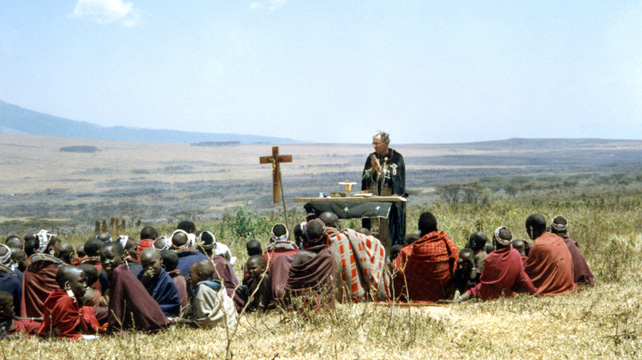
Outdoor Mass in Tanzania.

There’s a lot of Bible each Mass. First, there is often an Old Testament reading (except during the season of Easter, when we read through the whole book of Acts.) Then, there is a Psalm, except instead of it being read, the Psalm is typically sung. Which is cool because the Psalms are originally songs. So, in the Mass we put them to music, and it’s sung responsorally, where a lead singer, or cantor, sings part of it, and the congregation joins in throughout. After that, there is a New Testament reading. And, finally, we conclude with a reading from the Gospels. Often, there is a theme that connects many of the readings, and there are studies available to further dig into the readings of each week. Also, the Catholic readings cycle over 3 years, throughout which, if you are attending daily Mass, you’ll have read through pretty much the entire Bible! And finally, the readings are the same globally. So each Mass, I am hearing the same readings as Catholics in my own town, in Minnesota, Africa, Europe… everywhere! This is cool because I can discuss something about the readings with JP’s family or a friend of mine from a different parish, and we all have heard the same Scripture each week.

3-We say the Creed every Mass. 

Nicaea_icon.jpg

Christians have shared a creed, or set of beliefs since the earliest days of Christianity. The Nicene Creed was formalized in 325 A.D. It’s a series of “I believe” statements, and is a beautiful, easy to understand representation of Universal Christian teachings. Every single Mass, we stand up together and state our beliefs corporately. That’s a cool moment- publicly affirming your beliefs among others who are affirming the same.

4- Mass is offered every day. 

chalice paten.jpg

Anyone looking to attend Mass can find one any day of the week, often offered at different times in different parishes. An interesting thing about this is if you think about time zones, and that daily Mass has been a global practice since the days of the Early Church, there is pretty much a Mass being offered somewhere continually on Earth at all times… and has been for… well a really long time!

5- The Making Present of the Last Supper. 

Leonardo_da_Vinci_-_Last_Supper_(copy)_-_WGA12732.jpg
The real one. Not the painting. 🙂

Catholics believe Communion is more than just are representation, or symbol, or what Jesus did in the Upper Room. And Catholic belief on Communion actually goes wayyyy back into Jewish culture and history. Historically, when Jewish people celebrated the Passover of Moses’ day, they didn’t believe they were just symbolically representing what happened; they believed they were participating in a “making present” of that actual one time historical Passover event. That they too, somehow, mysteriously, were also participating in the Passover of Moses. In Mass, we believe that Communion is a “making present” of Jesus’ Last Supper with His disciples. That we, too, are participating, mysteriously, in that one time event. There are a lot of connections to Judaism in Catholicism and in Mass as well. This is only one of them.


I hope you’ve found these 5 Cool Facts about Mass interesting, at least, and educational at most! I know I didn’t get to all the sit, stand, kneel stuff in this post- but I can write about that another time. There’s a lot of meaning behind each of those postures as well.

Until next time!

-Lorelei

Purchase Lorelei’s Books Here: