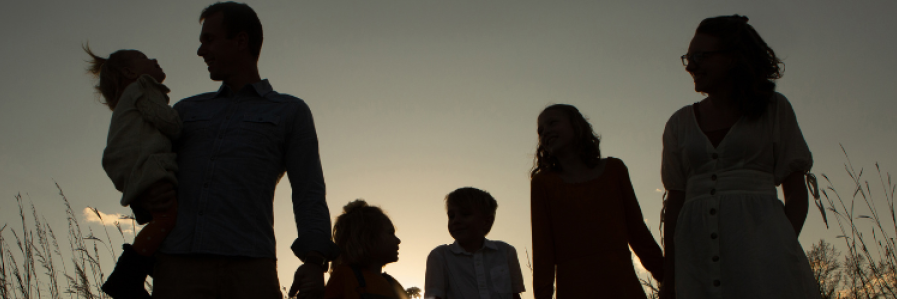
Should Catholic Families Celebrate Halloween?

The Catholic History of Halloween, Trick-or-Treating, and Whether or Not We’ll Let Our Kids go to a Haunted House!

This letter is free for you to read, but it wasn’t free for me to produce. If you’re interested in supporting the work of This Catholic Family, I would be honored if you would prayerfully consider upgrading your subscription. Or, you can always buy me a coffee here.

The Halloween Dilemma for Catholic Families

As Catholics, we get a lot of mixed messages when it comes to Halloween. It was a even confusing holiday for me back when I was a Protestant Christian too! Many of the churches I went to opted for something along the lines of a Trunk-or-Treat hosted in the parking lot of the church vs. Trick-or-Treating. Some families didn’t celebrate the holiday at all, citing it as having evil origins and celebrating evil, which is of course something we want to avoid as people of the Christian faith.

The complication takes on a new layer when we need to navigate Halloween with our children. When there are Halloween parties at school and the opportunity to get tons of candy just by walking up to different houses.

So, how do we navigate Halloween and stay true to our Catholic faith? Below is an outline of what I have learned along our Catholic journey, and I hope it is helpful to you. That said, there is not one exact right way to navigate Halloween as a Catholic, and your individual family may make different choices in this area.

At the end of the day, our decisions hopefully lift us up in faith and draw us closer to God!

The Catholic History of Halloween

One of my favorite Halloween facts is that the word Halloween is an evolution of “All Hallows Eve.” As Catholics, we know that the Eve of something is the evening before a major religious event. Christmas Eve might be the prime example of this.

All Hallows Eve is the evening before All Saints Day! Hallow is a word that means holy, and so we are on the eve of a very holy day! In fact, Halloween, All Saints’ Day, and All Souls’ Day form a Triduum of Death- which isn’t really something to be scared of at all.

On All Hallows Eve, we anticipate the Holy Day of All Saints’ Day.

On All Saints’ Day, we celebrate and ask for the intercession of those who are in perfect union with God in Heaven.

On All Souls’ Day, we pray for the not yet holy dead.

These days also remind us of the inevitable end of our own earthly journeys and our progress toward heaven. By remembering our death, we are inspired to turn more fully toward God, and to live each day well.

But the truth behind of Halloween can get confusing when we set it into our culture.

For our Protestant brothers and sisters who don’t believe in purgatory, ghosts take on a more sinister form, and are often viewed as evil in nature. People who practice paganism are quick to claim the holiday as their own, but that conclusion lacks significant historical context or backing. Unfortunately, in all practicality, these two factors combined obstruct the Catholic origins and meaning of holiday (origins: holy day) and cause misconceptions and confusion.

Those factors don’t change the Catholic origins of Halloween, but they can make it more difficult to see the truth through all the noise.

Trick-or-Treating

All that is to say that yes, we allow our children to dress up and go trick-or-treating. There is evidence to suggest that this particular tradition originated in Europe from the baking of soul cakes on All Hallows Eve. On All Saints’ and All Souls’ Day, children would go from house to house begging for the cakes and promising to pray for the deceased relatives of the cake-givers in return.

Modern trick-or-treating is no longer connected explicitly to praying for the dead, but a Catholic family could easily offer up prayers for the deceased loved ones in the neighborhood we trick-or-treat through.

One rule that we follow in our home is that we don’t allow costumes that glorify anything evil. I’ve seen a lot of great ideas for costumes that feature people from the Bible or Catholic Saints, but so far our kids have mostly shown interest in dressing up like characters from their favorite movies and shows. This year, I believe we will also have one taco in the house.

Haunted Houses, Yes or No?

We have, however, decided as a family that haunted houses will not be part of our Halloween traditions, even as the kids get older, as long as they live in our home. This might sound strange to anyone who knows me and who knows that I write spooky stories for young readers, but allow me to explain.

I enjoy reading and writing spooky books. I like watching spooky movies. But, really, I should be more specific when I say things like that because what I mean is that I like spooky things that elevate what is true and good. Any book I write or recommend for kids that has spooky elements, will ultimately show good triumphing over evil in the end. It will highlight goodness, truth, and light, and even though the characters might face something scary, evil will never win. Those are important lessons for kids and adults alike, and we can use reminders of the reality of evil, but also of the healing power of God and the hope that comes from fighting for what is good and right.

I believe that haunted houses fall into a different category entirely. Haunted houses often glorify evil for evil’s sake. Their goal is to highlight and emphasize the truly scary and dangerous, and to turn those things into a form of entertainment. There is no redemption at the end of a haunted house. A haunted house simulates a world in which evil has won, and that isn’t the kind of thing we want to spend our time, energy, or money on.

Of course, we can’t control what our kids will do when they’re grown, but we hope we are able to teach them the difference between something that is scary but points to truth and something that glorifies evil before they head out on their own.

How to Have a Catholic Halloween With Your Family

In conclusion, there are many ways to continue the religious traditions of the Triduum of Death.

We can ensure that our families don’t partake in any of the cultural traditions that glorify evil, whether through visiting haunted houses or choosing costumes that represent characters with. an evil nature.

We can call to mind the progression of our life, our death, and our ultimate destination by praying for the deceased of the homes we trick-or-treat at, and attending All Saints’ Day Mass (a Holy Day of Obligation!), as well as All Souls’ Day.

We can have healthy conversations with our kids when they ask us about things like ghosts, haunted houses, and our beliefs surrounding good vs. evil and death. We can educate ourselves on Church teaching on these matters so we are ready to answer their questions as they come and can be ready to instruct when opportunities arise.

All in all, I believe that understanding the Catholic roots of Halloween can be enriching and edifying for Catholic Families. I’d love to learn in the comments if you have any particular ways you navigate this holiday with your families too!

Sources for this article and for further exploration:

Halloween and the Triduum of Death

Trick-or-Treat is Harmless Fun

The Catholic Origins of Trick-or-Treating

Do Ghosts Really Exist

-Lorelei

Why I Believe In Purgatory

Oh my goodness. As a Protestant, Purgatory was the weirdest.

Along with the Mary stuff.

I didn’t think about Purgatory much, but when I did, I had no idea what Catholics were thinking. I thought Purgatory was some sort of bizarre waiting place, like a really long DMV line. Or a bus route that just kept going in circles over and over again. I thought it was either a place where souls somehow had to prove themselves worthy of heaven, or a place where souls waited until God thought it was time to let them in. I knew Purgatory wasn’t supposed to be enjoyable. And I just didn’t see the point.

As I began my journey towards embracing the Catholic faith, I looked into everything I could. At the time, Purgatory was one of the bigger hurdles I had to jump.

I found my original conception of Purgatory was actually, once again, a misconception. And I learned there is a lot that makes sense about believing in Purgatory.

Justification and Sanctification

I know there is quite a bit of hubbub around the definition of Justification between Protestants and Catholics. It was one of the central issues in the Reformation. It seems, however, not many people are aware that Catholics and Lutherans and Methodists, have, for a while now been in agreement on that issue. The Joint Declaration on the Doctrine of Justification is a worthwhile thing to know about.

But, in short, and without going into the specifics of how justification is applied, justification means our salvation. It means heaven is our ultimate destination through Jesus’ atoning work. This article is not the place to delve into details. But, a person justified is in God’s grace.

Sanctification is the process by which we are made holy. By which the sinfulness in our life is burned away as we cooperate with God’s grace, and by which we are made into the likeness of our Heavenly Father.

Side note: I don’t buy the idea that once one is a Christian, sin is a non-issue. I’m not walking around like “oh I sin so much I’m depressed all the time,” but I am very, very aware of my tendency to sin even though I have a Christian faith. I think the Christian traditions that have moved in the direction of assuming that Christ’s work means that sin is not really something we need to worry about or think about much is concerning. I, personally, have found that every moment of every day, I have the choice to cooperate with that which God wishes to do inside of me, and be sanctified, or I can reject that work and choose to sin. I am, therefore, writing from the perspective that Sanctification is an active, not a passive, process by which we cooperate with God.

Completion

Perhaps this is a layperson’s oversimplification, but it helped me a lot to think about Purgatory as the completion of one’s sanctification.

Here are a couple examples.

1- A person who believes in Christianity from the earliest age possible. They cooperate with God’s grace in their life, and live a long life of faith. By the end of their life, God has worked in them and through them so much, that they are not selfish, or prideful, or seeking their own comfort. They have been entirely conformed to The Father. We might call this person a Saint.

2- The man on the cross next to Jesus. He had lived a life of sin and selfishness. Yet, his heart turned toward God at the last moment.

Are both of these people justified by virtue of their faith in Jesus? Yes! Are both of them sanctified to the same degree upon their death? I’d say definitely not.

And then what? What happens to the sanctification of the man on the cross next to Jesus?

I don’t think it’s possible that people are in heaven only partially sanctified. That would mean there are people in heaven still dealing with sin issues. And that just doesn’t make sense. We won’t struggle with sin in heaven.

How Are We Sanctified?

Well, first of all, God isn’t a liar. He doesn’t declare us righteous and then be like “Well, I’ve said you’re righteous, but I’m not going to actually make you righteous. I’m just going to say it and we can all pretend it’s true.” No. God does what he says, and sanctification is how we are made righteous, or holy. We can only be sanctified through God’s grace. We can’t earn it or work at it in our own power. But, we need to cooperate with that grace. God can’t just drag us kicking and screaming into holiness. We have free will. Sanctification requires we say “Yes” to the work God is doing in us. God can’t force us to be selfless. God can’t force us to be humble. We need to submit to allowing God to do that work inside us, and cooperate with Him. And God isn’t going to be cool with a prideful, sinful person in Heaven with Him.

A Comparison

It was helpful to me to compare sanctification to exercise in this regard. Exercise is good for us! And necessary for our health. But it is not easy. It requires action on our part, and, often, discomfort or pain. We can’t get healthy without exercising. And we can’t exercise effectively and still avoid discomfort.

Sanctification is, in a very real sense, painful. Because through sanctification, we are rejecting the sin in our life.

Whenever we allow God to help us turn away from sin, it hurts. Biting my tongue when I want to say something snarky hurts. Eating a proper portion size of cake when I want to stuff my face with it hurts. Turning off technology for periods of time throughout the day, denying myself that nice little dopamine high from checking Facebook, hurts. Think of any sin you struggle with, and then think of denying yourself that sin… and you quickly realize the pain in sanctification.

That’s the pain people are talking about when they talk about Purgatory. It’s painful, but not arbitrarily so. There is purpose to it, and necessity. Because Purgatory is the end of any sin’s grip on you that you struggled with during your life on Earth. Struggled with pornography? It’s burned off. Struggled with laziness? Burned. Impatience? Burned. Pride? Burned.

Sanctification is good for us, and necessary, even, before entering Heaven. And it hurts because turning away from sin hurts.

Purgatory in the Bible

1 Corinthians 3 states:

10 By the grace of God which was given to me, I laid the foundations like a trained master-builder, and someone else is building on them. Now each one must be careful how he does the building.11 For nobody can lay down any other foundation than the one which is there already, namely Jesus Christ.12 On this foundation, different people may build in gold, silver, jewels, wood, hay or straw 13 but each person’s handiwork will be shown for what it is. The Day which dawns in fire will make it clear and the fire itself will test the quality of each person’s work.14 The one whose work stands up to it will be given his wages; 15 the one whose work is burnt down will suffer the loss of it, though he himself will be saved; he will be saved as someone might expect to be saved from a fire.

JP was at a men’s Bible study one night before we became Catholic. He came home and shared with me the discussion the men had surrounding this verse. It was an odd thing for the men in the group to reconcile… this being saved through fire. I looked at him, and said: “It sounds like Purgatory.” He agreed.

I’ve since heard there is an argument that a person’s works are tested, not the person themselves. But that just doesn’t make sense to me. Works don’t exist apart from the person doing them. There is always a hand feeding the hungry person. There is always an eye looking at someone in judgment. There is always a foot going to dark places to spread the light of Jesus. Whether our works are in cooperation with God, or whether our works are sinful, there is a person attached to the work.

Also, in 2 Maccabees we also learn that Jewish people prayed for the dead. Whether or not one accepts that Maccabees belongs in the Bible, it still gives us a historical reference to know that the Jewish people, of which Jesus was one, prayed for the dead. That’s why we pray for souls in Purgatory. Just as we would pray for a friend in our Bible Study to work through a sin in their own life that they were struggling with, we pray for our fellow Christians in Purgatory that they would cooperate with God, and allow God to work through the sin they still struggle with and are holding on to as well.

C.S. Lewis and Purgatory

Now, just because C.S. Lewis believes something, doesn’t make it true. But, he is a well-respected theologian among Christians everywhere. And, he made some really good points about Purgatory.

He wrote:

Our souls demand Purgatory, don’t they? Would it not break the heart if God said to us, “It is true, my son, that your breath smells and your rags drip with mud and slime, but we are charitable here and no one will upbraid you with these things, nor draw away from you. Enter into the joy”? Should we not reply, “With submission, sir, and if there is no objection, I’d rather be cleaned first.” “It may hurt, you know” — “Even so, sir.”

I assume that the process of purification will normally involve suffering. Partly from tradition; partly because most real good that has been done me in this life has involved it. . . .

(Letters to Malcolm: Chiefly on Prayer, New York: Harcourt Brace Jovanovich, 1964, 107-109)

And, in the acclaimed Mere Christianity, he writes:

“Make no mistake,” He says, “if you let me, I will make you perfect. The moment you put yourself in My hands, that is what you are in for. Nothing less, or other, than that. You have free will, and if you choose, you can push Me away. But if you do not push Me away, understand that I am going to see this job through. Whatever suffering it may cost you in your earthly life, whatever inconceivable purification it may cost you after death, whatever it costs Me, I will never rest, nor let you rest, until you are literally perfect — until My Father can say without reservation that He is well pleased with you, as He said He was well pleased with me. This I can do and will do. But I will not do anything less.”

God will conform us to His likeness. He will not leave us half-sanctified. He will do what He says.

The Great Divorce is also awesome book that helps illustrate some of these concepts. A character at the very end, has the ability to enter into Heaven, but has to go through a painful transformation to get there. The book is short, and powerful. I highly recommend it.

Conclusion

Well, suffice it to say I’ve come a long way from believing Purgatory is some weird DMV line with no point. I see it now as the process by which God completes his sanctifying work inside of me.

Purgatory is a really beautiful and life-giving thing for our souls.

It’s the death blow to our own personal struggles with sin.

It’s the final and full cooperation with God’s offer of grace, wherein any bits of sin we’ve stubbornly held onto are burned away by His love.

-Lorelei

Purchase Lorelei’s Books Here: