While spending time with my husband and brother recently, I said: “I don’t know if either of you know this, but I can sometimes be a bit rigid.” They laughed, because it’s true. I laughed, because it’s true. It was a good, lighthearted moment.
But now, a few days later, when reflecting on that rare time spent together (my brother lives several states away and was with us for a brief visit), I realize that even my ability to say that, and then to laugh about it, is actually a marker of a significant amount of growth over the past couple of years.
Desiring Control
Some of the pieces of my past have led me to tend toward wanting to control as many variables as possible in my life. Things not going according to plan used to have the ability to send me into a spiral of anxiety. I’ve been doing a lot of work to dig deep into these things in order to not pass them along to my children.
I used to measure success by how many things I accomplished on my to-do list, and whether the kids and I got everything done by sticking to my self-imposed schedule.
Emphasizing the Wrong Things
I’ve been learning, sometimes through fire, that all those things, like getting tasks accomplished when I hoped, or even getting everything done at all, puts an overemphasis on the things of this world, including time, productivity, and what I perceive to be ‘good’ behavior from my kids. I was in danger of sometimes falling into the trap of thinking “My kids are well behaved, so I must be doing a good job as a mom.”
It didn’t leave a lot of room for flexibility, or mistakes, or, the most important of all, all of our journeys to, hopefully, sainthood.
Shifting Focus
My ultimate goal as a mother is to help my children grow into the people God created them to be. To become the saint God intends them to be.
So I’ve been working very hard to flip my normal tendencies on their head. How about, instead of seeing a conflict between the kids as some kind of failure, I see it as an opportunity to teach them how to apologize, forgive, and then make amends. To take a moment of sin or selfishness and support them in facing it head on and doing the hard work to overcome it.
Sticking to a schedule or having everything go exactly according to plan is of such small importance compared to their souls.
A New Way to Measure Success
At the end of the day, I’m working toward measuring success in an entirely different way than I have in the past. Instead of asking if everything went according to my plan, I’m trying a new question.
And that question is this: “Did I support my children in their journey toward becoming the people God created them to be?”
Even if the kids fought every ten minutes. Even if the kitchen is a mess. Even if we only got math done and nothing else for homeschool. Even if I’m exhausted. I want to see my kids in heaven. I want them to go off into the world one day loving God and seeking Him all the days of their lives. That is, unequivocally, the most important thing.
There are so many messages bombarding us mothers these days about what “good” motherhood looks like. It can be so easy to fall into the trap of comparing, of pushing to do more, of measuring up to some standard of success someone else has set for us or that we’ve set for ourselves.
If anyone else struggles with rigidity, or the great tendency to view the immediate moment as the most important thing, please know you aren’t alone. It’s hard, when we’re in this skin and inside of time, to maintain a view of the eternal.
Even Saint Zélie, mother of St. Thérèse of Lisieux, had bad days. In one of her letters, she writes: “Oh well, that’s the day so far, and it’s still only noon. If this continues I will be dead by this evening! You see, at the moment, life seems so heavy for me to bear, and I don’t have the courage because everything looks black to me.”
But she also said this: “For me, our children were a great compensation, so I wanted to have a lot of them in order to raise them for Heaven.” And she did raise her children for heaven.
That is success as a parent. That is the ultimate goal. May we ask God for the grace to see each and every day in light of the eternal, and do the same.
Lorelei is the author of creepy, magical, hopeful stories for children. Her debut, The Circus of Stolen Dreams, released in 2020. Her second book, a magical retelling of The Secret Garden, released in 2022. Both are available for purchase wherever books are sold.
Growing up, the words “I’m sorry” and “I forgive you” didn’t always come together. I think my parents, particularly when dealing with me and my brother, did their best to teach us how to get along and make things right when someone was offended. But one of the things that strikes me the most when looking back, is that repentance and forgiveness wasn’t necessarily modeled to us, at least not regularly and consistently for me to remember that as a pattern of family life.
I think that’s partly why, as an adult, it was really hard for me to say I was sorry, and even harder for me to say “I forgive you” after someone had apologized to me. This was especially true when it came dating and early marriage. I remember times, sitting in the car with my husband driving, when he had apologized for something and I just sat there, staying silent. I literally felt the heat of anger inside of me as I made him wait a long time for those words. Even when he pointed out my reluctance and that it ws hurtful to him, my mouth did not want to open. I still don’t fully understand why it was so hard for me to offer that to someone I loved, other than some selfishness in me felt it would be more just to make him suffer.
Confession and Forgiveness
Another piece of my journey in this area that’s been helpful has been the Sacrament of Reconciliation. Five years ago, as I neared the culmination of my conversion to the Catholic faith, I began to understand and deeply appreciate the value of examining my conscience-saying I was sorry, and literally, audibly, hearing forgiveness offered to me by the Priest, who is really standing in Jesus’s place. Trusting you’re forgiven is one thing. Hearing that mercy spoken to you out loud is certainly another. Confession has changed me, and continues to do so. I know now very deeply how it feels to know you are forgiven by hearing it said. I know how much it has the power to heal.
My husband had grown up in a home when repentance and forgiveness came easy, or readily, at least. And he couldn’t understand why it was so hard for me to offer forgiveness to him. I’ve had to work really, really hard over the years to say “I’m sorry” as soon as I understand I’ve caused hurt to someone, and to say “I forgive you” honestly and quickly after an apology is offered to me. We are now teaching this to our kids and modeling it intentionally with our own actions in and out of the home.
Because here’s the thing: Our entire faith is based on an ocean of unmerited grace. It doesn’t really matter what someone has done to me or how I’ve been offended. If I believe in Jesus and his sacrifice on the cross and his power over death, and his doing all of that to offer reconciling grace to me and everyone else who has ever existed or will ever exist, that significantly changes how much of a right I have to hold a grudge.
In some cases, offering forgiveness and also letting go or setting boundaries might be the appropriate choice. But I also think there is something to be said for the healing power of forgiveness not only for the person being forgiven but also for the person who forgives. Forgiveness can help heal the offender, but it also heals the offended. And if the Creator of the Universe has chosen to not only forgive us, but has suffered greatly to do it, then how freely should I open my arms to others and forgive them?
If we truly understand the former, then the latter isn’t even really a question.
Lent is a beautiful time of year in the Church for so many reasons. The continued call to conversion through almsgiving, fasting, and penance helps prepare our hearts for Easter in such a special way. If you haven’t been in a while, or even if you have, perhaps it’s time to go to Confession. To find a few quiet moments this Lent to examine your heart and say you’re sorry and turn yourself back to love.
And then, of course, to receive an absolute ocean of unmerited grace. A grace that has the power to fill us, and flood out into the whole entire world as we forgive others, too.
-Lorelei
Purchase Lorelei’s Books Here:
Lorelei is the author of creepy, magical, hopeful stories for children. Her debut, The Circus of Stolen Dreams, released in 2020. Her second book, a magical retelling of The Secret Garden, released in 2022. Both are available for purchase wherever books are sold.
I’ve had a presence problem for a long time. Even before the strange and troubling events of this past year, I’ve been very good at being distracted. At spending a lot of my attention listening to the running commentary inside my head.
I need to do this. I didn’t do that. What if this happens. What if this big risk I’m taking fails. What if I fail as a parent. My house is a mess. How is there possibly a mountain of laundry already. Why can’t the kids put anything away. Will I ever stop doing the dishes. I am always doing the dishes. Did someone just sniffle? Did we catch something at church because that’s the only place we’ve been going. What’s for dinner when do I need to put dinner in I think I need chocolate oh no the kids ate all my chocolate.
Exhausing, right?! Maybe you can relate, maybe you can’t, but I felt like my brain was on one constant speed-like I was driving with the windows down on the highway all the time.
I’m a planner by nature. I like to mitigate risks and maximize efficiency. It’s taken me five months, but I finally finished reading a book that has actualy helped me to slow down, make room for all my worries and feelings, and be more present in the moment. It helped a lot when my debut was launching, and has helped even more in the day-to-day life since!
The book is called The Happiness Trap, and you can purchase it here:
I love how the book is written in a linear, easy to follow and understand format. It has exercises you can do throughout. And I was able to take it in bite-sized pieces over time, which helps when you are juggling many things and balancing many plates.
There are three areas where I’ve found it’s been most helpful:
1- The running commentary in my head. I’m doing a better job at making room and accepting uncomfortable feelings. This leaves me more space to be present in the moment with my kids. To catch Zelie in a playful mood and play a silly game by the stairs. To color with Mary. To notice the concentration on August’s as he learns to draw his favorite super hero from a tutorial. To catch how Felicity’s hair falls over her cheek as she’s mixing batter for cookies. My commentary is still there, and still loud often, but I’m noticing more moments in my life and am less distracted.
2- I learned that avoiding bad feelings at all costs isn’t actually a healthy goal. A lot of self-help books seem super focused on being positive and eliminating bad feelings. This book did the opposite. It made sense for me to learn to accept that life will come with negative thoughts and feelings, but that I don’t have to place judgment on them, or even try to avoid them. I can accept them for what they are- negative thoughts. They don’t have to have any more value or worth than any of the other thoughts inside my head. Their existence doesn’t make them true or not true. And I can make decisions that align with my values no matter what my thoughts are thinking.
3- Creating a life I value. As I read the book, I realized I had done some important things to create a life that aligns with my deep values already. I was willing to take on a lot of discomfort to make it through four pregnanacies, and also to pursue the scary unknown of writing a book. But I honed in more on the specific things that I deeply value, and have worked on aligning more decisions with those vs. making decisions by default or because of fear. One of the big consequences of that has been that I’ve reduced my presence on social media. I still have a FB page for this website and for being an author. But I deactivated my personal account. So far, that’s been a healthy choice for me.
Precious Little Moments.
If you find yourself listening to the running commentary in your own mind, struggling with negative thoughts or worries or fears, if you are feeling like your life is somehow a mismatch for the things you feel are truly important, this might be a good resource to check out! I have a long way to go, and this is something that’s a life-long process, but it’s definitely helped this constantly-thinking momma, and I think it could be helpful to others too!
-Lorelei
Purchase Lorelei’s Books Here:
Lorelei is the author of creepy, magical, hopeful stories for children. Her debut, The Circus of Stolen Dreams, released in 2020. Her second book, a magical retelling of The Secret Garden, released in 2022. Both are available for purchase wherever books are sold.
When Covid started, I kept seeing all these people getting dogs. I was like “JP, all these people are getting dogs because they’re stuck at home hahaha, how interesting is that. We will clearly never get a dog because we’ll be too busy resuming our jet-setting lifestyle as soon as this is over. Also, dogs poop all over the yard.”
And then…with 13 days to go in this difficult year, a puppy arrived at our home and joined our family. Turns out, never say never has become quite the theme in my life, in many more ways than one.
Meet Saint Maker Savaryn!
We call him Saint, but his full name is Saint Maker because he will help us grow in virtue. Also, every time we call his name, which is a lot, it’s a reminder of our main objective- to become Saints ourselves!
Saint is a fluffy cuddle ball who loves pretending he is a great hunter, cuddling, licking peoples’ faces, and sometimes tinkling on our floor.
I am not a dog person, but I’m slowly warming to him. I like seeing the kids take him outside to go to the bathroom. I don’t completely mind when he’s tired at night and rests his little warm fuzzy self on my lap. JP has promised to brush his teeth daily so he doesn’t get stinky dog breath as he gets old.
JP is very sweet with him, too. He grew up with dogs and loves them even more than I realized. It’s cute to see my full grown husband walking around with the little fluffball Saint. They’re already becoming good friends.
Reflections on the Year
There have been less distractions this year- in terms of places to go, things to do, people to see. And it’s given me so much time to look at the life right in front of my face with clarity. Because of this, one of my biggest take home messages of the year has interestingly been an intense reaffirmation of how often the most worth-it things are not the easiest.
Growing in holiness is hard, raising children is hard, writing a book is hard, loving selflessly is hard, homeschooling is hard. But they are are really, really important things that I value, and this year, I found myself often reevaluating how I can be more intentional in all of these areas. Each is an act of love, in a very particular way, so, really, with all of these things so very present, and my own flaws so very exposed, the question has truly become: how can I love better? Especially inside the domestic church that is my home.
I’m much more impatient than I would like. I grow weary quickly with my family. I can have unrealistic expectations or not give someone the benefit of the doubt. I’ve fought battles against my own insecurities this year, particularly with writing. Once- when realizing I had to undertake a huge revision on my second book- a really, really important one that would make the difference between getting the book right or not- JP found me on the floor of our closet crying a little. This story mattered so much but I didn’t know if I was good enough to do what needed to be done. I was so scared! But, in time, I stood up, pushed through the uncomfortable feelings and got to work, one word at a time. And now I’m on the other side of that revision and am so very proud and excited to share that book with the world!
Which brings me to another big takeaway of 2020. Life isn’t about avoiding uncomfortable feelings at all costs, or even about avoiding suffering. Both of those things are part of life, and this year has given us all a lot to be uncomfortable with, or to bear as suffering. We cannot avoid those things, even in a ‘normal’ year, but in 2020 we all had to confront it on a global scale. What do we do when uncertainty hits? What do we do when we suffer? How can we take those things and use them for good-or to make the world a better and more hopeful, loving place?
Happy New Year
I wish everyone who reads this blog a Happy New Year. I almost was going to wish everyone a smoother 2021, but I think it’s better to wish everyone a 2021 that brings us all closer to God, to Love, to living as Gift of Self. God knows what we need to be holy, and it’s our job to accept whatever he brings.
Even if he brings you a puppy that likes to tinkle on your floor. 🙂
I love learning about the Catholic Church. We’ll be celebrating my 5-year confirmation anniversary in the spring, and the more I’ve lived the faith and studied it, the more I fall in love. It might sound silly, but many times it feels like I’m stepping into the warmest hug in the safest arms when I go to Mass, or study theology, or even see the effects of my faith slowly but surely overcoming my own tendencies towards selfishness and sin. The depth, the beauty, the history, the Truth–it’s all there and it often leaves me in awe.
There were a couple of areas of faith that were a bit more difficult for me as I made my transition. Understanding Mary’s role in the church took a bit more time. And so did my appreciation of the Saints. I used to tell JP that the Saints intimidated me, half as a joke and half as a serious comment.
For some reason, the Saints seemed so out of reach. It was tough to think that people existed who walked this earth let God fill them so much that there wasn’t room for anything else. Meanwhile, I felt so far from that. I lose my patience so easily, and tend to seek my own comfort, and am prone to anxiety and worry about things I can’t control. I feared that I’d read something by a Saint and be frightened off…of what, I don’t exactly know. But I didn’t trust that it would be helpful, at least not for a while.
My Walk with Saint Teresa of Calcutta
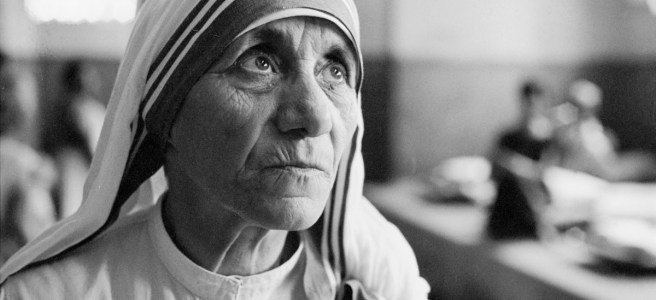
In the end, I want to grow in holiness no matter how uncomfortable it feels, so I decided it was time to read my first official work by a Saint. Since Mother Teresa of Calcutta (now Saint Teresa) was my confirmation Saint, it made sense for me to start there. I received a couple of books for my confirmation, and they’d been staring at me from my bookshelf for far too long. I read Where there is love, there is God over the course of about two weeks. It’s more a collection of things Saint Teresa wrote and said than a book she wrote from start to finish, but I got such an intimate glimpse into the person she was through it. I could see her simple, yet poignant theology in the stories she repeated, in the phrasings she came back to time and time again.
A few points that have particularly woven their way into my heart:
Humility is to accept humiliations. Wiping my baby’s diaper. Letting someone say something short to me without saying anything back. I had never really thought of humility like that before, and it was refreshing and rang so true.
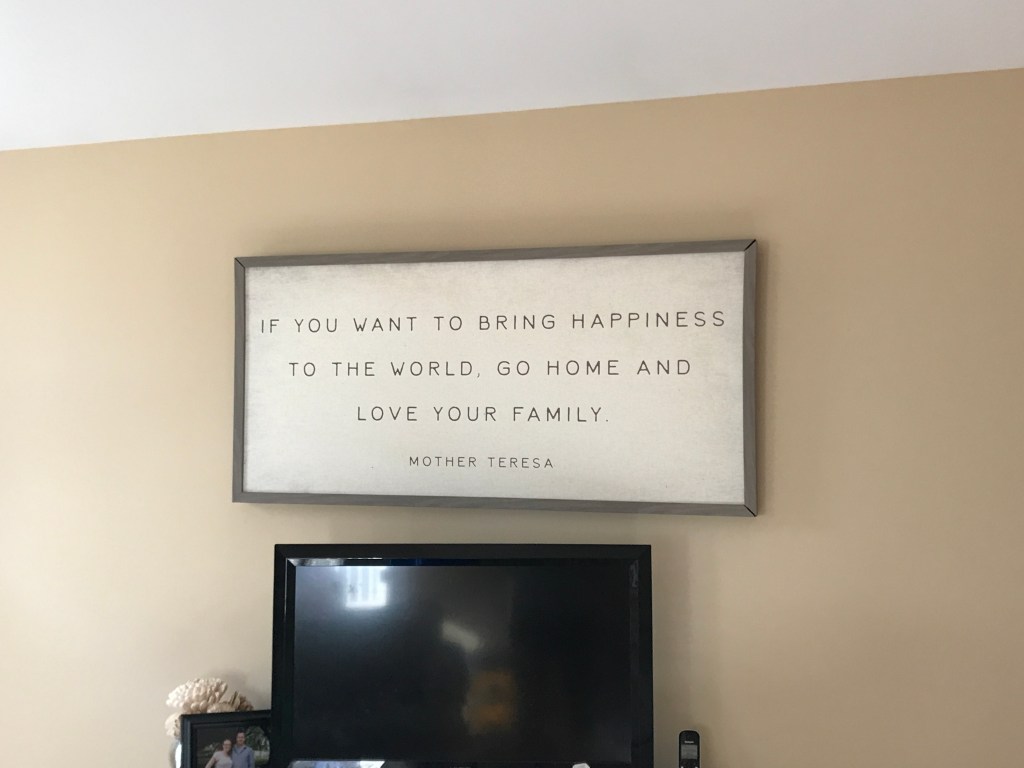
Love starts in the family. This was especially meaningful to me. I struggled for many years if staying home to raise my kids was ‘meaningful enough’ work according to some mysterious earthly standard. We have a framed piece of art in our living room with a quote from Mother Teresa, and we look at it every single day.
Seeing her broader perspective on this sort-of Theology of the Domestic Church, encouraged me in the truth I’ve been coming to accept more and more as time goes on: that my work here is vitally, beautifully important. Jesus says that when you feed the hungry and clothe the naked, that you’re doing it to Him. Saint Teresa helped me grow to understand that the little children living under my roof are the hungry one and the naked one too, and that by loving them, I’m also loving Jesus.
I also see my own sin the most at home in my family life, because I show it the easiest here. They’re the ones I lose patience with, or snap at if I’m stressed out. Because my interactions with them are such a clear mirror to my heart, they’re also the ones who give me the best chance to become a Saint. They’re the ones who I can learn to love well and patiently and fully, no matter what. They’re the ones I can most often offer dignity to in the big things and small, because they’re the ones I’m most often with.
Jesus thirsts. On the cross, Jesus said “I thirst.” While I’ve learned there have been different approaches to understanding His words, Mother Teresa’s is my favorite. Those words are displayed in each chapel of the Missionaries of Charity. Mother Teresa’s saw Jesus’s “I thirst” as a deep expression of how much he desires each and every one of our love, our souls, our all. And, therefore, she concluded, every act of love that we do is, in some mystical way, quenching the thirst of Jesus on the cross. It begs the question: have I quenched Jesus’s thirst today?
For love to be real, it has to hurt. This isn’t about staying in an unhealthy or unsafe situation, but it is about self-sacrifice and what it means and what it takes. We have the ultimate example of Jesus on the cross, because that was His love, full and true, given for us. And it hurt. My opportunities to love until it hurts are frequent but so much smaller than that- getting up when I’m exhausted to comfort a crying child, admitting that I was wrong and apologizing for it. The world has it so backwards when it comes to love- the world tells us that love should make us feel good, that it should serve us well. But it’s really the other way around. Realizing that to truly love means that I hurt because selfishness and sin is being put to death in me, well, it changes everything. I’ve been familiar with this way of looking at love for a while, but Saint Teresa put it so beautifully, and it made such an impression on my heart.
Do small things with great love. I think many of us have heard this quote from Saint Teresa a time or two. My three year old asked God to help her become a Saint yesterday, and a few minutes later I asked her to pick up a blanket from the floor and put it on the couch. She wasn’t sure she wanted to help, but I had the thought that she could probably understand what the idea of “small things with big love” meant. So I told her that one way to become a Saint was to start doing small things with really big love. Like even picking up that blanket for her mother. If she does that little thing with big love, then she’s letting God’s love into her heart more and more. Mother Teresa’s life was marked by some really big moments, but it was filled with many more small moments where she fed a hungry person, or washed a dirty person, or smiled at someone who needed to be seen. Even washing a dish or sweeping the floor can be done with love. That was a challenge to me, in a good way. It’s something small but significant that I can do in the dozens upon dozens of small, seemingly insignificant tasks set before me through the day.
Simple, Yet Profound
The funny thing is, Saint Teresa didn’t even feel close to God for most of her life. She felt his absense from her, but loved him with all of herself regardless of that. She used that sense of absence to unite herself with the lonely and abandoned in the world and to fuel her love.
And her theology was fairly simple compared to some. JP is reading the Summa Theologica right now, and it’s quite a bit heaftier both in weight and in wording than what I just read. But I think that’s one of the really amazing things about the Saints. Saints have been made from all kinds of people, all over the world, with such a diverse array of experiences. The Saints didn’t all start out holy, but they proved that it can be done. Here, now, while we live on earth. If they could do it, then maybe there’s hope that we can, too.
Turned out, reading Saint stuff wasn’t that scary at all. In fact, it was lovely, and challenging and inspiring. I haven’t fully decided who I’ll read next, but I’ve got my eye on Saint Zelie. We named our youngest after her, and I know I’m inspired by her life as a worker, mother, and wife. I think we have a lot in common, I’d love to gain some deeper insights into the person she was.
-Lorelei
Purchase Lorelei’s Books Here:
Lorelei is the author of creepy, magical, hopeful stories for children. Her debut, The Circus of Stolen Dreams, released in 2020. Her second book, a magical retelling of The Secret Garden, released in 2022. Both are available for purchase wherever books are sold.
I think we’ve all seen or heard someone make a joke about “Catholic Guilt” at one point or another.
This article explores what Catholic Guilt is, really. And if it’s actually funny. Or, on the other hand, if it a misrepresentation of something meant for our good.
What is Sin?
It’s important to get on the same page about sin before we even attempt to talk about this issue. Let’s turn to the Catechism to get our definition.
1849Sin is an offense against reason, truth, and right conscience; it is failure in genuine love for God and neighbor caused by a perverse attachment to certain goods. It wounds the nature of man and injures human solidarity. It has been defined as “an utterance, a deed, or a desire contrary to the eternal law.”121
1850 Sin is an offense against God: “Against you, you alone, have I sinned, and done that which is evil in your sight.”122Sin sets itself against God’s love for us and turns our hearts away from it.Like the first sin, it is disobedience, a revolt against God through the will to become “like gods,”123 knowing and determining good and evil. Sin is thus “love of oneself even to contempt of God.”124 In this proud self- exaltation, sin is diametrically opposed to the obedience of Jesus, which achieves our salvation.125
(emphasis mine)
Using this definition, I often break down the idea of sin to conclude it is any time where I choose to serve myself rather than another. It’s desiring my perceived good over my actual good. It’s refusing to love. And in refusing love, I am refusing God because God is Love itself.
Sin wounds my relationship with God, because I’m actively rejecting Him. It hurts my soul. It makes me sick.
When I think about sin now, I think about any one of us, if we gave in freely to our own passions, distorted from God’s good intent, might even find ourselves on earth in our own sort of personal hell.
Sin is serious business. But, thankfully, that’s not the end of the story.
My Protestant Practice
Before becoming Catholic, I didn’t spend a lot of time thinking about the ways I rejected or blocked God (Love) out of my life. Some of the churches I attended would have a moment for such reflections. But it was usually just that, a moment. And, to be honest, in those moments I most often thought “meh- I think I’m doing pretty good, comparatively speaking.” I shake my head at my past self now. And I’m still not exactly sure who I was comparing myself to… those convicted of crimes against humanity? The people in pews beside me, as some sort of holiness version of keeping up with the Joneses? Just the general sense that, in the grand scale of humanity, I was doing okay?
And then the service would move on and I would move on and I continue along my merry way. I knew I could ask God for forgiveness, but as someone who had come from a Once Saved, Always Saved tradition (for much of my life), I didn’t have an ingrained sense that my confession mattered. I had ‘invited Jesus into my heart’ as a child. And if you are Once Saved, Always Saved, then the moment you say that prayer, it’s a done deal.
Now, you can read more about how I learned that perspective didn’t fit with my actual life experience in my Coming Home Network conversion story by clicking here, but suffice it to say, I had accepted Jesus as a child, then possibly crossed over into rejecting Him as a young adult before I made my way back through the Catholic Church.
I learned through that journey that my choices do matter. They have eternal impact. And yes, everything good I do is by the grace of God, but I’m not an automaton. God can work through me to show his love and healing to this world, but He needs my yes to do it.
And so I’d better pay attention to the areas in my life where I’m letting Love in, and also to the areas in my life where I’m not.
The Value in Examining Our Conscience
I worry about the fading of the concept of confession in general as the trees of Christian separation continue to branch farther and farther away from their historical roots. And I have personally found immense value in examining my conscience on a regular basis, followed by a good Confession.
But first, what is an Examination of Conscience?
An Examination of Conscience is a beautiful exercise we do as Catholics, where we take stock of our lives and our heart. We spend time praying about and thinking about the areas where we are letting God (Love) lead the way, and the areas where we are turning from Him (Love) and choosing to serve ourselves first. We take an honest look at where we are being selfish, or prideful, or fearful, or careless, or impatient, or any number of things.
There are many ways to examine our conscience. Click here for a link to some excellent resources that walk you straight through the entire process.
But we don’t just leave it there when we’re done. We aren’t meant to just acknowledge our shortcomings and sit around feeling bad about ourselves. We know we have the ability to make a change. We can grow in virtue and holiness. We can turn our “No” to God, into a resounding “Yes.”
Once we have examined ourselves, we are ready to make a Confession.
Confession is so many things. But one thing it is not. It is not a rote recital of our wrongs just for the sake of checking an item off a list.
It is a Healing Sacrament. And for good reason.
When we go to Confession, we sit before a Priest, who is standing in place of Jesus for us. We share with him those struggles we identified in ourselves. And we receive, not only God’s forgiveness to us, but we also receive penance, our medicine to help heal the wounds created by our sin.
We leave Confession with the Grace of God to continue to say yes to Him. And if and when we fail, we know Confession is always there, to help us right our path. To help us to learn to love others better than we could on our own. To help sanctify us, and to flood us with God’s Amazing Grace so we can effectively live as His hands and feet.
Back to Catholic Guilt
Nothing about the Catholic Church desires for us to hobble around, eternally burdened by our shortcomings. And long story short, anyone who has been haunted by Catholic Guilt in their life, has taken these beautiful practices meant for our own good, for our own healing, and for whatever reason, allowed them to become distorted.
When I’m carrying some burdens inside my heart, I might know it’s time to go to Confession. So I just set up a time and go. I know I want to let as much of God (Love) into my life as possible, and if I can be honest with myself about when I’m not doing that, then I can experience healing and let His Grace help me make different choices.
There’s a huge difference between the conviction we need to make something right, and then doing something to heal what we’ve broken, and the notion of “Catholic Guilt.” Guilt, when left to its own devices and void of the connection to healing, can turn us inward and makes us focus dangerously on ourselves. And when we focus on ourselves, we are entering a realm that is unhealthy for our souls. We are entering the realm of sin.
So, no, Catholic Guilt isn’t funny. It’s actually probably a sign that someone has experienced pain in some form or another inside the Church, and have not yet found their way to the healing. If we know people who struggle with this, or who have left the Church because of it, it is so vital that we live Grace in our own lives. Forgiveness in our own lives. The joy of healing in our own lives.
We have the opportunity to be an example to those who misunderstand our faith, to those who are seeking, and to those who might be confused. Let us be an example of the Church’s beauty as we seek, more and more each and every day, to choose Love.
-Lorelei
Purchase Lorelei’s Books Here:
Lorelei is the author of creepy, magical, hopeful stories for children. Her debut, The Circus of Stolen Dreams, released in 2020. Her second book, a magical retelling of The Secret Garden, released in 2022. Both are available for purchase wherever books are sold.
This Catholic Family just got back from a Mega Family wedding. It was so much fun, and we will be sharing more about our weekend with you in our next post!
-JP and Lorelei
Purchase Lorelei’s Books Here:
Lorelei is the author of creepy, magical, hopeful stories for children. Her debut, The Circus of Stolen Dreams, released in 2020. Her second book, a magical retelling of The Secret Garden, released in 2022. Both are available for purchase wherever books are sold.
Oh my goodness. As a Protestant, Purgatory was the weirdest.
Along with the Mary stuff.
I didn’t think about Purgatory much, but when I did, I had no idea what Catholics were thinking. I thought Purgatory was some sort of bizarre waiting place, like a really long DMV line. Or a bus route that just kept going in circles over and over again. I thought it was either a place where souls somehow had to prove themselves worthy of heaven, or a place where souls waited until God thought it was time to let them in. I knew Purgatory wasn’t supposed to be enjoyable. And I just didn’t see the point.
As I began my journey towards embracing the Catholic faith, I looked into everything I could. At the time, Purgatory was one of the bigger hurdles I had to jump.
I found my original conception of Purgatory was actually, once again, a misconception. And I learned there is a lot that makes sense about believing in Purgatory.
Justification and Sanctification
I know there is quite a bit of hubbub around the definition of Justification between Protestants and Catholics. It was one of the central issues in the Reformation. It seems, however, not many people are aware that Catholics and Lutherans and Methodists, have, for a while now been in agreement on that issue. The Joint Declaration on the Doctrine of Justification is a worthwhile thing to know about.
But, in short, and without going into the specifics of how justification is applied, justification means our salvation. It means heaven is our ultimate destination through Jesus’ atoning work. This article is not the place to delve into details. But, a person justified is in God’s grace.
Sanctification is the process by which we are made holy. By which the sinfulness in our life is burned away as we cooperate with God’s grace, and by which we are made into the likeness of our Heavenly Father.
Side note: I don’t buy the idea that once one is a Christian, sin is a non-issue. I’m not walking around like “oh I sin so much I’m depressed all the time,” but I am very, very aware of my tendency to sin even though I have a Christian faith. I think the Christian traditions that have moved in the direction of assuming that Christ’s work means that sin is not really something we need to worry about or think about much is concerning. I, personally, have found that every moment of every day, I have the choice to cooperate with that which God wishes to do inside of me, and be sanctified, or I can reject that work and choose to sin. I am, therefore, writing from the perspective that Sanctification is an active, not a passive, process by which we cooperate with God.
Completion
Perhaps this is a layperson’s oversimplification, but it helped me a lot to think about Purgatory as the completion of one’s sanctification.
Here are a couple examples.
1- A person who believes in Christianity from the earliest age possible. They cooperate with God’s grace in their life, and live a long life of faith. By the end of their life, God has worked in them and through them so much, that they are not selfish, or prideful, or seeking their own comfort. They have been entirely conformed to The Father. We might call this person a Saint.
2- The man on the cross next to Jesus. He had lived a life of sin and selfishness. Yet, his heart turned toward God at the last moment.
Are both of these people justified by virtue of their faith in Jesus? Yes! Are both of them sanctified to the same degree upon their death? I’d say definitely not.
And then what? What happens to the sanctification of the man on the cross next to Jesus?
I don’t think it’s possible that people are in heaven only partially sanctified. That would mean there are people in heaven still dealing with sin issues. And that just doesn’t make sense. We won’t struggle with sin in heaven.
How Are We Sanctified?
Well, first of all, God isn’t a liar. He doesn’t declare us righteous and then be like “Well, I’ve said you’re righteous, but I’m not going to actually make you righteous. I’m just going to say it and we can all pretend it’s true.” No. God does what he says, and sanctification is how we are made righteous, or holy. We can only be sanctified through God’s grace. We can’t earn it or work at it in our own power. But, we need to cooperate with that grace. God can’t just drag us kicking and screaming into holiness. We have free will. Sanctification requires we say “Yes” to the work God is doing in us. God can’t force us to be selfless. God can’t force us to be humble. We need to submit to allowing God to do that work inside us, and cooperate with Him. And God isn’t going to be cool with a prideful, sinful person in Heaven with Him.
A Comparison
It was helpful to me to compare sanctification to exercise in this regard. Exercise is good for us! And necessary for our health. But it is not easy. It requires action on our part, and, often, discomfort or pain. We can’t get healthy without exercising. And we can’t exercise effectively and still avoid discomfort.
Sanctification is, in a very real sense, painful. Because through sanctification, we are rejecting the sin in our life.
Whenever we allow God to help us turn away from sin, it hurts. Biting my tongue when I want to say something snarky hurts. Eating a proper portion size of cake when I want to stuff my face with it hurts. Turning off technology for periods of time throughout the day, denying myself that nice little dopamine high from checking Facebook, hurts. Think of any sin you struggle with, and then think of denying yourself that sin… and you quickly realize the pain in sanctification.
That’s the pain people are talking about when they talk about Purgatory. It’s painful, but not arbitrarily so. There is purpose to it, and necessity. Because Purgatory is the end of any sin’s grip on you that you struggled with during your life on Earth. Struggled with pornography? It’s burned off. Struggled with laziness? Burned. Impatience? Burned. Pride? Burned.
Sanctification is good for us, and necessary, even, before entering Heaven. And it hurts because turning away from sin hurts.
Purgatory in the Bible
1 Corinthians 3 states:
10 By the grace of God which was given to me, I laid the foundations like a trained master-builder, and someone else is building on them. Now each one must be careful how he does the building.11 For nobody can lay down any other foundation than the one which is there already, namely Jesus Christ.12 On this foundation, different people may build in gold, silver, jewels, wood, hay or straw 13 but each person’s handiwork will be shown for what it is. The Day which dawns in fire will make it clear and the fire itself will test the quality of each person’s work.14 The one whose work stands up to it will be given his wages; 15 the one whose work is burnt down will suffer the loss of it, though he himself will be saved; he will be saved as someone might expect to be saved from a fire.
JP was at a men’s Bible study one night before we became Catholic. He came home and shared with me the discussion the men had surrounding this verse. It was an odd thing for the men in the group to reconcile… this being saved through fire. I looked at him, and said: “It sounds like Purgatory.” He agreed.
I’ve since heard there is an argument that a person’s works are tested, not the person themselves. But that just doesn’t make sense to me. Works don’t exist apart from the person doing them. There is always a hand feeding the hungry person. There is always an eye looking at someone in judgment. There is always a foot going to dark places to spread the light of Jesus. Whether our works are in cooperation with God, or whether our works are sinful, there is a person attached to the work.
Also, in 2 Maccabees we also learn that Jewish people prayed for the dead. Whether or not one accepts that Maccabees belongs in the Bible, it still gives us a historical reference to know that the Jewish people, of which Jesus was one, prayed for the dead. That’s why we pray for souls in Purgatory. Just as we would pray for a friend in our Bible Study to work through a sin in their own life that they were struggling with, we pray for our fellow Christians in Purgatory that they would cooperate with God, and allow God to work through the sin they still struggle with and are holding on to as well.
C.S. Lewis and Purgatory
Now, just because C.S. Lewis believes something, doesn’t make it true. But, he is a well-respected theologian among Christians everywhere. And, he made some really good points about Purgatory.
He wrote:
Our souls demand Purgatory, don’t they? Would it not break the heart if God said to us, “It is true, my son, that your breath smells and your rags drip with mud and slime, but we are charitable here and no one will upbraid you with these things, nor draw away from you. Enter into the joy”? Should we not reply, “With submission, sir, and if there is no objection, I’d rather be cleaned first.” “It may hurt, you know” — “Even so, sir.”
I assume that the process of purification will normally involve suffering. Partly from tradition; partly because most real good that has been done me in this life has involved it. . . .
(Letters to Malcolm: Chiefly on Prayer, New York: Harcourt Brace Jovanovich, 1964, 107-109)
And, in the acclaimed Mere Christianity, he writes:
“Make no mistake,” He says, “if you let me, I will make you perfect. The moment you put yourself in My hands, that is what you are in for. Nothing less, or other, than that. You have free will, and if you choose, you can push Me away. But if you do not push Me away, understand that I am going to see this job through. Whatever suffering it may cost you in your earthly life, whatever inconceivable purification it may cost you after death, whatever it costs Me, I will never rest, nor let you rest, until you are literally perfect — until My Father can say without reservation that He is well pleased with you, as He said He was well pleased with me. This I can do and will do. But I will not do anything less.”
God will conform us to His likeness. He will not leave us half-sanctified. He will do what He says.
The Great Divorce is also awesome book that helps illustrate some of these concepts. A character at the very end, has the ability to enter into Heaven, but has to go through a painful transformation to get there. The book is short, and powerful. I highly recommend it.
Conclusion
Well, suffice it to say I’ve come a long way from believing Purgatory is some weird DMV line with no point. I see it now as the process by which God completes his sanctifying work inside of me.
Purgatory is a really beautiful and life-giving thing for our souls.
It’s the death blow to our own personal struggles with sin.
It’s the final and full cooperation with God’s offer of grace, wherein any bits of sin we’ve stubbornly held onto are burned away by His love.
-Lorelei
Purchase Lorelei’s Books Here:
Lorelei is the author of creepy, magical, hopeful stories for children. Her debut, The Circus of Stolen Dreams, released in 2020. Her second book, a magical retelling of The Secret Garden, released in 2022. Both are available for purchase wherever books are sold.

.png?width=1080&name=20210920%20LSavaryn%202%20(1).png)












 This Catholic Family: Catholic Womanhood, Family, and Conversion