Leaning into the Saints as a Catholic Convert

I love learning about the Catholic Church. We’ll be celebrating my 5-year confirmation anniversary in the spring, and the more I’ve lived the faith and studied it, the more I fall in love. It might sound silly, but many times it feels like I’m stepping into the warmest hug in the safest arms when I go to Mass, or study theology, or even see the effects of my faith slowly but surely overcoming my own tendencies towards selfishness and sin. The depth, the beauty, the history, the Truth–it’s all there and it often leaves me in awe.

There were a couple of areas of faith that were a bit more difficult for me as I made my transition. Understanding Mary’s role in the church took a bit more time. And so did my appreciation of the Saints. I used to tell JP that the Saints intimidated me, half as a joke and half as a serious comment.

For some reason, the Saints seemed so out of reach. It was tough to think that people existed who walked this earth let God fill them so much that there wasn’t room for anything else. Meanwhile, I felt so far from that. I lose my patience so easily, and tend to seek my own comfort, and am prone to anxiety and worry about things I can’t control. I feared that I’d read something by a Saint and be frightened off…of what, I don’t exactly know. But I didn’t trust that it would be helpful, at least not for a while.

My Walk with Saint Teresa of Calcutta

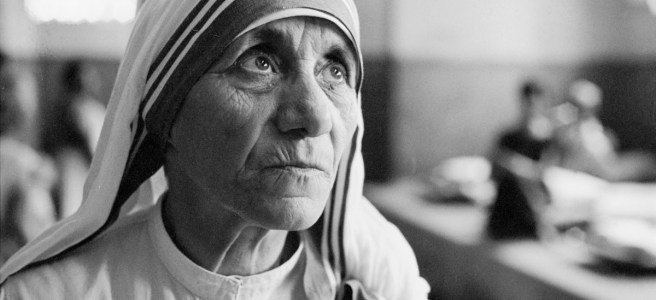
In the end, I want to grow in holiness no matter how uncomfortable it feels, so I decided it was time to read my first official work by a Saint. Since Mother Teresa of Calcutta (now Saint Teresa) was my confirmation Saint, it made sense for me to start there. I received a couple of books for my confirmation, and they’d been staring at me from my bookshelf for far too long. I read Where there is love, there is God over the course of about two weeks. It’s more a collection of things Saint Teresa wrote and said than a book she wrote from start to finish, but I got such an intimate glimpse into the person she was through it. I could see her simple, yet poignant theology in the stories she repeated, in the phrasings she came back to time and time again.

A few points that have particularly woven their way into my heart:

Humility is to accept humiliations. Wiping my baby’s diaper. Letting someone say something short to me without saying anything back. I had never really thought of humility like that before, and it was refreshing and rang so true.

Love starts in the family. This was especially meaningful to me. I struggled for many years if staying home to raise my kids was ‘meaningful enough’ work according to some mysterious earthly standard. We have a framed piece of art in our living room with a quote from Mother Teresa, and we look at it every single day.
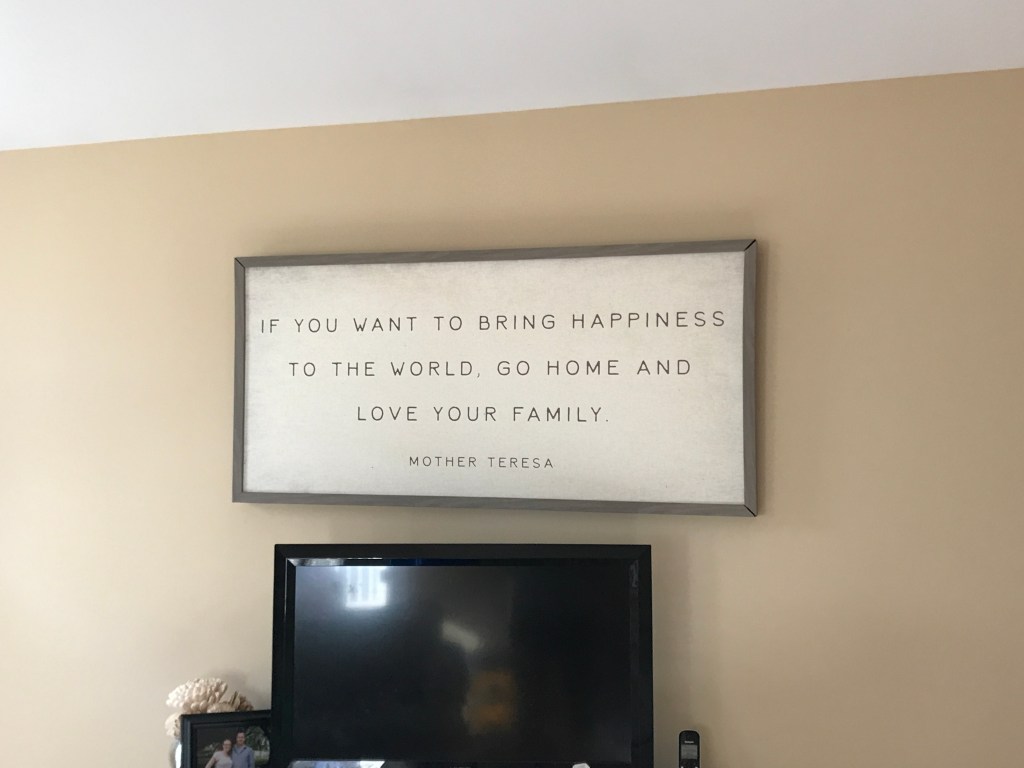
Seeing her broader perspective on this sort-of Theology of the Domestic Church, encouraged me in the truth I’ve been coming to accept more and more as time goes on: that my work here is vitally, beautifully important. Jesus says that when you feed the hungry and clothe the naked, that you’re doing it to Him. Saint Teresa helped me grow to understand that the little children living under my roof are the hungry one and the naked one too, and that by loving them, I’m also loving Jesus.

I also see my own sin the most at home in my family life, because I show it the easiest here. They’re the ones I lose patience with, or snap at if I’m stressed out. Because my interactions with them are such a clear mirror to my heart, they’re also the ones who give me the best chance to become a Saint. They’re the ones who I can learn to love well and patiently and fully, no matter what. They’re the ones I can most often offer dignity to in the big things and small, because they’re the ones I’m most often with.

Jesus thirsts. On the cross, Jesus said “I thirst.” While I’ve learned there have been different approaches to understanding His words, Mother Teresa’s is my favorite. Those words are displayed in each chapel of the Missionaries of Charity. Mother Teresa’s saw Jesus’s “I thirst” as a deep expression of how much he desires each and every one of our love, our souls, our all. And, therefore, she concluded, every act of love that we do is, in some mystical way, quenching the thirst of Jesus on the cross. It begs the question: have I quenched Jesus’s thirst today?

For love to be real, it has to hurt. This isn’t about staying in an unhealthy or unsafe situation, but it is about self-sacrifice and what it means and what it takes. We have the ultimate example of Jesus on the cross, because that was His love, full and true, given for us. And it hurt. My opportunities to love until it hurts are frequent but so much smaller than that- getting up when I’m exhausted to comfort a crying child, admitting that I was wrong and apologizing for it. The world has it so backwards when it comes to love- the world tells us that love should make us feel good, that it should serve us well. But it’s really the other way around. Realizing that to truly love means that I hurt because selfishness and sin is being put to death in me, well, it changes everything. I’ve been familiar with this way of looking at love for a while, but Saint Teresa put it so beautifully, and it made such an impression on my heart.

Do small things with great love. I think many of us have heard this quote from Saint Teresa a time or two. My three year old asked God to help her become a Saint yesterday, and a few minutes later I asked her to pick up a blanket from the floor and put it on the couch. She wasn’t sure she wanted to help, but I had the thought that she could probably understand what the idea of “small things with big love” meant. So I told her that one way to become a Saint was to start doing small things with really big love. Like even picking up that blanket for her mother. If she does that little thing with big love, then she’s letting God’s love into her heart more and more. Mother Teresa’s life was marked by some really big moments, but it was filled with many more small moments where she fed a hungry person, or washed a dirty person, or smiled at someone who needed to be seen. Even washing a dish or sweeping the floor can be done with love. That was a challenge to me, in a good way. It’s something small but significant that I can do in the dozens upon dozens of small, seemingly insignificant tasks set before me through the day.

Simple, Yet Profound

The funny thing is, Saint Teresa didn’t even feel close to God for most of her life. She felt his absense from her, but loved him with all of herself regardless of that. She used that sense of absence to unite herself with the lonely and abandoned in the world and to fuel her love.

And her theology was fairly simple compared to some. JP is reading the Summa Theologica right now, and it’s quite a bit heaftier both in weight and in wording than what I just read. But I think that’s one of the really amazing things about the Saints. Saints have been made from all kinds of people, all over the world, with such a diverse array of experiences. The Saints didn’t all start out holy, but they proved that it can be done. Here, now, while we live on earth. If they could do it, then maybe there’s hope that we can, too.

Turned out, reading Saint stuff wasn’t that scary at all. In fact, it was lovely, and challenging and inspiring. I haven’t fully decided who I’ll read next, but I’ve got my eye on Saint Zelie. We named our youngest after her, and I know I’m inspired by her life as a worker, mother, and wife. I think we have a lot in common, I’d love to gain some deeper insights into the person she was.

-Lorelei

Purchase Lorelei’s Books Here:

The Inescapable Beauty of Hope

Breathing Hope

So much of my life is framed by hope. I hope the kids will sleep well, I hope the weather will be nice, I hope I’ll have time to drink my coffee. Hope, hope, hope. Little things like that. And big things, too. I hope I’ll be a published author some day. I hope my kids will grow up to be kind, good adults. I hope JP and I will live long lives and be able to see our children’s children grow.

But there is also a deeper hope than this. And it is also part of my every breath. It is something that brings me such joy, even when things don’t go as I hope on a small scale, or even big.

And it is the hope that there is something more than just the physical world we encounter during our short time on this earth.

A Crutch of Hope

For example, I have to hope that this intense love I feel for my children and my husband is more than just biochemistry for biochemistry’s sake. I have to hope that humanity is an echo of God, and familial love is an echo of heaven. I have to hope that my attraction to beauty and harmony comes from something deep and vast. And that my anger at injustice comes from a connection to an ultimate source of Good.

Some people may say I’m weak for leaning on a crutch like that. But I’m okay with going through my life on a crutch of hope. A few years ago, when JP and I were figuring out the worldview by which we would live our lives, I experimented to see if I could find meaning dissociated from a higher power. And maybe some people can. But I couldn’t do it. I couldn’t get myself to a place where I could believe we didn’t have souls, and that there was no ultimate source of Good, and there was no point, and never would be for our existence, and then along those lines still believe my life had value, or that it mattered how I treat others, or that justice of any kind was important other than to further survival in a segment of our species so we could live long enough to be burned up by the sun.

If I lost that hope, I couldn’t find a way to justify, other than a desire to procreate, why I would have brought three more meaningless souls into the world. But if there is hope, then procreation is co-creating with the Ultimate Creator, who is also the ultimate source of Good. My children, like all of humanity, carry souls and are stamped with the image of the Creator.

So, for these and many reasons, I actively, and with great intention, chose hope.

My True North

Hope in something more is my True North. It is the direction by which everything else in my life is set. It’s how I frame my own minutes spent on this earth. It’s how I frame my actions towards other people. It is at the very foundation of the value and dignity I believe every human inherently carries by virtue that they exist.

It is this same hope that underlies my belief that there is still a chance my aunt, who we lost to suicide in February, has found or is finding peace and healing. That her story doesn’t end with ultimate despair. That all our stories don’t just end.

I choose to believe that Aslan will defeat the White Witch. That Good will defeat Evil. That wrongs done on this earth will be made right in a way that will more than atone for the suffering people faced.

Once I decided to live a life believing something bigger than us out there, I also chose to believe that higher power is all Good, is all Love, and is all Truth. That next step helps me to further frame how I build my life.

If There Is…

Because if there is Good, then it matters that I learn what is Good, and that I choose Good over its opposite.

Because if there is Love, then it matters that I learn what is Love, and that I live a life built around willing the good of those whose lives cross paths with mine.

If there is Truth, then it matters that I learn what is Truth. That I sift through my own personal biases and preferences, and even my own selfishness in order to recognize Truth and assent to it.

A Life Well-Lived

I hope to look back on my life one day, and have peace that it was well-lived. Lived for others, lived in the promise of something more, something beyond, something that is the source of all Good and all Love and all Truth.

It gives me great peace to hope we are all a small part of something bigger, something ultimately Good. It doesn’t matter if someone thinks I’m foolish for leaning on a crutch. That person doesn’t have to answer for the minutes of my life, or for how I choose to experience my existence. But in the name of hope, I will always hope that all those I encounter are able to find their peace. The compass by which they can walk this journey of life.

And that, in a nutshell, is why and how I have chosen to frame my life through a lens of hope.

-Lorelei


Purchase Lorelei’s Books Here:

Strong But Not Superhuman

The Swells and Crests of Life

We had a period of time this fall into early winter where things were relatively calm. I remember thinking to myself during that time, Remember to appreciate this. Be thankful for this.

Because I’ve been around at least long enough to know that life comes in seasons, in swells and crests, and that something would come to stir up our temporarily calm seas.

Mary was in the hospital for two nights just before Christmas, and RSV spread through the rest of the family for most of Christmas break.

Then, in January we caught our breath.

In February, we lost my aunt to suicide, and we are still recovering from that loss. The pain continues to come in waves. There are good days, and there are difficult days. The air leaves my chest and my stomach sinks every time I go in the basement and see a pile of boxes there. All her stuff. Filled with clothes and baking supplies and art that I have no idea what to do with and no clue if or when or how I will be ready to see it, to touch it, to use it again.

Coming to terms with the pain she felt, our own powerlessness to do anything to change it, and the hope that my prayers can help her still all make for a complicated mix of emotions. I can’t control when the grief hits. And when it does, it isn’t always convenient.

And it just seems like right now there is an abundance of regular but personal and professional business that make finding balance more tricky than it is at other times. I’ve wanted to have time to write more on the blog, but it’s been difficult to find the words to say amidst all the sadness.

I’m struggling with knowing the best direction to take my novel, and in discerning if it’s time to let it rest for a bit and start something new. It’s tough for me to leave a thing unfinished, in any area of life. And it’s also tough for me when there is no clear end point. I can’t say for certain when it will be ‘done.’

We are making some positive, needed, good changes, like moving to a bigger home to account for the growing number of people in our family. I’ve started being asked to speak even in different states, which is super cool and exciting.

Managing Self-Care

But compartmentalizing is tricky for me. It’s tough for me to keep everything in it’s own separate baskets in my mind and things tend to spill over. Today, I wrote an outline for myself to make sure I’m managing my self-care. Blocking time to write, to read, to exercise, to sleep. To make sure I respect the rhythm of my own body and the way God has made me. I recharge my batteries by having time alone. By writing. By reading. And by prayer. If I don’t make it a priority, then I can go too long without making it happen, get caught up in the current, and I start to feel anxious.It was good to take time to actually write out those priorities.  And it’s amazing what a quiet hour by myself can do for my peace of mind and ability to be present for my family.

The long and short of it is, I need to remember to give myself a break! I can’t be All The Things All The Time to All The People. I can’t read an article while Mary is crawling on my lap. I can, however, set aside time specifically for Mary crawling on my lap and other kid related endeavors, and also set aside different time to read that article.

I am strong, but I am not a superhero. And I think consistently trying to do more than one thing well at one time is a way to drain this momma fast.

If I need some time to grieve, I need to take some time to grieve. Not grieve AND feed the kids dinner. Not grieve AND coach a teacher. I need to open up time to just let myself grieve, at least at some point during that day. And respect it. Likewise, I can’t write a super cool blog post AND interact with my kids (with any level of patience). I can work on house hunting/building stuff, but not at the same time as I pack my lunch.

It sounds so simple, but it is something I try and do so often! Not only am I going to do this one thing, but I’m going to do more than most other normal people and try and do more than one thing at the same time and then take pride in the fact that I am able to be so productive and efficient!

But at the end of the day, I just make myself tired.

So this is a good, recurring lesson for me. We won’t ever be able to finish All The Things when all is said and done. And learning to let myself take a slower pace, or set something aside for a while will only help maintain some much-needed balance. During the times when the seas are calm, but also when they are rougher too.

-Lorelei

What helps you keep balance when things get busy? Have you had seasons of your life where you learned new ways to keep a healthy perspective?

Purchase Lorelei’s Books Here:

10 Tips for Those Entering The Catholic Church This Easter

Two years ago this Easter Vigil, I entered the Catholic Church. Here are 10 things I found helpful when approaching my own Confirmation. I hope they are helpful to any of you out there who will be Confirmed this year! Several of the items on this list are helpful for us all to remember, no matter how many years we have been a part of the Catholic faith.

1. Go to Confession

This is a good idea for anyone as we come up to Easter. Let us make sure we are turning towards God in our lives, with our choices and our heart, so we are ready to receive Him and celebrate the joys of Easter Sunday. Let us bring our struggles before God, and let him help us change. Let us get right with our God.

2. Go to as Many Services as You Can

The days leading up to Easter Sunday can be a profoundly spiritual experience for someone entering the Catholic Church. If you can attend the Triduum services, that is amazing. It helps put our faith into context as we approach this most significant celebration. It gives you time to pray, to connect with God, and to prepare your heart.

3. Look Around

When you stand in front of the congregation on Easter Vigil in the moments after you are anointed with oil and confirmed into the Catholic Church, take a moment to look around you. Take a moment to appreciate that you are in full union with the Church established by Jesus himself 2,000 years ago. The Church that has remained connected to its history and its source through apostolic succession. You are connected, in the most powerful way on earth, to the roots of your Christian faith.

4. Take Pictures

I am so thankful to have pictures from the night of my Confirmation. I can just see the joy on my face. It takes me right back there, right back to that moment when I knew I was finally, and fully home- as much as I am going to be before heaven. Whatever your path to get here, it’s worth recording and remembering and celebrating. It’s a hugely significant moment in your life. Document it.

Lorelei_Savaryn_Easter_Vigil
Yay Catholic!!!

5. Reflect

When my own Confirmation approached, I took some time to look back and was so, so thankful for all the bits and pieces along the way that led me to find peace, and Truth, and such a firm foundation. So, take some time. What was your path like to get here? Was it smooth, difficult? Did you wrestle through doubts or did you walk a path of peace? Where do you see God’s hand leading you? Who were the people who helped you along the way? How would you tell your story? However you got here, it’s beautiful. It’s amazing. Give it the weight it deserves, and be sure to give thanks.

6. Get Connected with Other Converts

One of the things that helped me the most,both when things were good and when things were difficult in my transition to the Catholic Church, was being connected with other converts. Regardless of how similar or different our backgrounds were, I found I had so much in common with those who walked the path before I did, in so many ways. This gave me encouragement and strength. It still does to this day. This connection can take many forms. I read stories of converts in books like Journey’s Home. I joined the Coming Home Network, which provides resources, articles, and community online and in print for those of us making our way back to Rome. Watch Journey Home episodes on EWTN. Keep an eye open for other converts in your parish. We all share a common bond. Let’s continue to walk alongside each other even after Confirmation.

7. Go Big

One of the most fun things for me around the time of my Confirmation was getting caught up on my Catholic “Swag.” I was so excited to receive some Rosaries. We got a Mary statue for our backyard. Bought some books on the Saints. Put up a legitimate crucifix in our home. Holy water font. Had things blessed by a priest. I gotta be honest, the weeks leading up to Easter still get me excited and I just bought this Nerdy Catholic Tee (not making fun of it- that’s what the company is called!)

mockup-57853159.jpgMy lovely, but cradle Catholic husband asked me what on earth that meant. When we become Catholic, we call it Crossing the Tiber. And this shirt is awesome. So, if you are feeling inspired, add some of those items to your own life and home. They are tools to help us keep our faith in our hearts and minds at all times. They are tools to help us reflect, remember and pray. And, at least in my case at the time, I had some serious catching up to do.

8. Study up on Easter Vigil

Friends, if you have never been to an Easter Vigil service before. It is amazing and beautiful and symbolic and The. Best. It is also long. It will help so much if you can take some time to understand what is happening and why at each part of the service. Here’s a primer on the USCCB website. I found I was able to embrace the beauty of the Catholic Church once I understood what it was. You will be able to get the most out of the service if you do too.

9. Be Patient

If you are already connected to your parish community- great! If you don’t yet feel connected, I encourage you to keep pressing on. Sometimes it takes time to get to know people in a Catholic parish. This is a huge, global church. Depending on the background you are coming from, and depending on the parish you attend, many things might be different from what you’re used to. There might not be an active home/small group structure, there might not be donuts and coffee after Mass. But there will be people there that you will connect with. It might just take some more time. Two years in, JP and I have found some very dear friends in our parish, and in the Catholic community in our town. We recognize people at Mass on Sunday and stay for a bit and chat. It didn’t happen overnight, but somewhere between year 1 and year 2 we got there. We weren’t feeling lonely anymore. Not only do I now know I’m spiritually home, but going to Mass actually feels like home in the way of the fact that our parish family is there with us too. Be patient. Connection will come.

10. Celebrate!

Whether you will be alone with your sponsor at Mass on Easter vigil, or if there will be pews filled with people who have come alongside you on that day, Confirmation is something to celebrate. Celebrate in whatever way is right for you. A dinner before Mass, some time in Adoration, taking a walk, announcing it to the world. Stay true to yourself, but celebrate. Celebrate the beauty of Easter, the beauty of our faith, and the beauty of crossing the bridge into full unity with the Catholic Church.

-Lorelei

Purchase Lorelei’s Books Here:

Morning Air Interview: “Being Gift in a Take World”

Hello friends!

Lorelei was interviewed this week for Relevant Radio’s Morning Air program about her recent article: “Being Gift in a Take World.”

Check it out by clicking here! She’s the first guest right at the beginning of the show.

Thanks!

-JP and Lorelei

Purchase Lorelei’s Books Here:

Lorelei’s Guest Appearance on the Catholic Vitamins Podcast!

Hello This Catholic Family Friends!

Lorelei was recently interviewed by the podcast Catholic Vitamins. She was able to speak with Deacon Tom and his wife Dee and share her story home to the Catholic Church. Deacon Tom and Dee are a wonderful couple, and it was a pleasure to get to know each other a bit and share about being Elated in her conversion to the Catholic faith.

Check out the link here!

-Lorelei

Purchase Lorelei’s Books Here:
Being “Gift” In A “Take” World

The Disease of What’s Best for Me

There is a disease rampant in our world today. A disease called “What’s Best for Me.”

Entertainment programs are filled with tips on how to make our lives better. How to get the best deal. How to make ourselves look good. How to advance in our careers. How to make more money. How to improve our existence.

And we absorb that culture, particularly if we live in a part of the world where we are saturated with it. Unless we actively counteract the messages we receive, they absorb into us, and we end up reflecting the approach of the world instead of the approach of our faith. Unlike what we see and read and hear every day, happiness isn’t found in improving our lives and seeking our benefit. The Catholic Church teaches that happiness is found in seeking to improve the lives of others, through a sacrificial donation of self.

To Will the Good of Another

At the core of this question is the idea of love.

To love, according to the Catholic Church, is to “will the good of another.” (Catechism of the Catholic Church, 1766). That’s it. It sounds so simple.

If we are married, love is to will the good of our spouse. If we are parents, to love is to will their good too. Whatever phase of life, to love is to will the good of those we encounter.

It rings so true when we hear it, but it’s so different from the culture we live in! And it is less easy to apply to our relationships each and every day than it seems. But if we live our faith, if we put our energies into absorbing the truths the Catholic Church teaches, living as gift becomes more and more natural, more and more a part of how we function and view the world. Our lives become all the more beautiful for it.

Being Gift in Choosing Life

Our parish Knights of Columbus just distributed baby bottles for us to collect change in, and that will go towards Right to Life causes. The tragedy of abortion is great in our world, and this is another example of where so many have bought into the lie of What’s Best for Me so much, that they are willing to support the legal right to end a human life.

The reality is that women have this awesome opportunity to live our lives as gift in a way unique from men. We give our bodies as a sacrifice to grow and nurture life. And pregnancy and raising children is, indeed, a big sacrifice.

But we have an amazing example of bodily donation as gift for another in Jesus.

Jesus lived as the ultimate and perfect self-gift. His own words, which we hear at each and every Mass, are: “This is my body, given for you.” He gave his whole self for us, and it’s a beautiful parallel to what happens when a woman sets aside her own comfort to bring life into the world.

“This is my body” is such a popular phrase in pro-choice culture. But they distort the beautiful meaning of the phrase. Those who fight for legal abortion say, “This is my body, and I get to do what I want with it. No one has the right to stop me.” Jesus says, “This is my body, and I am going to give of myself fully to turn the power of sin on its head and to heal the world.”

There is a clear winner between the two uses of that phrase. In goodness, in beauty, and in the truth of what our bodies are meant to be.

Living as Gift is life-giving. Living for self is life-taking, sometimes in the very real and literal sense in issues like abortion. But also, in the sense that each time we choose self over another, we take the essence of life – truth, beauty, love, from those we wound with our sin.

Living as Gift within Marriage

I spent more years than I’m proud of watching the popular TV show, The Bachelor.

That show sends the message that love is meant to make us feel good. That it’s exciting and thrilling. There is the unspoken belief that love will be like that forever. Like a fairy tale, it will make me feel good forever.

It sets up extremely unrealistic, unhealthy expectations. Nothing about even the concept of that show is willing the good of the other – one person dating upwards of 20 men or women at one time is not good for anyone involved. That’s one of the reasons I won’t watch the show anymore.

It’s distorted. It’s sending a lie about love. It perpetuates a belief that I can do what’s best for me, no matter how many people get hurt in the process.

If we understand what the Church teaches about love and Catholic marriage, the idea of Gift is one of the keys to living a marriage that stands as witness to God’s love for humanity. This occurs when the husband and wife are living as Gift to each other in all areas of the marriage.

When we encounter any situation with our spouse, and we ask the question “Am I doing this for his/her good?” we are letting God into our decision with our spouse. Before we say that sharp word, before we lose our patience, before we assume the worst, we can think about our partner’s good.

This applies in a special and beautiful way to our sexuality, too. Catholic teaching on sexuality isn’t meant to be repressive, and it isn’t without reason. The things we are not allowed to use/do in Catholic marriage – contraception, climax without intercourse, pornography, etc., are all forms of believing the “What’s Best for Me” lie. Contraception says “I’m going to give myself to you, but I’m not going to give myself fully.” Climax without intercourse says “I’m going to take from you, rather than give myself to you.” And pornography says “I’m going to take pleasure without giving anything at all.”

But when we live as Gift, when we respect the whole person of our spouse, including our fertility, when we give mutually and fully to each other, each and every time, that is where the beauty lies. The joy of sex isn’t in finding the best way to feel good for ourselves. It’s in mutually seeking the good of the other in an all-encompassing and powerful way. A way that mirrors the life of the Trinity and foreshadows heaven.

A Disease of Humanity and the Cure

Reaching for goals and working to improve are all positive things. But when those things are distorted, and we start pursuing our own betterment even when it is to the detriment of others, then we do have a problem. When we seek our own comfort first, or own best first, when we forget to be Gift to those around us, then we have become sick.

If we live with a What’s Best for Me mindset, we will never be as happy as we could be. We will never have the peace we could have. We will never find the joy. We weren’t meant to be satisfied with the things of this world. We were meant to be satisfied with God. It follows that living life as God intended will bring us the greatest true fulfillment.

The ultimate way we can serve God is by living our lives as a gift in gratitude to our Creator. All of the above examples help to lead us in that direction. The realization that our lives are, ultimately, not our own, that each and every day is a gift from God helps us release any false control we have tried to cling to. None of this is ours. Life is gift from God. It’s meant to be lived as Gift to God and others.

The Me First disease is more than just an American problem. It’s a humanity problem. A result of original sin, when Adam and Eve were the first to believe the lie that eating the fruit was what was best for them and their own personal goals and advancement.

But the Church gives us this beautiful remedy to the sickness. The remedy for the poison that is What’s Best for Me is a firm commitment to What’s Best for You, to living life as Gift. It turns selfishness to selflessness, greed to generosity, and taking to giving. Living life as gift reverses the darkness of sin and let’s God’s light shine through. That is a powerful witness to a world that has absorbed a dangerous lie.

For more information on living life as “Gift,” please see John Paul II’s Theology of the Body, or check out Theology of the Body for Beginners by Christopher West.

Note: This article was originally published on Catholic Stand.

Why Are Catholic Sermons So Short?

This letter is free for you to read, but it wasn’t free for me to produce. If you’re interested in supporting the work of This Catholic Family, I would be honored if you would prayerfully consider upgrading your subscription. Or, you can always buy me a coffee here.

They’re so Short!

Something that was always strange to me as a Protestant attending Mass was how short Catholic sermons are. Well, technically we call what happens when the Priest speaks after the gospel reading a homily, but homily isn’t a word seen too often outside the Catholic realm.

The priests seemed to have varying degrees of preparation in their message, and it varied from a minute to about ten minutes at most. It varied greatly in level of depth. Sometimes it was more an encouraging word than a message at all.

I thought, what’s the deal with this?

At every single non-Lutheran Protestant Church I attended, there was a sermon. And the sermon was comparatively long. 20 minutes was normal. Some could go over 30. If the sermon was good, I left church feeling challenged and uplifted. If it was just okay, I might have been disappointed.

Expositional Preaching vs. The Homily Objective

There is a big movement right now in the non-liturgical Protestant realm towards expositional preaching. Where a pastor delves deep into a passage of scripture, often going through entire books of the Bible in an extensive sermon series. The pastor delves into the historical, cultural context, along with the original language and preaches on what he or she concludes after that extensive study.

This makes sense in the Protestant world because in Protestant churches, the sermon is the pinnacle of the service. Everything, the music, the offering, the reading (if there is one before the sermon itself), builds up to the sermon. The sermon is, structurally, the main event.

The homily, on the other hand, is meant to be an application of the readings for the day.

More in-depth study of the Bible is available to Catholics, (and should be used!), in a variety of different formats. There are Bible Studies, books, and video and online resources for in-depth delving into scripture. The readings for each day are thematically connected, and resources are readily available each day from a variety of different sources that delve into the readings. It’s been amazing to learn how connected the Old Testament is to the New via utilization of these resources. Here’s a link to one.

But the Mass isn’t ever going to be a place for lengthy, expositional study of Scripture.

But why???

Simply put, in a Protestant service, everything builds up to the sermon.

But in Catholic Mass, everything builds up to something else.

The Eucharist

Christian Mass, and living the Christian faith, from the time of the earliest Christians, focused heavily on Holy Communion. Another word we use for that as Catholics is The Eucharist. The earliest Christians called it that too.

In many Protestant Churches, communion is served once a month, or twice a month in some instances, but this wasn’t always the case in the history of our faith.

As a Catholic, though we need to be in attendance on Sundays, there is actually Mass held every single day. And at every single Mass, the Eucharist is there.

josh-applegate-301321
Photo by Josh Applegate on Unsplash

The preparations for the Eucharist begin in concrete form after the prayers of the faithful.

Then, the liturgy of the Eucharist begins and takes us to the completion of the Mass.

Why is that important?

It’s important because Catholics, like the early Christians, believe Christ is truly present in Holy Communion. We believe we actually receive Jesus: body, blood, soul and divinity when we receive the Eucharist.

We believe this is one of the most intimate ways we can interact with our Creator while we walk on this earth. We believe there is grace there. We believe receiving the Eucharist on a regular basis helps strengthen our walk of faith, helps unite us to other Christians, and that, among other things, it helps us turn our hearts to God. We believe that just as Jesus took the form of a man, that he is with us still, in the form of bread and wine. That he instituted the Eucharist at the Last Supper. That he meant what he said in John 6.

When we kneel before the Eucharist, we kneel before our Savior.

Weirdness

As someone who grew up in a Protestant world, the things I just wrote would have been weird and offensive.

Communion was merely a symbol in my Protestant realm. It was more casually passed out, and more casually received. I ultimately concluded that this Catholic practice was so weird to me because it was unfamiliar. But just because I had never heard of something before, didn’t mean it wasn’t true. Imagine someone living a Pagan existence in a remote location of the world. The Gospel would sound pretty strange to them at first. But that doesn’t mean it isn’t true.

When deciding where my faith would land, I researched a lot of things extensively. Especially this. And I found only solid evidence that the earliest Christians, those closest to Jesus held that exact same belief as the Catholic Church about Holy Communion. That belief as Communion as a symbol was considered heresy. This may not be the case everywhere, but the churches we attended didn’t delve regularly into Church history. Especially not Church history on the Christian beliefs surrounding Communion.

I’ll probably dive more into this in another post, but if it was good enough for Jesus’ disciples, and their disciples after, and on and on through apostolic succession, then it was good enough for me.

Conclusion

So that’s why Catholic sermons, or homilies, are so short. Some are longer than others, and some Priests spend more time crafting them than others do. But Priests are really busy guys. They spend time visiting the sick, and being instruments of grace through the sacraments.

Besides, the sermon isn’t the main event. Jesus is. And, long homily or not, he meets us there, every single Mass, loving us and offering to us himself in the bread and the wine.

-Lorelei

Want to hear more from This Catholic Family?

Join us on Facebook!

Purchase Lorelei’s Books Here:

My Experience on EWTN’S The Journey Home

A few weeks back, I hopped on an airplane and headed to Columbus, Ohio to film an episode of ETWN’s The Journey Home, hosted by Marcus Grodi.

I was met at the airport by Scott Scholten and his wife Barb. Scott produces and directs the show, and they also have a special B&B apartment in the basement of their home to host many of The Journey Home’s guests.

I had read other articles about people who had been on the show, and was very excited to see the famous “Guest Book,” where many notes and signatures from guests of the program reside. It was a surreal moment adding my name to that list, especially considering that two years ago, I was closer to leaving Christianity entirely than I was to becoming Catholic.


And let me tell you this, the Scholten’s are experts at hospitality. I was so blessed to be able to stay in their incredibly comfortable accommodations. Every little detail was attended to, and I was made to feel like a member of their extended family.

1511189820655
There was also a Mother Angelica mug, out of which I just had to drink my evening tea 🙂

We had lovely conversation over dinner and breakfast the next morning, and then it was off to Mass at this beautiful, quaint, historical Catholic church near the Coming Home Network headquarters, where we would film the show.

I caught sight of Marcus Grodi in the back of the church and we made a quick wave ‘hello’ to each other during the giving of the peace. I knew from my hosts as well as other guest posts about the show that Marcus doesn’t spend much time with guests before the filming begins. He wants to get to know each guest and his/her story for the first time genuinely during the taping.

1511192397074
They filmed 2 shows this day, back to back. I was up first.

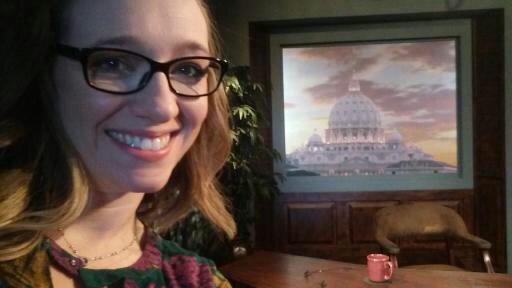
Walking onto the set was also very surreal. I had seen this set before in the shows I had watched. There were some people who were very important and encouraging to me on my faith journey who had sat on the same side of the desk I would sit on soon. Scott Hahn, Jennifer Fulwiler and Steve Ray were a few that immediately came to mind. But there are many others.

1511189832287
Well hello there, Mr. Desk.

The show used to be filmed live, and still tapes as though it is. There are no re-do’s, just a 2 minute break in the middle. It was a bit intense to think about at first, but everyone is so kind and welcoming. I was definitely on high alert and excited, but once we started filming it felt more like a conversation. I didn’t forget about the cameras and people in the shadows of the lights, but Marcus Grodi is a very gracious host, and it was easy to tell him my story.

1511192017588.jpg

He listened so well. I don’t remember everything I said, but I do remember there were a couple of things he brought up at the end to help a point I had mentioned earlier come full circle. He asked great questions to help me elaborate on some things. You can tell Marcus is a pro. I told my story pretty much from birth to life after conversion, and felt like the time flew by. We then answered a couple of email questions, filmed a short promo, and that was it!

1511198741529

After filming, some of the Coming Home Network folk took me and the other guest out to lunch, then it was back to the airport and home again. It was a whirlwind, but one I will never forget.

I also don’t think it will ever cease to amaze me that my story is now counted among those that made a huge difference to me as I prepared to enter the Catholic Church, and even still after. Those stories were a lifeline as I wrestled through questions, dealt with loneliness and difficulty in the transition from our Protestant Church, and as I rejoiced in the Truth I had found resided within the Catholic faith.

I hope you will have the chance to watch my Journey Home. It airs Monday, December 18th, 2017 at 8pm Eastern/ 7pm Central on EWTN. If you don’t have EWTN, you can live stream it here online.

Encores will air:

Tuesday, December 19th, 1am Eastern

Friday, December 22nd, 1pm Eastern

Or Watch the whole episode below!

My written conversion story is also featured in the Coming Home Network’s newsletter this month, and can be found here.

-Lorelei

Do you have any questions about my conversion story? Or whose conversion stories have impacted you in your faith walk?

Purchase Lorelei’s Books Here:

7 Misconceptions I Held About The Catholic Church Before Becoming Catholic

The Default of The Catholic Church Being Wrong

In my Protestant life, I held a lot of default positions that I had never given much thought. One of my main default positions was that the Catholic Church was, at least in some very important ways, wrong.

I had this default because of growing up where I did, and how I did. I didn’t even think about it. I didn’t even know the reasons I rejected Catholic teaching, I just believed they were wrong based on things people said to me over the years. It was the view I was taught. But I realized, as I found myself restless in my faith, that just because I grew up with something was not enough of a justification for me to assume it as correct.

It was an important step for me to acknowledge the default position I learned, but it was also important not to assume that default position is I held was necessarily the right one.

Below are some of my Protestant default positions, and then the questions I started asking to allow myself to be more fair and balanced in determining from what viewpoint I was going to approach my faith.

I believed that if there was Truth out there, my taking an honest and fair evaluation of my default positions would lead me closer to it. Truth need not fear an inquiring and honest heart.

The List

Default 1

The Catholic Church is in error.

Questions: What valid justification do I have to not give the Catholic Church a fair and objective examination? Is it possible my lack of knowledge about what the Catholic Church teaches is impacting my opinion of it? What gaps do I have in my own understanding of the development of my Christian faith that has informed this belief?

Default 2

The Catholic Bible has books that are not canonical.

Questions: Why does the Protestant Bible have 7 less books than the Catholic Bible? Where in history did that happen? Which books were removed, and for what reason? Did those who made those changes have the authority to do so?

Default 3

We all pretty much believe the same thing- the differences aren’t important.

Questions: God gave us an infallible book- wouldn’t he have given us a means to interpret it correctly? Is it fair to assume that it isn’t important to God if the Truths of Scripture are known accurately by Christians. Or is it important? And if it is, who has a claim to interpretive authority that can be backed by the history of the Christian faith as well as the scriptures?

Default 4

Praying to Saints is wrong

Questions: What do Catholics mean when they use the word prayer in this context? Do they mean the same thing I mean when I use the word ‘pray?’ Are those in heaven aware of those of us on earth? And if they are aware, why don’t I ask those who have gone before me and are now in heaven to pray for me?

Default 5

Sola Scripture– Bible Alone

Questions: Where is the evidence for Sola Scriptura in scripture? The Bible is an authority but is there anywhere in Scripture that claims it to be the final and ultimate authority? What did the earliest Christians do before the New Testament was written and before the canon was confirmed? What does the Bible have to say about the role of the Church and Tradition?

Default 6

Worship should be relevant to the culture.

Questions: What role does church history and traditional Christian practices have in the church today? What value could be found in practicing our faith in a manner similar to the earliest Christians? And what have we lost in the name of cultural relevance?

Default 7

Catholics focus too much on Mary

Questions: What did the early Christians attribute to Mary and why? How can I justify the differences in my view of Mary and the view of Mary of the historical church- including certain views held by Luther and Calvin? Is my discomfort with these teachings due to their falsehood or due to the fact that I am too far separated from the beliefs of the historical Christian Church?

A Default of Ignorance

I found, in my exploration, that I was so entirely ignorant of Catholic teaching because of these original default positions. But I was also ignorant of the history of our faith and what the earliest Christians professed to be true.

Once I opened myself up to the possibility of a different position than the default I had grown up with, I was both surprised and not surprised. Each and every default I had against the Catholic Church turned out to be a misconception. Something I misunderstood or understood incompletely. And once I opened a small crack in the door to the idea to give that which I thought was so wrong a fair shot, I was overwhelmed with depth and truth. Logic and consistency. The beauty of a combination of the thoughts of many, many Christian souls who had gone before me. And I found myself on my way to living a life of gratitude and peace within the Catholic Church.

-Lorelei

Purchase Lorelei’s Books Here: