Before I was Catholic, I focused on Mary during the holiday season. I mostly thought about her, pregnant and heavy laden, making the long journey for the census just before her baby was to be born. Tired, searching for a place to rest. Giving birth in a dirty, humble place. Holding the infant Jesus in a night where shepherds and angels and the light of a star paid Him heed. I had the honor of being in late stage pregnancy twice during the Advent season. I was very comfortable thinking about Mary then.
But I didn’t think about her much otherwise. Thoughts about Mary were safe during Advent and Christmas. But, like the tree and decorations we put up in our home, my thoughts of Mary, too, were boxed up and put away at the end of the season, until the following year. Mary belonged in a nativity scene, not in my life.
A Growing Admiration
All of that necessarily changes when one is on a journey to the Catholic Church. Mary plays such a key role in our salvation story, and Catholics aren’t afraid to acknowledge it. I know, based on the Bible and the teaching of The Church, that Mary is in heaven, and prays for us. I also know that Jesus listens carefully to what his mother requests of Him. Her role as the New Eve, the Ark of the New Covenant, her Immaculate Conception, her lifelong obedience and holiness, also are things I worked through as I prepared for Confirmation.
It became easy to realize there was much more to Mary than what I had previously thought. It became easy to be thankful for how precious a role God gave Mary, from the moment of her own conception. It became easy to admire her.
But, as I am learning, admiring someone is not the same thing as being in a relationship.
Baby Steps
As a teen, spending time with my mother wasn’t as high on the priority list, though that has long since changed. But in some ways, I think I still relate to Mary in that way. I know she loves me and is there for me, but I don’t often make time with her a priority. Some of the Rosary’s I’ve prayed have ended up being the most powerfrul prayers of my life, prayers that were clearly answered, and graces that were abundantly given.
So why don’t I do it more?
Perhaps it’s some tendency leftover from my Protestant days. The Rosary isn’t often one of the first prayers I go to, and even though it doesn’t take incredibly long, I often struggle at the time commitment a Rosary takes. I have been praying Hail Mary’s more often in my day to day life, which I think is a good baby step. But it feels too tiny sometimes, when I know the beautiful graces given to me through Mary on the occassions I have spent time intentionally turning to her.
But I also know Mary has a lot to offer me if I would not only spend time talking toher, but also listening.
I have so many wonderful mother figures in my life. There’s my mom, who has been with me since the beginning. I also have a step-mom, and a mother-in-law, as well as many other women who have been influential in my life.
But as much as these women have allowed me to talk and share my heart with them, I find I often learn the most when I listen to the wisdom they have to give me. And Mary has so very, very much wisdom to offer. Through her example in Scripture, through her presence in the ways she has appeared to many throughout history, offering Truth and encouragement and building our faith as a Church. This weekend, we are celebrating the 100th anniversary of Fatima, and that is just one of many examples of her intervention in our world. And I’m sure she would speak to my own heart, if I only would quiet myself and listen.
Many Mothers
I think a person has room for many mothers. Women who love, guide, and shape us. Who intercede for us. Who listen to us. Who offer us comfort. And I firmly believe Mary should be at the top of the list of Mothers in our lives.
Mom and Me, on the day of my Confirmation
Amazing 80’s Hair Mom!
On this Mother’s Day, it is my prayer that as I celebrate the earthly mothers in my life, I would also move closer to embracing my heavenly Mother, Mary. That I would allow her guidance and wisdom more and more into my own daily existence. That I would not take the blessing of having a heavenly Mother for granted. And that I would look to emulate her, and ask for her intercession to become even a small portion of the woman and mother she was to Jesus and is to The Church. For God’s grace to emulate her in holiness. And to know she is there for me, loving me, and waiting for me to spend some time.
-Lorelei
We Want to Know: What is your relationship with Mary like? How do you relate to her as a Mother?
P.S. If you found this post interesting, and would like to read more on This Catholic Family… hit up that follow button on the top left of our page, or follow us on Facebook. We’d love to have you back again!
Purchase Lorelei’s Books Here:
Lorelei is the author of creepy, magical, hopeful stories for children. Her debut, The Circus of Stolen Dreams, released in 2020. Her second book, a magical retelling of The Secret Garden, released in 2022. Both are available for purchase wherever books are sold.
Having a Protestant friend visit Mass may seem like a big deal, or not, depending on you and your friend. But I know, as a Protestant, there was a lot that confused me during Mass, and I often didn’t feel super comfortable. The following things all would have been helpful to me as a visitor, and I hope they are able to help others as well. Because Mass can be a rich faith-building experience for Catholics and other visiting Christians alike.
1- Explain what the Holy Water/Baptism font is and why we stick our fingers in there and cross ourselves.
Hint: It is not a bird bath. But seriously, just a simple explanation that we utilize the font to remember our own baptism, and cross ourselves, which I write more about here, as a recognition of the Trinity, will go a long way in making that particular practice less odd to a visitor.
2- Show them how to use the Missalette (and find one for them).
What we do when during Mass becomes second nature for a practicing Catholic. But, as a former Protestant, speaking from experience, I was lost for a long time when attending Mass with JP’s family. Finding a Missalette for your friend, and showing them how to use it is one of the greatest kindnesses you can do for someone visiting Mass. They can then follow along with the readings, find the songs, follow along with the prayers, and the whole order of service. They will have something to guide them so they know what is coming next, and what words they should be saying during the Creed, for example, or at other times, like the Penetential Rite.
3- Prep them on when we will be standing/kneeling ahead of time.
Just as a general rule of thumb, explain that we will be kneeling in front of the Eucharist (which you might need to explain is Holy Communion. Also see #5 of this article.) Explain we will be standing when we pray and out of respect when we hear the Gospel. And explain we sit when we are listening. My article here goes into a bit more detail about what we do when and why, but a brief overview will help a Protestant friend at least be aware of the general purpose and timing of our bodily postures during Mass.
4- Encourage them to participate!
There are so many ways a Protestant can participate in Mass. Things just might look a bit different, so might be worth going over.
Here are a few ways Protestants can comfortably participate in a Catholic Mass:
The Penetential Rite. Most Protestant churches I have been to have some sort of brief moment to acknowledge our sins. The Catholic version is more extensive, but is basically the same concept.
Listening to the readings
Listening to the homily
The Lord’s Prayer (we all have that one!)
The Creed (Protestants can totally recite the Nicene or Apostles Creed. It’s all stuff we agree on. Even the part at the end that says “One holy, catholic and apostolic church.” The word ‘catholic’ there is lowercase, and is referring to all of Christianity, the Universal Church, not only Catholicism.)
The petitions
Most of the songs. There are times when we sing a song to Mary, or sing about the Eucharist in a very Transubstation-oriented way, and they may prefer to stay quiet during those times. But so many of our hymns are theologically in agreement with all of Christianity. They may find they even recognize one or two from their own faith tradition!
5- Explain the Eucharist.
Briefly share why we kneel in front of The Blessed Sacrament. Share that it is because we believe it is truly Jesus in the form of bread and wine, and kneeling is an appropriate response to being in His presence. Give your Protestant friend grace, though, if they choose not to kneel. Obviously it is the True Presence whether they acknowledge it to be or not. But they don’t know it/understand it. It may even be an entirely new concept to them, as Protestant churches view Communion as symbolic.
I remember sitting in Mass with JP’s family as a Protestant, scooting forward in the pew so I could give the person behind me room to kneel, but myself not kneeling because I just didn’t get it yet. I wasn’t trying to be irreverant to Jesus. I just honestly didn’t know He was there.
Also, explain to them about who is able to receive Communion. That it is appropriate for those who believe in the True Presence, and are in a state of grace. Invite them to come up during Communion time, and to cross their arms over the body and receive a blessing. Encourage them that no one will think they are weird for staying back, or crossing their arms. In fact, they are showing respect for our faith by not receiving irreverantly, or feigning agreement in an area where they disagree.
Conclusion
If we have Protestant friends/relatives visiting us in Mass, these 5 things will go a long way from them feeling like outsiders, to being able to follow along and participate as they are comfortable. I know they would have been helpful to me as a Protestant. They were things I learned over time, but I spent many an awkward Mass as I tried to put the pieces together. Protestant services, especially contemporary ones, can be quite different than Catholic Masses, and helping bridge that unfamiliarity is a great step in helping our Protestant brothers and sisters to better understand all that is mysterious to them about the Catholic faith.
Purchase Lorelei’s Books Here:
Lorelei is the author of creepy, magical, hopeful stories for children. Her debut, The Circus of Stolen Dreams, released in 2020. Her second book, a magical retelling of The Secret Garden, released in 2022. Both are available for purchase wherever books are sold.
This past weekend, we travelled to the great state of Minnesota for JP’s youngest sister’s wedding. There was a lot to look forward to, and the weekend didn’t disappoint.
The Beaming Bride
First, the Sacrament of Marriage. Four of the five of us were able to stand up in the wedding. And, if I may, Lissie and Auggie made a pretty stinking cute pair as flower girl and ring bearer.
And the wedding itself… Marriage is such a beautiful Sacrament. Where two people make the decision to lay down their life for the other, each and every day until death do they part. The homily for Kristy and Joe’s wedding was about the sacraficial nature of marriage, and how it mirrors the sacraficial nature of Christ’s relationship with the Church. Marriage is serious business, and it is so beautiful to be a part of weddings where the Sacrament is appropriately understood.
It is also always a joy to talk to Fr. Nick Nelson, JP’s cousin, who is also a Priest and officiated the ceremony of this and several other family weddings.
The weather was Heaven weather. Like, exactly the temperature you would imagine Heaven would have, if there are temperatures there. Literally perfect. And the reception was held on site at the family winery, Sovereign Estate Wine. Check them out if you are in the Twin Cities area.
There were horse drawn carriage rides, a bonfire, a live band, and a send-off at the end of the evening marked by lanterns floating into the night sky. A beautiful celebration.
The 26th of this month also marks JP and my ten year anniversary as a married couple. We see a lot of ourselves in Kristy and Joe (hope that’s a good thing guys). 🙂
Interestingly, way back then, looong before I desired to become Catholic, we had a Catholic wedding. It was liturgy only, but I didn’t really have a home church at that point, and much of our relationship took place in and around JP’s college, St. Norbert in De Pere, Wisconsin. So we got married there.
Marrying into JP’s huge, super Catholic family was kind of overwhelming at first. I have one brother, and five cousins total.
JP has, siblings and stepsiblings combined, eight brothers and sisters (many of whom are now married, and starting to have children of their own!). And it would take me a while to count all his cousins. But, suffice it to say when the whole family gets together, aunts, uncles, siblings, and cousins, it’s more than a full house.
And when I met everyone, I remember being weirded out by how Catholic they all were, with their weird Catholic prayers, and their seeming lack of understanding of how strange their Catholic-ness appeared to me. Now I totally laugh about it, but going from pretty low exposure to Catholicism, to getting engaged to a Savaryn… well, culture shock might be putting it lightly. I’m sure, looking back, that the way I practiced my faith was just as foreign to some of them as Catholicism was to me.
Over time, the authenticity of the faith of the family helped me to appreciate it more, and as I got to know the people behind the strong opinions on Truth and the Hail Mary’s, it all became less bizzare. And, eventually, resulted in my openness to give the Catholic Church a second look.
Confirmation Buddies!
And my new brother-in-law, who happens to be my Confirmation buddy, has taken on this huge Catholic Family like a champ.
And the only downside to the enormity of this family I have had the pleasure to join, is we would need several days probably to catch up with everyone appropriately. There’s just so many of us!
Let the Celebration Continue!
Over the course of this particular weekend, the Savaryn family covered 5 of the 7 Sacraments. Amongst us all we had Marriage, Confession, Anointing of the Sick for JP’s dear Oma, The Eucharist and yes, a Baptism!
Welcome to The Church, Baby Elliott!
All in all, it was an honor to stand up for Kristy and Joe’s wedding. And as JP and I look forward to celebrating our 10 year anniversary on the 26th of this month, it was a wonderful reminder of the blessing of the Sacrament of Marriage, as well as the blessing of marrying into a Huge, Super Catholic Family.
-Lorelei
Purchase Lorelei’s Books Here:
Lorelei is the author of creepy, magical, hopeful stories for children. Her debut, The Circus of Stolen Dreams, released in 2020. Her second book, a magical retelling of The Secret Garden, released in 2022. Both are available for purchase wherever books are sold.
This Catholic Family just got back from a Mega Family wedding. It was so much fun, and we will be sharing more about our weekend with you in our next post!
-JP and Lorelei
Purchase Lorelei’s Books Here:
Lorelei is the author of creepy, magical, hopeful stories for children. Her debut, The Circus of Stolen Dreams, released in 2020. Her second book, a magical retelling of The Secret Garden, released in 2022. Both are available for purchase wherever books are sold.
This letter is free for you to read, but it wasn’t free for me to produce. If you’re interested in supporting the work of This Catholic Family, I would be honored if you would prayerfully consider upgrading your subscription. Or, you can always throw a little change in the tip jar here.
I’ve heard the following statements, or some variation, from friends and acquaintences over the years:
“Mass is too long.”
“Catholics always look bored.”
“You guys just do the same things over and over.”
But… is Mass really too long? Are Catholics all super bored? Is doing the same thing over and over again really that bad of a thing? Let’s find out.
Boring
If we are defining boring as not having stage lights, or Hillsongy-music worthy of youtube sharing, or mega video projectors, then, yah, okay… you have a point. But all that stuff just deals with the appearance of things. You have to be willing to go beyond the surface to understand just how exciting Mass actually is.
Case in point. No one looks at the Mona Lisa and thinks its boring because it’s just a picture of some lady. You might not totally understand it, but you know it’s something special. Likewise, you might not understand symphonies. But you probably can at least admit you don’t understand them, rather than jumping immediately to the conclusion that they are boring. Mass is kind of like that. You might not understand it, but it is anything but boring.
And, historically speaking, time has shown that all that flashy stuff in church doesn’t actually help retain people anyway. In fact, here’s a link to an article about someone who left the church after growing up in the “make Christianity relevant” movement of the past few decades. The author makes a good point that if Christians aren’t even convinced the basic truths of our faith are “not boring,” no one else is going to want in, or want to stay. She was so saturated with relevance and excitement, that once she grew out of buying into the Christian marketing package, she left, having never learned the legitimacy of Christianity’s claim to Truth. And Truth is what makes people stay. Truth is what people live their lives for.
One of the benefits (and sometimes frustrations) of Catholicism being such a big entity, is it is like a huge steamship… it turns slowly. So, it hasn’t gone through the same rapid transition that many evangelical churchs have gone through as far as how the message is packaged. And, innately, it can’t really change all that much. Mass is Mass. The structure of Mass has been the same since the beginnings of Christianity itself, and will continue to be the same until the end of time.
And, just because Mass doesn’t have mega projectors, or Hillsong-style worship, doesn’t mean it doesn’t have anything going on.
But, as with the Mona Lisa or any other great piece of art, or music, it means more if you know what you’re looking at. If a symphony puts you to sleep that doesn’t mean there isn’t anything going on worth paying attention to. On the other hand, if you know the nuances and meaning behind that symphony, you are going to appreciate its beauty so much more.
For anyone who thinks Mass is boring, feel free to start by checking out my post on 5 Cool Facts About Catholic Mass. That’s literally just the tip of the iceburg. Mass is amazing, and beautiful, and rooted in the Bible, as well as Christian and Jewish history and tradition. Each and every Mass contains a real miracle in the Eucharist. Each and every Mass is a chance to come physically in contact with our Savior through Holy Communion. There is literally, nothing boring about Mass, if you know what you’re participating in.
And, I no longer have a lot of patience for the “Catholics look bored” argument. Sure, I may not be bouncing up and down and waving my hands in the air at Mass (though I have worshipped in that way for years in other church settings, so no judment here), but that doesn’t mean I’m not worshipping. We can’t know the state of someone’s heart. And, yeah, in Mass, my face looks more serious sometimes. Sometimes I smile, too. Sometimes, Mass brings me to tears. But, mostly, I probably look serious. And mostly, I hope and I pray, my heart is engaged, regardless of the expression on my face.
Repetitive
I am a teacher by trade. Elementary teacher, to be precise. I think the following analogy is helpful in understanding why repetitiveness can actually be good for us.
When teaching a subject like Writer’s Workshop, at the beginning of the year I set up the structure of that part of our day. It always starts with a mini-lesson, then time for the students to practice the skill of the day with support, and then writing time where I go confer with individual students or small groups. We end by coming all back together to share. The structure is the same every. single. time.
Routines are good for us. Within that structure of Writer’s Workshop, I am making sure my students brain power doesn’t have to be wasted on thinking about what is coming next. I want the routine to become automatic for them, so they can focus their energy on the lesson I have for them for that day.
Likewise, within the structure and routine of Mass (or any church that holds to a routine for their order of service), I don’t have to think about what’s coming next. I can spend my time being prayerful, and listening to what God has for me, and I can also focus on giving worship and reverence to God, without unneccessary distractions. Except those from my troup of tiny humans, which is unavoidable at this phase of life. 🙂
The Rosary is another example of repetitiveness within Catholicism that is actually very helpful. I’ll explain more about the specific prayers in the Rosary, including the Hail Mary, in another post (and also why it isn’t weird). In short, however, the Rosary consists of 5 sets of 10 Hail Marys (each set is called a decade) along with a few other prayers. Within each decade, we focus on a specific set of mysteries within our Christian faith. For example, when we meditate on what we call the Sorrowful Mysteries, we spend a decade on each of the following: Jesus in the garden, Jesus being scourged, Jesus being crowned with thorns, Jesus carrying the cross, and the actual crucifixion. There are also many joful and light-filled mysteries, depending on which set you choose to meditate on. And when we pray a decade, saying the Hail Mary over and over again, that prayer itself becomes a sort of meditation. It helps us block out distractions from our mind, so we can stay focused on the parts of Jesus’ life we want to spend time focusing on and remembering. Another instance when being repetitive is a beautiful thing.
Conclusion
So… Is being Catholic repetitive? Sometimes, sure.
Is it boring? Not if you know what you’re looking at.
And, as always, anyone in any setting can go through the motions and be bored while experiencing something meant to be beautiful. If you go into Mass expecting it to be long and boring, your preconceived notion might just be right. But, if you go into Mass expecting to participate in the Kingdom of Heaven on Earth, to join in with the angel’s songs, and to receive Jesus into yourself, body, blood, soul and divinity in the Eucharist… then you are well prepared to receive the many beautiful benefits of your Catholic faith.
-Lorelei
Purchase Lorelei’s Books Here:
Lorelei is the author of creepy, magical, hopeful stories for children. Her debut, The Circus of Stolen Dreams, released in 2020. Her second book, a magical retelling of The Secret Garden, released in 2022. Both are available for purchase wherever books are sold.
A couple of months ago, JP and I decided to make an attempt at starting a small group for adults in their 20’s-40’s from church.
The Protestant churches we came from were really good at connecting people via small groups. Everyone we knew at the church we were at just prior to becoming Catholic was in one. The groups met weekly, in people’s homes. And it was just a nice way to get connected in our faith, make friends, and do some life together.
We found there wasn’t anything like that at our Catholic parish. There were programs that would probably best fit people who were older, or who didn’t have young kids at home, or programs for youth. We felt our age range was underserved, and decided to do something about it.
A huge barrier for people in our phase of life is the fact that many of us have young children. It’s tricky to focus when there are littles running amuk, so we knew we would have to do something to remove that barrier. Hence, we found babysitters.
We also knew food and drink would be an extra enticement to get people to show up. We offered beer, wine, and snacks to help set up an atmosphere of hospitality and fellowship.
Our initial plan was to host the small group weekly in our home. We don’t have a huge house, but we figured it would start small since it was such a new concept.
Well, much to our surprise the interest exceeded the size of our living room! Which was great news, but we really wanted to be able to follow through on our promises of a babysitter, and still maintain the small group structure, so we had to make a slight adjustment to our original plans.
We were able to meet in the St. Lucy school cafeteria, while the kids played with the babysitters in the gym. We split up into two groups for discussion, and spent some time getting to know each other, with plans to start the official study next week.
And… it went really well!
JP and I tried to plan very thoroughly to make this first meeting a success. The only hiccup came towards the end of our discussion time when the fire alarm went rogue and sounded off, forcing us all into a foyer-type area to wrap up kind of early, and in an odd way. Fire alarms weren’t, unsurprisingly, a contingency we planned for. 🙂 But it seemed like everyone took it in good humor, and one couple had brought ice cream cups for the kids, which we then used, and which helped keep them busy and happy.
When all is said and done, it looks like we’ll have between 18-20 adults in this first round. We will be doing a Bible Study called Lectio Eucharist, from the website Formed. It’s a high quality study with great discussion questions and excellent content. We hopt it will help us all grow in our faith and understanding of Holy Communion, and that we’ll be able to develop lasting friendships within the group.
Down the line, we would still very much love to have this group split up into people’s homes, and then offer common fun events where everyone could get together. But, for this first time through, I think it’s good that we are able to model the feel and structure of a small group, even though we need a larger meeting place to do it.
We are praying for everyone to feel welcome, and for potential home hosts to develop over the course of this first study. And we are so thankful for the opportunity to fill a need in our parish, and to connect some of us 20’s-40’s folks together in a meaningful way.
-Lorelei
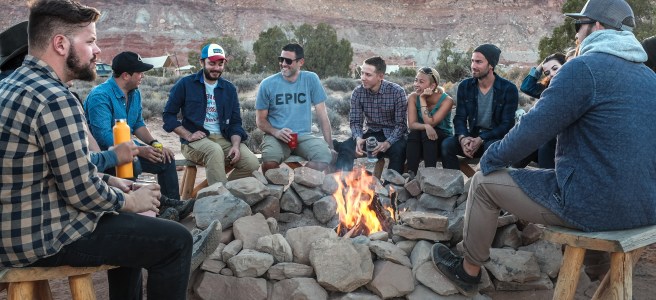
P.S. Our first small group did not, as the photo for this blog post shows, include a bonfire in the grand canyon. But we do have a bonfire on the calendar for Memorial Day weekend, so… close enough. 🙂
What about you? How have you been able to connect to people at your church/parish? What are the challenges to connecting with others in your particular phase of life?
Purchase Lorelei’s Books Here:
Lorelei is the author of creepy, magical, hopeful stories for children. Her debut, The Circus of Stolen Dreams, released in 2020. Her second book, a magical retelling of The Secret Garden, released in 2022. Both are available for purchase wherever books are sold.
Oh my goodness. As a Protestant, Purgatory was the weirdest.
Along with the Mary stuff.
I didn’t think about Purgatory much, but when I did, I had no idea what Catholics were thinking. I thought Purgatory was some sort of bizarre waiting place, like a really long DMV line. Or a bus route that just kept going in circles over and over again. I thought it was either a place where souls somehow had to prove themselves worthy of heaven, or a place where souls waited until God thought it was time to let them in. I knew Purgatory wasn’t supposed to be enjoyable. And I just didn’t see the point.
As I began my journey towards embracing the Catholic faith, I looked into everything I could. At the time, Purgatory was one of the bigger hurdles I had to jump.
I found my original conception of Purgatory was actually, once again, a misconception. And I learned there is a lot that makes sense about believing in Purgatory.
Justification and Sanctification
I know there is quite a bit of hubbub around the definition of Justification between Protestants and Catholics. It was one of the central issues in the Reformation. It seems, however, not many people are aware that Catholics and Lutherans and Methodists, have, for a while now been in agreement on that issue. The Joint Declaration on the Doctrine of Justification is a worthwhile thing to know about.
But, in short, and without going into the specifics of how justification is applied, justification means our salvation. It means heaven is our ultimate destination through Jesus’ atoning work. This article is not the place to delve into details. But, a person justified is in God’s grace.
Sanctification is the process by which we are made holy. By which the sinfulness in our life is burned away as we cooperate with God’s grace, and by which we are made into the likeness of our Heavenly Father.
Side note: I don’t buy the idea that once one is a Christian, sin is a non-issue. I’m not walking around like “oh I sin so much I’m depressed all the time,” but I am very, very aware of my tendency to sin even though I have a Christian faith. I think the Christian traditions that have moved in the direction of assuming that Christ’s work means that sin is not really something we need to worry about or think about much is concerning. I, personally, have found that every moment of every day, I have the choice to cooperate with that which God wishes to do inside of me, and be sanctified, or I can reject that work and choose to sin. I am, therefore, writing from the perspective that Sanctification is an active, not a passive, process by which we cooperate with God.
Completion
Perhaps this is a layperson’s oversimplification, but it helped me a lot to think about Purgatory as the completion of one’s sanctification.
Here are a couple examples.
1- A person who believes in Christianity from the earliest age possible. They cooperate with God’s grace in their life, and live a long life of faith. By the end of their life, God has worked in them and through them so much, that they are not selfish, or prideful, or seeking their own comfort. They have been entirely conformed to The Father. We might call this person a Saint.
2- The man on the cross next to Jesus. He had lived a life of sin and selfishness. Yet, his heart turned toward God at the last moment.
Are both of these people justified by virtue of their faith in Jesus? Yes! Are both of them sanctified to the same degree upon their death? I’d say definitely not.
And then what? What happens to the sanctification of the man on the cross next to Jesus?
I don’t think it’s possible that people are in heaven only partially sanctified. That would mean there are people in heaven still dealing with sin issues. And that just doesn’t make sense. We won’t struggle with sin in heaven.
How Are We Sanctified?
Well, first of all, God isn’t a liar. He doesn’t declare us righteous and then be like “Well, I’ve said you’re righteous, but I’m not going to actually make you righteous. I’m just going to say it and we can all pretend it’s true.” No. God does what he says, and sanctification is how we are made righteous, or holy. We can only be sanctified through God’s grace. We can’t earn it or work at it in our own power. But, we need to cooperate with that grace. God can’t just drag us kicking and screaming into holiness. We have free will. Sanctification requires we say “Yes” to the work God is doing in us. God can’t force us to be selfless. God can’t force us to be humble. We need to submit to allowing God to do that work inside us, and cooperate with Him. And God isn’t going to be cool with a prideful, sinful person in Heaven with Him.
A Comparison
It was helpful to me to compare sanctification to exercise in this regard. Exercise is good for us! And necessary for our health. But it is not easy. It requires action on our part, and, often, discomfort or pain. We can’t get healthy without exercising. And we can’t exercise effectively and still avoid discomfort.
Sanctification is, in a very real sense, painful. Because through sanctification, we are rejecting the sin in our life.
Whenever we allow God to help us turn away from sin, it hurts. Biting my tongue when I want to say something snarky hurts. Eating a proper portion size of cake when I want to stuff my face with it hurts. Turning off technology for periods of time throughout the day, denying myself that nice little dopamine high from checking Facebook, hurts. Think of any sin you struggle with, and then think of denying yourself that sin… and you quickly realize the pain in sanctification.
That’s the pain people are talking about when they talk about Purgatory. It’s painful, but not arbitrarily so. There is purpose to it, and necessity. Because Purgatory is the end of any sin’s grip on you that you struggled with during your life on Earth. Struggled with pornography? It’s burned off. Struggled with laziness? Burned. Impatience? Burned. Pride? Burned.
Sanctification is good for us, and necessary, even, before entering Heaven. And it hurts because turning away from sin hurts.
Purgatory in the Bible
1 Corinthians 3 states:
10 By the grace of God which was given to me, I laid the foundations like a trained master-builder, and someone else is building on them. Now each one must be careful how he does the building.11 For nobody can lay down any other foundation than the one which is there already, namely Jesus Christ.12 On this foundation, different people may build in gold, silver, jewels, wood, hay or straw 13 but each person’s handiwork will be shown for what it is. The Day which dawns in fire will make it clear and the fire itself will test the quality of each person’s work.14 The one whose work stands up to it will be given his wages; 15 the one whose work is burnt down will suffer the loss of it, though he himself will be saved; he will be saved as someone might expect to be saved from a fire.
JP was at a men’s Bible study one night before we became Catholic. He came home and shared with me the discussion the men had surrounding this verse. It was an odd thing for the men in the group to reconcile… this being saved through fire. I looked at him, and said: “It sounds like Purgatory.” He agreed.
I’ve since heard there is an argument that a person’s works are tested, not the person themselves. But that just doesn’t make sense to me. Works don’t exist apart from the person doing them. There is always a hand feeding the hungry person. There is always an eye looking at someone in judgment. There is always a foot going to dark places to spread the light of Jesus. Whether our works are in cooperation with God, or whether our works are sinful, there is a person attached to the work.
Also, in 2 Maccabees we also learn that Jewish people prayed for the dead. Whether or not one accepts that Maccabees belongs in the Bible, it still gives us a historical reference to know that the Jewish people, of which Jesus was one, prayed for the dead. That’s why we pray for souls in Purgatory. Just as we would pray for a friend in our Bible Study to work through a sin in their own life that they were struggling with, we pray for our fellow Christians in Purgatory that they would cooperate with God, and allow God to work through the sin they still struggle with and are holding on to as well.
C.S. Lewis and Purgatory
Now, just because C.S. Lewis believes something, doesn’t make it true. But, he is a well-respected theologian among Christians everywhere. And, he made some really good points about Purgatory.
He wrote:
Our souls demand Purgatory, don’t they? Would it not break the heart if God said to us, “It is true, my son, that your breath smells and your rags drip with mud and slime, but we are charitable here and no one will upbraid you with these things, nor draw away from you. Enter into the joy”? Should we not reply, “With submission, sir, and if there is no objection, I’d rather be cleaned first.” “It may hurt, you know” — “Even so, sir.”
I assume that the process of purification will normally involve suffering. Partly from tradition; partly because most real good that has been done me in this life has involved it. . . .
(Letters to Malcolm: Chiefly on Prayer, New York: Harcourt Brace Jovanovich, 1964, 107-109)
And, in the acclaimed Mere Christianity, he writes:
“Make no mistake,” He says, “if you let me, I will make you perfect. The moment you put yourself in My hands, that is what you are in for. Nothing less, or other, than that. You have free will, and if you choose, you can push Me away. But if you do not push Me away, understand that I am going to see this job through. Whatever suffering it may cost you in your earthly life, whatever inconceivable purification it may cost you after death, whatever it costs Me, I will never rest, nor let you rest, until you are literally perfect — until My Father can say without reservation that He is well pleased with you, as He said He was well pleased with me. This I can do and will do. But I will not do anything less.”
God will conform us to His likeness. He will not leave us half-sanctified. He will do what He says.
The Great Divorce is also awesome book that helps illustrate some of these concepts. A character at the very end, has the ability to enter into Heaven, but has to go through a painful transformation to get there. The book is short, and powerful. I highly recommend it.
Conclusion
Well, suffice it to say I’ve come a long way from believing Purgatory is some weird DMV line with no point. I see it now as the process by which God completes his sanctifying work inside of me.
Purgatory is a really beautiful and life-giving thing for our souls.
It’s the death blow to our own personal struggles with sin.
It’s the final and full cooperation with God’s offer of grace, wherein any bits of sin we’ve stubbornly held onto are burned away by His love.
-Lorelei
Purchase Lorelei’s Books Here:
Lorelei is the author of creepy, magical, hopeful stories for children. Her debut, The Circus of Stolen Dreams, released in 2020. Her second book, a magical retelling of The Secret Garden, released in 2022. Both are available for purchase wherever books are sold.
Lorelei is the author of creepy, magical, hopeful stories for children. Her debut, The Circus of Stolen Dreams, released in 2020. Her second book, a magical retelling of The Secret Garden, released in 2022. Both are available for purchase wherever books are sold.
I sit here, smack dab in the middle of Holy Week, anticipating the approaching daylight, but still knowing we have the darkness of Good Friday and Holy Saturday to pass through on our way to it.
And I am in awe. In awe of the fact that we exist. We are on a ball floating in space, constrained in the exact position necessary to sustain life due to the gravity of the sun and a bunch of other factors I probably will never understand. We exist in a universe of black holes, and asteroids and fiery balls of light. The whole thing could have been, and perhaps, according to the odds, should have been, chaos.
But it isn’t.
No… not only does out planet sustain life, but it sustains intelligent life. There is chaos, yes, but there is also an astounding level of order in our world to the largest magnitude and the smallest degree. The chaos is subdued, and here we are. What are the odds?
You know something else that has me in awe, every single day of my life? The fact that over 2,000 years ago a man walked this earth and claimed to be God. That man was crucified for his claims and he died.
His followers claimed he rose again.
What are the odds his claim was true?
This man, Jesus, was clearly, and only, one of three things. He could possibly have been a liar. Just a normal man making grandiose, yet fictional, claims about himself. He could possibly have been insane. A God Complex to the highest degree. The third option, is he is who he said he was.
Based on the nature of the claims, I suggest it is actually pretty important for us humans to figure out which one of those three options is true.
What do we do with the historical information surrounding the life of this man? What do we do with the ancient prophecies his life fulfilled? What do we do with the fact that ten of his twelve original disciples were martyred for their belief in him? And the many, many more martyrs in the times that followed up until now? Were they, too, all crazy or liars? What do we do with the eyewitness corroborative accounts of the things this man said and did? What are the odds the eyewitness accounts would hold up to both scrutiny and history? What do we do with the fact that this religion, despite a multitude of efforts stomp it out, still exists, thousands of years later? What do we do with the billions of lives changed over the course of history because of this man’s teachings?
What are the odds…
Well… according to the odds, we humans shouldn’t exist. But we do.
So… if we exist against all odds, perhaps looking into the claims of the Christian faith isn’t that far fetched at all. Perhaps the Christian faith is more than just stories and morals. Perhaps the Christian faith contains something so surprising, and so True, it will knock your socks off.
Perhaps there is unfathomable depth there, and incomprehensible beauty there, and abiding peace to be found there. Perhaps He who holds everything in this universe together, against all odds, did something so significant for you, that it could change every breath you take every moment forward for the rest of this life and onward into eternity.
So… what are the odds you will take another look at the God Man Jesus? Whether you’ve believed passionately, or nominally, or not at all-ly… let’s give the claims of this man the scrutiny they deserve. Fair warning: Those who believed His claims were true? They were forever, immensely changed.
If you’re willing, Easter is a great time to start.
Here are some resources to being learning about the Christian faith. And, as always, feel free to ask a question via comment or email. We would love to be a part of your journey in any small way. And, if you live in our neck of the woods, we’d be pleased to have you join us on Easter morning.
Lorelei is the author of creepy, magical, hopeful stories for children. Her debut, The Circus of Stolen Dreams, released in 2020. Her second book, a magical retelling of The Secret Garden, released in 2022. Both are available for purchase wherever books are sold.
Has there ever been a time in your life when your actions have been misunderstood… or, worse yet, you have been misunderstood? When someone took a piece of something you had done, or a piece of who you are, and then turned that bit of truth, or added to it, or took away from it, or scrutinized it so severely that the context got lost? So much so that what that person ended up with was not an accurate representation of you or your actions at all?
I am sure many of us have been there, at some point.
It happened to me personally this week, regarding my Catholic faith. And it was in a situation where I was unable to say anything back at all. Because the person misunderstanding me was in a video on YouTube.
A friend of mine was sent a video by someone she knows. A video sent to her because some people in her life are concerned she is spending so much time with a Catholic. Because some people in her life are concerned she has attended Mass with us a few times.
The person in the video was a scholar who studied theology from the Reformed (Calvinist perspective). He was being interviewed by a couple of people on the problems with Roman Catholicism.
Truth be told, by now I have heard most of the arguments that Reformed theologians have about my faith. But when we were converting, none of it made any sense, as I had never before come fully into contact with the Reformed perspective’s wrath against the Catholic Church. And it’s still never fun to hear.
In the video (which I cannot recommend at all, and thus will not be linking to,) the scholar said Catholics and Christians have a different gospel (this is the Reformed perspective, not all Protestants believe that). He strongly implied that Catholics believe Priests to be some sort of deity. He said Catholics had no means of experiencing true Shalom (peace). He implied transubstantiation was not believed by the majority of Early Church Fathers. He misconstrued the relationship between Scripture and Church Authority. He said the Catholic Church was incapable of reforming. I could go on…
When I started watching the video, I was chuckling. When I finished, I was unbelievably sad. Because when misunderstanding and half-truths are being spread about something important to you, it hurts.
This video reminds me why some people from the Reformed church we left to become Catholic, no longer continued a friendship with us. And it reminds me why Pastors from that church sat in our living room and told us we were not, and never had been, Christian.
If that surprises anyone reading this, I understand. It was a very jarring experience to go through. If you are reading this and that is your perspective, I hope this helps you understand what that experience was like, and also challenges you as to where you choose to receive information about things you disagree with.
It’s a lot easier to joke about the number of conditions a Catholic would have to meet to receive salvation on a YouTube video, sitting next to people that agree with you than it is to look another human being in the eye and do the same.
It’s a lot easier to propagate stereotypes and misconceptions than it is to share a meal with someone, and get to know them and their faith personally.
Because I bet if anti-Catholics did that, even if they never experienced an inkling of desire themselves to become Catholic, that Catholics and the Catholic faith in general would become a lot less scary and mysterious. And who knows, maybe they would make some new friends.
I will say the Reformed (Calvinist) view of Catholicism, the view that says true Roman Catholics are not Christian, is in the minority among Protestant Christians. People in the Calvinist tradition don’t even think it appropriate to serve alongside Catholics in ecumenical ministry. Now, just because something is a minority, doesn’t make it untrue. But, the fact that among Protestant Christians, Calvinists stand apart as very anti-Catholic, while other Protestant groups and Catholics view each other as brothers and sisters in Christ at least is something worth mentioning.
But, my main point is this.
If I wanted to accurately learn and understand democracy, would it make sense for me to interview an anarchist about the democratic system? Would someone anti-government be a good and reputable source of information to accurately understand government?
If I wanted to learn about and understand the history of minorities in America, would it make sense for me to interview a white supremacist? Would someone with extreme prejudices against a group of people be a good and reputable source of information about the history of the people they are prejudice against?
If I wanted to learn about the Pro-Life movement in America, it’s motivations, history, strategy, and practical implications, would it make sense for my primary source of information to be someone adamantly Pro-Choice? Would they be likely to give an accurate representation of those that believe life begins at conception?
I hope we could agree in all of those cases that the answer would be an emphatic No!
It follows, then, if you have only learned about the Catholic Church from anti-Catholic sources, is that likely to be a a good and reputable source of information about the Catholic Church?
I hope our answer again is, unequivocally, no.
I know this based on logic. I know this based on the misunderstandings I have experienced in this regard. But I also know this based on my own faith experience.
The man in the video said Catholics cannot have Shalom. And, I admit, he rattled mine a bit for a couple of days. But, the reason I lost my peace wasn’t because I’m Catholic. I have never been at more peace in my life than I am now living out my Christianity through my Catholic faith. I lost my peace for a bit because I was reacting to being grossly misunderstood.
I realize I didn’t have to give that man the power. I think it all stems back to my desire to be liked, which I recently wrote about in detail, because it reminds me that people I have cared about stopped being friends with us for some of the reasons the man in the video stated. And I also think part of it was a just reaction to a legitimate concern. There is a difference between communicating our faith with each other, in the hope to help bridge gaps, and spending one’s time defaming another faith, with the intent to increase divisions. There is something beneficial to understanding each other better. There is something terribly dangerous about spreading half truths.
My friend sent me the link to that video because she wanted to know, from a Catholic perspective, if the things he said were accurate. And, even though it was difficult to watch, I’m so glad she did. She went to the source and she valued our friendship, and she wants to know me and my faith because she cares about me as a friend. This is all good stuff.
And it feels a lot better to get my thoughts out in some capacity, even if I can’t respond directly to the man in the video. I’m ready to move on.
Because, at some point, as another good friend of mine often says, we need to meet at the cross, and work together to get out and be the hands and feet of Jesus to a hurting world. And I am so happy to do so with my many Christian friends of various faith backgrounds who are willing to serve alongside me. Because we can accomplish more together. Because we are the Body of Christ on this earth. And because we have much work to do.
-Lorelei
Purchase Lorelei’s Books Here:
Lorelei is the author of creepy, magical, hopeful stories for children. Her debut, The Circus of Stolen Dreams, released in 2020. Her second book, a magical retelling of The Secret Garden, released in 2022. Both are available for purchase wherever books are sold.







 This Catholic Family: Catholic Womanhood, Family, and Conversion