The First Day I Chose to Go to Mass

This December marks the five year anniversary of the first time I ever went to Mass by choice.

I had been to Catholic Masses before…as a baby, for my own baptism and that of my brother. I had been to funeral Masses. A few weddings. I had begrudgingly and awkwardly joined JP’s very devout family at Mass when we visited them so as not to cause ripples.

But there was something very different about the first time I decided I wanted to go to Mass, the first time I chose it for myself.

The Pre-Conditions

First of all, the conditions to led me, a once anti-Catholic evangelical, to seek out a Catholic Mass in the first place.

I had gone from a very fervent young Christian, to a disillusioned young adult inside the walls of various Protestant churches over a number of years. I was struggling to reshape the faith of my childhood into something with the depth required for my adult experiences. My own journey of faith began as a strong believer when I was a child and teen, but transitioned to a life as a near-agnostic in my early 20’s. That shift called into serious question the Protestant doctrine of “Once Saved Always Saved” because my own experience proved that one can start out with true belief but deny it later on. Our foray through a variety of denominations brought me to doubt individual interpretation of Scriptiure- if it’s that clear, why do all these churches disagree on issues both big and small? I grew weary of the hyper-emotional structure of worship, and the expectation that I developed equating a good church service with feeling emotionally fulfilled.

To top it off, no one could tell me what the early Church looked like, just as I was beginning to suspect that the Americanized version of Protestant Christianity wasn’t it. I wasn’t sure if what I was looking for even existed, and if it didn’t, I didn’t think I could remain in good conscience a sola-scriptura, once-saved-always-saved, American Protestant for much longer. Or, if this was all that Christianity was, I didn’t know if I would remain a Christian at all.

Cue me, sitting on my sofa, realizing that among these and many other things, I was possibly starting to think like…gulp…a Catholic. I hungered for a connection to the history of my faith. I wanted something deeper than an emotionally-driven experience could offer. I wanted sound theological depth.

I didn’t really know how to bring this up to JP because I had persuaded him away from actively practicing his Catholic faith early in our marriage. But I sprung the question on him one snowy night in downtown Racine while we were out at dinner. I asked, simply: “Do you want to go to Mass?” Shocked, JP shared with me that he had been praying for our unity in private, and had himself felt like he was being led back to the Catholic Church.

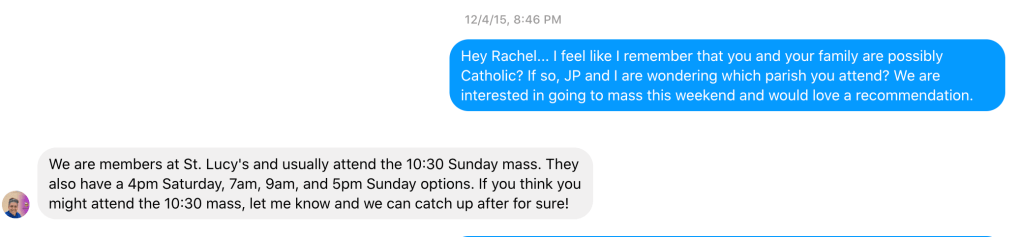
We got home from dinner and I sent a message to one of my friends, who I suspected might be Catholic:
The Mass Itself

Two days later, on December 6th, JP and I led our (then) two children through the doors of St. Lucy Parish in Racine, Wisconsin for the 10:30 Mass. Even though I had been to Masses here and there, I didn’t really know what to expect, and I wasn’t entirely sure what to do throughout the different components. But, on that Sunday, my experience in a Catholic church that early Sunday in December was markedly different from any Mass I had been to before.

I had chosen to be there. And, at last, my heart was open to what I might find.

I don’t remember a ton of specifics, other than the distinct feeling that if what I was looking for existed anywhere at all, it likely existed here. The very Church I had sometimes ignored and other times argued against, certain that it was filled with irrelivant, extranneous, anti-Biblical teachings, now might just be my only chance to remain in the Christian faith.

I do remember that there were many families with young children sitting altogether in the pews, which impacted me because at the church we went to a the time, we sent our kids to Sunday School in different rooms. I remember that there wasn’t any sense at all that this service was designed to cater to me, another marked contrast to the hip coffee-house, welcoming committees of the Protestant churches we had recently attended. The music was traditional. The components themselves were somewhat foreign, and yet oddly familiar too. I caught in them some echoes of the fragments that Protestant churches have held onto- Scripture readings, an act of contritian, Communion. But here, inside the Catholic Mass, they weren’t fragments of some lost, greater whole. I remember trying to piece together how it was I grew to be so anti-Catholic in the first place, when it was clear I knew so little about it.

The Aftermath

My friend met us after Mass and, after expressing my continued interest, she helped us get connected with RCIA at St. Lucy’s. We enrolled immediately. Inside the walls of that little RCIA room, I asked every question my heart had been wrestling through, knownig that I had to leave everything on the table. Based on what I had seen in multiple Christian churches over nearly 30 years, if the answers couldn’t be found in the Catholic Church, then they probably couldn’t be answered by anyone, and the Christian faith was a sham. One week later, we attended my last church service at the Protestant Church we had been a part of. I have many friends who love Jesus who remain Evangelical, but I could no longer look at it the same way as I once had.

And the rest, as they say, is history. That early December night, where the snow fell like wisps of cotton outside the restaurant window, when I asked JP if he wanted to go to Mass, was less than four months away from the day I’d stand in front of a full Cathedral in St. Paul Minnesota. Easter Vigil, 2016, when I was confirmed into the Catholic Church.

Protestant churches do a really good job of making new guests feel welcome. They greet you, connect you with a small group, offer you donuts and coffee. They give you great concert-quality music and an inspiring message. My first intentional visit to a Catholic Mass didn’t contain any of those things to the same extent I had been used to before. But I didn’t need any of that to be drawn in to the Catholic Church, at least not once my heart was open to it. The Mass drew me in, not with bells and whistles and trends and the promise of friendship with other people like me. It drew me in with beauty, and history, and, above all, rock-solid Truth.

-Lorelei

Purchase Lorelei’s Books Here:

Why Are Catholic Sermons So Short?

This letter is free for you to read, but it wasn’t free for me to produce. If you’re interested in supporting the work of This Catholic Family, I would be honored if you would prayerfully consider upgrading your subscription. Or, you can always buy me a coffee here.

They’re so Short!

Something that was always strange to me as a Protestant attending Mass was how short Catholic sermons are. Well, technically we call what happens when the Priest speaks after the gospel reading a homily, but homily isn’t a word seen too often outside the Catholic realm.

The priests seemed to have varying degrees of preparation in their message, and it varied from a minute to about ten minutes at most. It varied greatly in level of depth. Sometimes it was more an encouraging word than a message at all.

I thought, what’s the deal with this?

At every single non-Lutheran Protestant Church I attended, there was a sermon. And the sermon was comparatively long. 20 minutes was normal. Some could go over 30. If the sermon was good, I left church feeling challenged and uplifted. If it was just okay, I might have been disappointed.

Expositional Preaching vs. The Homily Objective

There is a big movement right now in the non-liturgical Protestant realm towards expositional preaching. Where a pastor delves deep into a passage of scripture, often going through entire books of the Bible in an extensive sermon series. The pastor delves into the historical, cultural context, along with the original language and preaches on what he or she concludes after that extensive study.

This makes sense in the Protestant world because in Protestant churches, the sermon is the pinnacle of the service. Everything, the music, the offering, the reading (if there is one before the sermon itself), builds up to the sermon. The sermon is, structurally, the main event.

The homily, on the other hand, is meant to be an application of the readings for the day.

More in-depth study of the Bible is available to Catholics, (and should be used!), in a variety of different formats. There are Bible Studies, books, and video and online resources for in-depth delving into scripture. The readings for each day are thematically connected, and resources are readily available each day from a variety of different sources that delve into the readings. It’s been amazing to learn how connected the Old Testament is to the New via utilization of these resources. Here’s a link to one.

But the Mass isn’t ever going to be a place for lengthy, expositional study of Scripture.

But why???

Simply put, in a Protestant service, everything builds up to the sermon.

But in Catholic Mass, everything builds up to something else.

The Eucharist

Christian Mass, and living the Christian faith, from the time of the earliest Christians, focused heavily on Holy Communion. Another word we use for that as Catholics is The Eucharist. The earliest Christians called it that too.

In many Protestant Churches, communion is served once a month, or twice a month in some instances, but this wasn’t always the case in the history of our faith.

As a Catholic, though we need to be in attendance on Sundays, there is actually Mass held every single day. And at every single Mass, the Eucharist is there.

josh-applegate-301321
Photo by Josh Applegate on Unsplash

The preparations for the Eucharist begin in concrete form after the prayers of the faithful.

Then, the liturgy of the Eucharist begins and takes us to the completion of the Mass.

Why is that important?

It’s important because Catholics, like the early Christians, believe Christ is truly present in Holy Communion. We believe we actually receive Jesus: body, blood, soul and divinity when we receive the Eucharist.

We believe this is one of the most intimate ways we can interact with our Creator while we walk on this earth. We believe there is grace there. We believe receiving the Eucharist on a regular basis helps strengthen our walk of faith, helps unite us to other Christians, and that, among other things, it helps us turn our hearts to God. We believe that just as Jesus took the form of a man, that he is with us still, in the form of bread and wine. That he instituted the Eucharist at the Last Supper. That he meant what he said in John 6.

When we kneel before the Eucharist, we kneel before our Savior.

Weirdness

As someone who grew up in a Protestant world, the things I just wrote would have been weird and offensive.

Communion was merely a symbol in my Protestant realm. It was more casually passed out, and more casually received. I ultimately concluded that this Catholic practice was so weird to me because it was unfamiliar. But just because I had never heard of something before, didn’t mean it wasn’t true. Imagine someone living a Pagan existence in a remote location of the world. The Gospel would sound pretty strange to them at first. But that doesn’t mean it isn’t true.

When deciding where my faith would land, I researched a lot of things extensively. Especially this. And I found only solid evidence that the earliest Christians, those closest to Jesus held that exact same belief as the Catholic Church about Holy Communion. That belief as Communion as a symbol was considered heresy. This may not be the case everywhere, but the churches we attended didn’t delve regularly into Church history. Especially not Church history on the Christian beliefs surrounding Communion.

I’ll probably dive more into this in another post, but if it was good enough for Jesus’ disciples, and their disciples after, and on and on through apostolic succession, then it was good enough for me.

Conclusion

So that’s why Catholic sermons, or homilies, are so short. Some are longer than others, and some Priests spend more time crafting them than others do. But Priests are really busy guys. They spend time visiting the sick, and being instruments of grace through the sacraments.

Besides, the sermon isn’t the main event. Jesus is. And, long homily or not, he meets us there, every single Mass, loving us and offering to us himself in the bread and the wine.

-Lorelei

Want to hear more from This Catholic Family?

Join us on Facebook!

Purchase Lorelei’s Books Here:

How This Catholic Family Approaches Mass With Young Children

Many Families, Many Approaches

There are as many ways to manage a family with young children at Mass as there are families that attend. Many people will have something different that works for them. I’m always on the lookout for ideas and have read several articles on what age appropriate expectations are, as well as articles with ideas on how to engage kids in our Catholic faith, both during Mass and throughout the week.

These articles have often been an encouragement to me, and I love picking up new ideas or being able to identify with a family who manages things in a similar way.

So, here is how our family approaches bringing our children to Mass. We have a 5-year-old, a 3-year-old, and a 9-month-old.

8 Ways Our Family Approaches Mass

1- We Bring Them

Each week, our family of five loads up in our car and goes to Mass together. Exceptions for this have been when a kid is sick, one parent stays back and the other parent takes the rest of the family. I think the fact that we do this each and every week, over time, will set a good example of the importance of practicing our faith. Even when we are out of town or on vacation, we find a Catholic Church and attend Mass together.

2- Expectations Vary By Age

When our daughter turned 5, we began expecting that she would follow along with the postures of Mass (sitting, standing, kneeling), and also to join in with the parts of Mass she knew. She now sings along with many of the congregational responses.

Our 3-year-old is expected to be quiet and not distract others. He sometimes joins in during some of the parts, but we aren’t requiring he follow every sit/stand/kneel yet.

More on our 9-month-old in a bit.

3- We Sit Up Front

We’ve tried many different seating positions, but have found, for our children, that sitting up front is the most conducive to a smooth Mass (at least for the older two). They can see what’s happening, and that helps keep them more engaged.

4- We Explain Things

We don’t insist that the kids be absolutely silent during Mass. But we also won’t talk about whether or not we are getting donuts after or other random things. They are more than welcome to ask us questions, quietly, or to point something out they notice in the church, or something relevant to the Mass itself. We also sometimes will explain what is happening, or note something interesting for them to pay attention to. These small things are done in whispers. It is important to me that if my kids have a question or are excited to notice something, that I validate their engagement. When it’s time for the Eucharist, we invite them to join us to come and see Jesus, even though they are too young to receive.

5- Activities

I’m a relatively recent Catholic convert (2016) and my husband is a revert. Just prior to becoming Catholic, we were at a church with a comprehensive children’s program, where our kids never were in church with us. They went to their own classrooms to play and have a Bible lesson for the entire service. So, going from that to having them in with us at Mass every week, was a bit of an adjustment for everyone, though I have come to enjoy having our family together each Sunday.

To start, we brought an activities kit, with coloring and notebooks. We also did some crackers and water. It’s what we saw as the best option to help our kids make the transition. Now, our daughter doesn’t use the coloring much at all because she is participating, and our son sometimes does, but often sits quietly. It was something that helped us. Our daughter also has taken to bringing her children’s Bible with her. We can sometimes turn to the story in her Bible that matches the reading, and definitely can turn to the Last Supper so she can draw connections between that and the Eucharist.

My hope is that parishioners can give families grace in this area. As a teacher, I know each child is so different. One kid might need something to fidget with the whole Mass. Another kid might be able to focus the whole time right away. And every possible thing in between. Having those activities helped our kids transition, and they are weaning off their dependence on them as they grow, and as we gain experience attending Mass together.

6- Taking Turns

Our 9-month-old is incredibly wiggly. She is constantly on the go. Right now, we try to start Mass with her in the pew with us. Typically, we can make it to the Gospel before she starts getting frustrated at the confinement we’ve placed her in. She wants to crawl under the pew, and out the side, and to eat the pew and make noises to hear the sound of her voice. My husband and I are currently taking turns bringing her out to the foyer, where we can hear the service, so she can get her wiggles out until she is old enough to know how to sit still. She’s just an adventurous baby, and she won’t be that way forever. The person who is out with the baby doesn’t experience Mass as fully as the other, but the Eucharist is there, and we are able to receive Jesus into us, even whilst in the phase of baby wiggles.

7- Special Masses

During the Easter Triduum this year, I tried something new that I think I would like to continue. During those special Masses, where some unique things occur (Holy Thursday Mass is an example,) I made my daughter a chart, with pictures noting certain things for her to look out for, like the presentation of the oils, the washing of the feet, the stripping of the altar. When she noticed each thing happening, she checked it off. It was a way to keep her engaged, and to start teaching her about these particularly important moments in our faith.

8- We Make It Special

We make sure to hold hands with the kids, or let them sit on our laps, or put our arms around them, and in general just make it a special family time. We want them to feel close to us, and to experience the faith together. We smile at the big kids when they participate in something new, encouraging them to keep it up. We want Mass to be a positive experience. Something they look forward to, most weeks at least, and something they see as part of our family identity.

Conclusion

Again, there are as many approaches to Mass with kids as there are families. This is just what has been working for us, at this phase of life. It always warms my heart to see other families with young kids at Mass each week. Bringing our children to Mass is one of many things we can do to help our children grow in faith and virtue now and for the long road ahead.

We’re all in this together.

(Note: This article originally appeared on Catholic Stand)

-Lorelei

Purchase Lorelei’s Books Here:

5 Things A Catholic Can Do To Help A Protestant Feel Comfortable at Mass

Having a Protestant friend visit Mass may seem like a big deal, or not, depending on you and your friend. But I know, as a Protestant, there was a lot that confused me during Mass, and I often didn’t feel super comfortable. The following things all would have been helpful to me as a visitor, and I hope they are able to help others as well. Because Mass can be a rich faith-building experience for Catholics and other visiting Christians alike.

1- Explain what the Holy Water/Baptism font is and why we stick our fingers in there and cross ourselves.

Hint: It is not a bird bath. But seriously, just a simple explanation that we utilize the font to remember our own baptism, and cross ourselves, which I write more about here, as a recognition of the Trinity, will go a long way in making that particular practice less odd to a visitor.

2- Show them how to use the Missalette (and find one for them).

What we do when during Mass becomes second nature for a practicing Catholic. But, as a former Protestant, speaking from experience, I was lost for a long time when attending Mass with JP’s family. Finding a Missalette for your friend, and showing them how to use it is one of the greatest kindnesses you can do for someone visiting Mass. They can then follow along with the readings, find the songs, follow along with the prayers, and the whole order of service. They will have something to guide them so they know what is coming next, and what words they should be saying during the Creed, for example, or at other times, like the Penetential Rite.

3- Prep them on when we will be standing/kneeling ahead of time.

Just as a general rule of thumb, explain that we will be kneeling in front of the Eucharist (which you might need to explain is Holy Communion. Also see #5 of this article.) Explain we will be standing when we pray and out of respect when we hear the Gospel. And explain we sit when we are listening. My article here goes into a bit more detail about what we do when and why, but a brief overview will help a Protestant friend at least be aware of the general purpose and timing of our bodily postures during Mass.

4- Encourage them to participate! 

There are so many ways a Protestant can participate in Mass. Things just might look a bit different, so might be worth going over.

Here are a few ways Protestants can comfortably participate in a Catholic Mass:

  • The Penetential Rite. Most Protestant churches I have been to have some sort of brief moment to acknowledge our sins. The Catholic version is more extensive, but is basically the same concept.
  • Listening to the readings
  • Listening to the homily
  • The Lord’s Prayer (we all have that one!)
  • The Creed (Protestants can totally recite the Nicene or Apostles Creed. It’s all stuff we agree on. Even the part at the end that says “One holy, catholic and apostolic church.” The word ‘catholic’ there is lowercase, and is referring to all of Christianity, the Universal Church, not only Catholicism.)
  • The petitions
  • Most of the songs. There are times when we sing a song to Mary, or sing about the Eucharist in a very Transubstation-oriented way, and they may prefer to stay quiet during those times. But so many of our hymns are theologically in agreement with all of Christianity. They may find they even recognize one or two from their own faith tradition!

5- Explain the Eucharist.

Briefly share why we kneel in front of The Blessed Sacrament. Share that it is because we believe it is truly Jesus in the form of bread and wine, and kneeling is an appropriate response to being in His presence. Give your Protestant friend grace, though, if they choose not to kneel. Obviously it is the True Presence whether they acknowledge it to be or not. But they don’t know it/understand it. It may even be an entirely new concept to them, as Protestant churches view Communion as symbolic.

I remember sitting in Mass with JP’s family as a Protestant, scooting forward in the pew so I could give the person behind me room to kneel, but myself not kneeling because I just didn’t get it yet. I wasn’t trying to be irreverant to Jesus. I just honestly didn’t know He was there.

Also, explain to them about who is able to receive Communion. That it is appropriate for those who believe in the True Presence, and are in a state of grace. Invite them to come up during Communion time, and to cross their arms over the body and receive a blessing. Encourage them that no one will think they are weird for staying back, or crossing their arms. In fact, they are showing respect for our faith by not receiving irreverantly, or feigning agreement in an area where they disagree.

Conclusion

If we have Protestant friends/relatives visiting us in Mass, these 5 things will go a long way from them feeling like outsiders, to being able to follow along and participate as they are comfortable. I know they would have been helpful to me as a Protestant. They were things I learned over time, but I spent many an awkward Mass as I tried to put the pieces together. Protestant services, especially contemporary ones, can be quite different than Catholic Masses, and helping bridge that unfamiliarity is a great step in helping our Protestant brothers and sisters to better understand all that is mysterious to them about the Catholic faith.

Purchase Lorelei’s Books Here: