Leaning into the Saints as a Catholic Convert

I love learning about the Catholic Church. We’ll be celebrating my 5-year confirmation anniversary in the spring, and the more I’ve lived the faith and studied it, the more I fall in love. It might sound silly, but many times it feels like I’m stepping into the warmest hug in the safest arms when I go to Mass, or study theology, or even see the effects of my faith slowly but surely overcoming my own tendencies towards selfishness and sin. The depth, the beauty, the history, the Truth–it’s all there and it often leaves me in awe.

There were a couple of areas of faith that were a bit more difficult for me as I made my transition. Understanding Mary’s role in the church took a bit more time. And so did my appreciation of the Saints. I used to tell JP that the Saints intimidated me, half as a joke and half as a serious comment.

For some reason, the Saints seemed so out of reach. It was tough to think that people existed who walked this earth let God fill them so much that there wasn’t room for anything else. Meanwhile, I felt so far from that. I lose my patience so easily, and tend to seek my own comfort, and am prone to anxiety and worry about things I can’t control. I feared that I’d read something by a Saint and be frightened off…of what, I don’t exactly know. But I didn’t trust that it would be helpful, at least not for a while.

My Walk with Saint Teresa of Calcutta

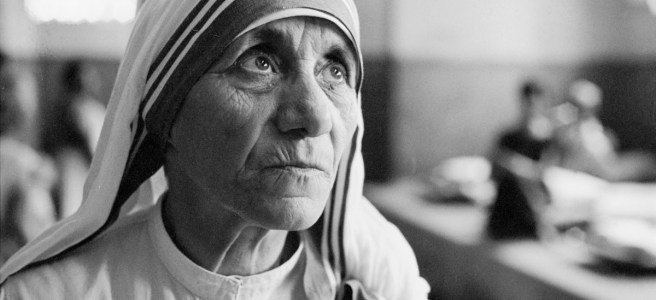
In the end, I want to grow in holiness no matter how uncomfortable it feels, so I decided it was time to read my first official work by a Saint. Since Mother Teresa of Calcutta (now Saint Teresa) was my confirmation Saint, it made sense for me to start there. I received a couple of books for my confirmation, and they’d been staring at me from my bookshelf for far too long. I read Where there is love, there is God over the course of about two weeks. It’s more a collection of things Saint Teresa wrote and said than a book she wrote from start to finish, but I got such an intimate glimpse into the person she was through it. I could see her simple, yet poignant theology in the stories she repeated, in the phrasings she came back to time and time again.

A few points that have particularly woven their way into my heart:

Humility is to accept humiliations. Wiping my baby’s diaper. Letting someone say something short to me without saying anything back. I had never really thought of humility like that before, and it was refreshing and rang so true.

Love starts in the family. This was especially meaningful to me. I struggled for many years if staying home to raise my kids was ‘meaningful enough’ work according to some mysterious earthly standard. We have a framed piece of art in our living room with a quote from Mother Teresa, and we look at it every single day.
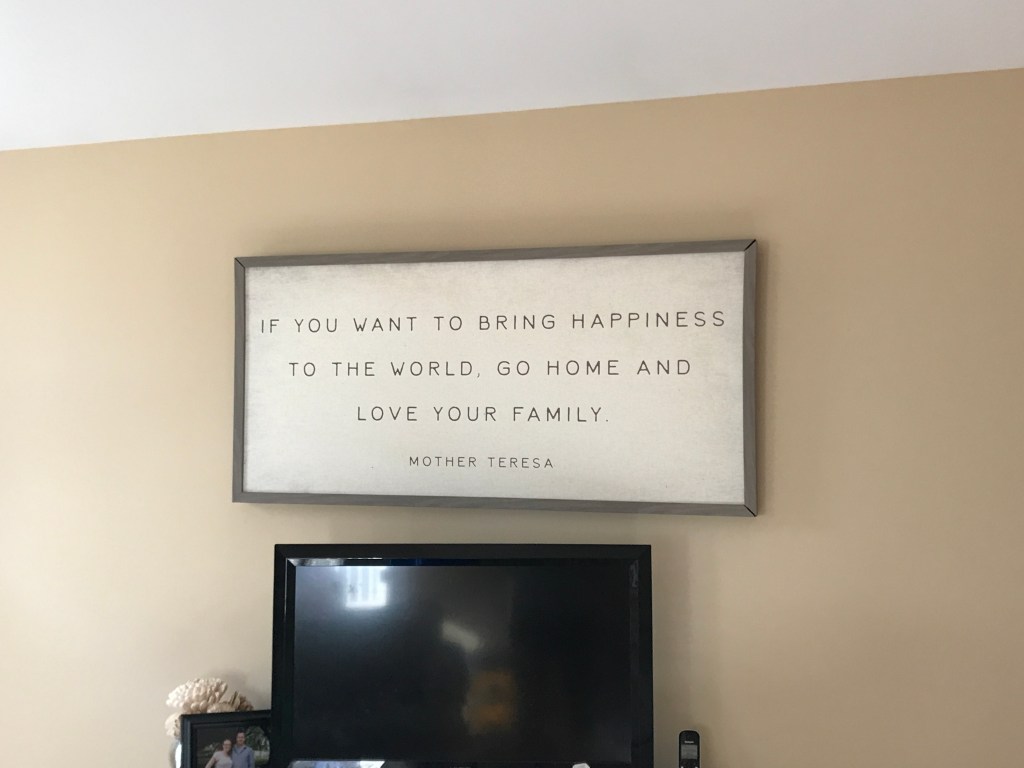
Seeing her broader perspective on this sort-of Theology of the Domestic Church, encouraged me in the truth I’ve been coming to accept more and more as time goes on: that my work here is vitally, beautifully important. Jesus says that when you feed the hungry and clothe the naked, that you’re doing it to Him. Saint Teresa helped me grow to understand that the little children living under my roof are the hungry one and the naked one too, and that by loving them, I’m also loving Jesus.

I also see my own sin the most at home in my family life, because I show it the easiest here. They’re the ones I lose patience with, or snap at if I’m stressed out. Because my interactions with them are such a clear mirror to my heart, they’re also the ones who give me the best chance to become a Saint. They’re the ones who I can learn to love well and patiently and fully, no matter what. They’re the ones I can most often offer dignity to in the big things and small, because they’re the ones I’m most often with.

Jesus thirsts. On the cross, Jesus said “I thirst.” While I’ve learned there have been different approaches to understanding His words, Mother Teresa’s is my favorite. Those words are displayed in each chapel of the Missionaries of Charity. Mother Teresa’s saw Jesus’s “I thirst” as a deep expression of how much he desires each and every one of our love, our souls, our all. And, therefore, she concluded, every act of love that we do is, in some mystical way, quenching the thirst of Jesus on the cross. It begs the question: have I quenched Jesus’s thirst today?

For love to be real, it has to hurt. This isn’t about staying in an unhealthy or unsafe situation, but it is about self-sacrifice and what it means and what it takes. We have the ultimate example of Jesus on the cross, because that was His love, full and true, given for us. And it hurt. My opportunities to love until it hurts are frequent but so much smaller than that- getting up when I’m exhausted to comfort a crying child, admitting that I was wrong and apologizing for it. The world has it so backwards when it comes to love- the world tells us that love should make us feel good, that it should serve us well. But it’s really the other way around. Realizing that to truly love means that I hurt because selfishness and sin is being put to death in me, well, it changes everything. I’ve been familiar with this way of looking at love for a while, but Saint Teresa put it so beautifully, and it made such an impression on my heart.

Do small things with great love. I think many of us have heard this quote from Saint Teresa a time or two. My three year old asked God to help her become a Saint yesterday, and a few minutes later I asked her to pick up a blanket from the floor and put it on the couch. She wasn’t sure she wanted to help, but I had the thought that she could probably understand what the idea of “small things with big love” meant. So I told her that one way to become a Saint was to start doing small things with really big love. Like even picking up that blanket for her mother. If she does that little thing with big love, then she’s letting God’s love into her heart more and more. Mother Teresa’s life was marked by some really big moments, but it was filled with many more small moments where she fed a hungry person, or washed a dirty person, or smiled at someone who needed to be seen. Even washing a dish or sweeping the floor can be done with love. That was a challenge to me, in a good way. It’s something small but significant that I can do in the dozens upon dozens of small, seemingly insignificant tasks set before me through the day.

Simple, Yet Profound

The funny thing is, Saint Teresa didn’t even feel close to God for most of her life. She felt his absense from her, but loved him with all of herself regardless of that. She used that sense of absence to unite herself with the lonely and abandoned in the world and to fuel her love.

And her theology was fairly simple compared to some. JP is reading the Summa Theologica right now, and it’s quite a bit heaftier both in weight and in wording than what I just read. But I think that’s one of the really amazing things about the Saints. Saints have been made from all kinds of people, all over the world, with such a diverse array of experiences. The Saints didn’t all start out holy, but they proved that it can be done. Here, now, while we live on earth. If they could do it, then maybe there’s hope that we can, too.

Turned out, reading Saint stuff wasn’t that scary at all. In fact, it was lovely, and challenging and inspiring. I haven’t fully decided who I’ll read next, but I’ve got my eye on Saint Zelie. We named our youngest after her, and I know I’m inspired by her life as a worker, mother, and wife. I think we have a lot in common, I’d love to gain some deeper insights into the person she was.

-Lorelei

Purchase Lorelei’s Books Here:

Why Didn’t God Just Take Away the Tree?

I love having conversations with the kids about our Catholic faith. Their insights and questions astound me and amaze me time and time again, and it’s such an honor and a privilege to engage with them.

Recently, while doing a short follow-up at bedtime to our most recent faith formation lesson, in which our six-year-old son learned about original sin and the fall of man, he asked a simple, yet profound question:

“Why didn’t God just take away the tree?”

The tree, of course, that he’s referring to, is the tree of the knowledge of good and evil as described in Genesis. His sweet reasoning was that if God had just taken away the tree, then Adam and Eve would never have sinned, and humanity would have saved ourselves a whole lot of trouble.

I realized very quickly that my son was really asking a much, much bigger question than he even realized at the time.

How do we even read the story of The Fall anyway?

I’ll pause here a moment to share my own journey with the book of Genesis. I was raised Protestant, and was taught to believe the Bible was both historically and literally true in all its components. That sort of thinking made it hard for me to reconcile certain parts of the Bible, like the two seemingly-conflicting accounts of creation in Genesis chapters 1 and 2. As I came into adulthood, it caused me to struggle to see the Bible as something more than a book of children’s stories. And, in the end, that type of firm adherence to literal interpretation across the board, was one of the many reasons I became Catholic.

There’s a great video here by Fr. Mike Schmitz that helps explain how the Bible is meant to be read, emphasizing the fact that the Bible is actually a collection of books by many different authors that are all true- but that are not all meant to be historically and literally true in every instance. The appropriate way to read a Bible would be to see it as a book made of books of different genres and purposes. While the accounts of creation in Genesis are historically true (in the sense that at some point God started time and brought the world into existence), they weren’t intended to be a literal telling of how that happened.

I like to say this when talking with my children about the different parts of the Bible- that some parts, like the gospels, were recorded as historical and literal truths about the life of the person Jesus. Some books, like the Psalms, are songs and poems. And some parts, tell us what happened, but weren’t meant to tell us exactly how.

The story of creation in Genesis and the depiction of the fall fit that what but not the specific how definition. For example, as Catholics, we are not bound to believe in a literal talking snake, but we are to believe the deeper truth of the fall of man and original sin, as taught in the Catechism.

Back to the Tree

Okay, so back to my conversation with my son.

What he was really asking, in the question of “Why didn’t God just take away the tree?” boiled down to what love means and what is required for love to be possible in the first place.

Let’s start with God. God is love, completely and fully. So, when God decided to create, He brought forth nature, he brought forth animals. And then, at some point in the vast spectrum of the process that was creation of the known universe, He did something different. He made an animal, but with something more. He gave that animal the capacity to love, just like Him. Until then, he had nature that followed the laws of science. He had animals that followed the laws of their instincts. But we are made in His image, particularly in His capacity to love. This is what sets us apart from squirrels and bears and donkeys. We can choose to go against our urges and instincts, we can do things that have absolutely no benefit to us or even to our survival, in the name of love.

Why Does that Matter?

Next, let’s imagine an Eden without the tree of the knowledge of good and evil. Adam and Eve live in peace and harmony, and all of mankind follows, right? Sure. They would have been perfectly contented little creatures.

But God didn’t make us to be perfectly contented little creatures. He made us for love.

And what is required for love?

Love requires and demands the freedom to choose.

Without choice, then we can’t really love. Without choice, we’re robots. We’re submissive. We do the will of God not because we want to but because we must.

If God had taken away the proverbial tree, he would have taken away Adam and Eve’s free choice to choose Love or to turn away from it. And then they wouldn’t have been able to really, truly, love at all.

The tree had to be there. And by the tree, I mean the choice. The choice had to exist. For love to be real, you have to have the option to say: “No, I don’t want that.” “I choose my good over your good.” Or, in the best case scenario, “I choose your good, regardless of what that means for me.”

We do it all the time, even still to this day. How many times during a day are we faced with that very same decision. I can be short with my kids or I can be patient. I can get irritated at the person in front of me in line who is taking forever, or I can be gracious. On a larger scale, I can offer myself as a gift to my husband and my children, my neighbors, strangers and friends, or I can choose self-preservation and selfishness.

Back at the beginning and resonating through time to our very moment in this world today, that choice contains so much power.

It’s what makes love possible in the first place.

The Bedtime Chat

Of course, with my son, I didn’t quite go into all of this depth just yet. He’s six, and, God-willing, we’ll have time. But we did talk about the tree, and what it means. We talked about God and how he desires more than anything for us to love Him and other people and the world. And if he had taken away the tree, if he had taken away that choice, then our original parents wouldn’t have been able to really love Him or anyone or anything at all.

The story of The Fall is a sad story, but it’s so very, very important. It’s only the beginning of a much bigger, much more beautiful story of Love, giving all of Itself for all of us. The story we are all a part of, even to this day.

And I can’t wait to have more conversations with my kids about it as we live our our lives in the domestic church we call home.

-Lorelei

Purchase Lorelei’s Books Here:

What’s The Deal with Catholic Guilt?

I think we’ve all seen or heard someone make a joke about “Catholic Guilt” at one point or another.

This article explores what Catholic Guilt is, really. And if it’s actually funny. Or, on the other hand, if it a misrepresentation of something meant for our good.

What is Sin?

It’s important to get on the same page about sin before we even attempt to talk about this issue. Let’s turn to the Catechism to get our definition.

1849 Sin is an offense against reason, truth, and right conscience; it is failure in genuine love for God and neighbor caused by a perverse attachment to certain goods. It wounds the nature of man and injures human solidarity. It has been defined as “an utterance, a deed, or a desire contrary to the eternal law.”121

1850 Sin is an offense against God: “Against you, you alone, have I sinned, and done that which is evil in your sight.”122 Sin sets itself against God’s love for us and turns our hearts away from it. Like the first sin, it is disobedience, a revolt against God through the will to become “like gods,”123 knowing and determining good and evil. Sin is thus “love of oneself even to contempt of God.”124 In this proud self- exaltation, sin is diametrically opposed to the obedience of Jesus, which achieves our salvation.125 

(emphasis mine)

Using this definition, I often break down the idea of sin to conclude it is any time where I choose to serve myself rather than another. It’s desiring my perceived good over my actual good. It’s refusing to love. And in refusing love, I am refusing God because God is Love itself.

Sin wounds my relationship with God, because I’m actively rejecting Him. It hurts my soul. It makes me sick.

When I think about sin now, I think about any one of us, if we gave in freely to our own passions, distorted from God’s good intent, might even find ourselves on earth in our own sort of personal hell.

Sin is serious business. But, thankfully, that’s not the end of the story.

My Protestant Practice

Before becoming Catholic, I didn’t spend a lot of time thinking about the ways I rejected  or blocked God (Love) out of my life. Some of the churches I attended would have a moment for such reflections. But it was usually just that, a moment. And, to be honest, in those moments I most often thought “meh- I think I’m doing pretty good, comparatively speaking.” I shake my head at my past self now. And I’m still not exactly sure who I was comparing myself to… those convicted of crimes against humanity? The people in pews beside me, as some sort of holiness version of keeping up with the Joneses? Just the general sense that, in the grand scale of humanity, I was doing okay?

And then the service would move on and I would move on and I continue along my merry way. I knew I could ask God for forgiveness, but as someone who had come from a Once Saved, Always Saved tradition (for much of my life), I didn’t have an ingrained sense that my confession mattered. I had ‘invited Jesus into my heart’ as a child. And if you are Once Saved, Always Saved, then the moment you say that prayer, it’s a done deal.

Now, you can read more about how I learned that perspective didn’t fit with my actual life experience in my Coming Home Network conversion story by clicking here, but suffice it to say, I had accepted Jesus as a child, then possibly crossed over into rejecting Him as a young adult before I made my way back through the Catholic Church.

I learned through that journey that my choices do matter. They have eternal impact. And yes, everything good I do is by the grace of God, but I’m not an automaton. God can work through me to show his love and healing to this world, but He needs my yes to do it.

And so I’d better pay attention to the areas in my life where I’m letting Love in, and also to the areas in my life where I’m not.


The Value in Examining Our Conscience

I worry about the fading of the concept of confession in general as the trees of Christian separation continue to branch farther and farther away from their historical roots. And I have personally found immense value in examining my conscience on a regular basis, followed by a good Confession.

But first, what is an Examination of Conscience?

An Examination of Conscience is a beautiful exercise we do as Catholics, where we take stock of our lives and our heart. We spend time praying about and thinking about the areas where we are letting God (Love) lead the way, and the areas where we are turning from Him (Love) and choosing to serve ourselves first. We take an honest look at where we are being selfish, or prideful, or fearful, or careless, or impatient, or any number of things.

There are many ways to examine our conscience. Click here for a link to some excellent resources that walk you straight through the entire process.

But we don’t just leave it there when we’re done. We aren’t meant to just acknowledge our shortcomings and sit around feeling bad about ourselves. We know we have the ability to make a change. We can grow in virtue and holiness. We can turn our “No” to God, into a resounding “Yes.”

Once we have examined ourselves, we are ready to make a Confession.

Confession: A Healing Sacrament

It’s no secret how much I love Confession.

Confession is so many things. But one thing it is not. It is not a rote recital of our wrongs just for the sake of checking an item off a list.

It is a Healing Sacrament. And for good reason.

When we go to Confession, we sit before a Priest, who is standing in place of Jesus for us. We share with him those struggles we identified in ourselves. And we receive, not only God’s forgiveness to us, but we also receive penance, our medicine to help heal the wounds created by our sin.

We leave Confession with the Grace of God to continue to say yes to Him. And if and when we fail, we know Confession is always there, to help us right our path. To help us to learn to love others better than we could on our own. To help sanctify us, and to flood us with God’s Amazing Grace so we can effectively live as His hands and feet.

Back to Catholic Guilt

Nothing about the Catholic Church desires for us to hobble around, eternally burdened by our shortcomings. And long story short, anyone who has been haunted by Catholic Guilt in their life, has taken these beautiful practices meant for our own good, for our own healing, and for whatever reason, allowed them to become distorted.

When I’m carrying some burdens inside my heart, I might know it’s time to go to Confession. So I just set up a time and go. I know I want to let as much of God (Love) into my life as possible, and if I can be honest with myself about when I’m not doing that, then I can experience healing and let His Grace help me make different choices.

There’s a huge difference between the conviction we need to make something right, and then doing something to heal what we’ve broken, and the notion of “Catholic Guilt.” Guilt, when left to its own devices and void of the connection to healing, can turn us inward and makes us focus dangerously on ourselves. And when we focus on ourselves, we are entering a realm that is unhealthy for our souls. We are entering the realm of sin. 

So, no, Catholic Guilt isn’t funny. It’s actually probably a sign that someone has experienced pain in some form or another inside the Church, and have not yet found their way to the healing. If we know people who struggle with this, or who have left the Church because of it, it is so vital that we live Grace in our own lives. Forgiveness in our own lives. The joy of healing in our own lives.

We have the opportunity to be an example to those who misunderstand our faith, to those who are seeking, and to those who might be confused. Let us be an example of the Church’s beauty as we seek, more and more each and every day, to choose Love.

-Lorelei


Purchase Lorelei’s Books Here:

Being “Gift” In A “Take” World

The Disease of What’s Best for Me

There is a disease rampant in our world today. A disease called “What’s Best for Me.”

Entertainment programs are filled with tips on how to make our lives better. How to get the best deal. How to make ourselves look good. How to advance in our careers. How to make more money. How to improve our existence.

And we absorb that culture, particularly if we live in a part of the world where we are saturated with it. Unless we actively counteract the messages we receive, they absorb into us, and we end up reflecting the approach of the world instead of the approach of our faith. Unlike what we see and read and hear every day, happiness isn’t found in improving our lives and seeking our benefit. The Catholic Church teaches that happiness is found in seeking to improve the lives of others, through a sacrificial donation of self.

To Will the Good of Another

At the core of this question is the idea of love.

To love, according to the Catholic Church, is to “will the good of another.” (Catechism of the Catholic Church, 1766). That’s it. It sounds so simple.

If we are married, love is to will the good of our spouse. If we are parents, to love is to will their good too. Whatever phase of life, to love is to will the good of those we encounter.

It rings so true when we hear it, but it’s so different from the culture we live in! And it is less easy to apply to our relationships each and every day than it seems. But if we live our faith, if we put our energies into absorbing the truths the Catholic Church teaches, living as gift becomes more and more natural, more and more a part of how we function and view the world. Our lives become all the more beautiful for it.

Being Gift in Choosing Life

Our parish Knights of Columbus just distributed baby bottles for us to collect change in, and that will go towards Right to Life causes. The tragedy of abortion is great in our world, and this is another example of where so many have bought into the lie of What’s Best for Me so much, that they are willing to support the legal right to end a human life.

The reality is that women have this awesome opportunity to live our lives as gift in a way unique from men. We give our bodies as a sacrifice to grow and nurture life. And pregnancy and raising children is, indeed, a big sacrifice.

But we have an amazing example of bodily donation as gift for another in Jesus.

Jesus lived as the ultimate and perfect self-gift. His own words, which we hear at each and every Mass, are: “This is my body, given for you.” He gave his whole self for us, and it’s a beautiful parallel to what happens when a woman sets aside her own comfort to bring life into the world.

“This is my body” is such a popular phrase in pro-choice culture. But they distort the beautiful meaning of the phrase. Those who fight for legal abortion say, “This is my body, and I get to do what I want with it. No one has the right to stop me.” Jesus says, “This is my body, and I am going to give of myself fully to turn the power of sin on its head and to heal the world.”

There is a clear winner between the two uses of that phrase. In goodness, in beauty, and in the truth of what our bodies are meant to be.

Living as Gift is life-giving. Living for self is life-taking, sometimes in the very real and literal sense in issues like abortion. But also, in the sense that each time we choose self over another, we take the essence of life – truth, beauty, love, from those we wound with our sin.

Living as Gift within Marriage

I spent more years than I’m proud of watching the popular TV show, The Bachelor.

That show sends the message that love is meant to make us feel good. That it’s exciting and thrilling. There is the unspoken belief that love will be like that forever. Like a fairy tale, it will make me feel good forever.

It sets up extremely unrealistic, unhealthy expectations. Nothing about even the concept of that show is willing the good of the other – one person dating upwards of 20 men or women at one time is not good for anyone involved. That’s one of the reasons I won’t watch the show anymore.

It’s distorted. It’s sending a lie about love. It perpetuates a belief that I can do what’s best for me, no matter how many people get hurt in the process.

If we understand what the Church teaches about love and Catholic marriage, the idea of Gift is one of the keys to living a marriage that stands as witness to God’s love for humanity. This occurs when the husband and wife are living as Gift to each other in all areas of the marriage.

When we encounter any situation with our spouse, and we ask the question “Am I doing this for his/her good?” we are letting God into our decision with our spouse. Before we say that sharp word, before we lose our patience, before we assume the worst, we can think about our partner’s good.

This applies in a special and beautiful way to our sexuality, too. Catholic teaching on sexuality isn’t meant to be repressive, and it isn’t without reason. The things we are not allowed to use/do in Catholic marriage – contraception, climax without intercourse, pornography, etc., are all forms of believing the “What’s Best for Me” lie. Contraception says “I’m going to give myself to you, but I’m not going to give myself fully.” Climax without intercourse says “I’m going to take from you, rather than give myself to you.” And pornography says “I’m going to take pleasure without giving anything at all.”

But when we live as Gift, when we respect the whole person of our spouse, including our fertility, when we give mutually and fully to each other, each and every time, that is where the beauty lies. The joy of sex isn’t in finding the best way to feel good for ourselves. It’s in mutually seeking the good of the other in an all-encompassing and powerful way. A way that mirrors the life of the Trinity and foreshadows heaven.

A Disease of Humanity and the Cure

Reaching for goals and working to improve are all positive things. But when those things are distorted, and we start pursuing our own betterment even when it is to the detriment of others, then we do have a problem. When we seek our own comfort first, or own best first, when we forget to be Gift to those around us, then we have become sick.

If we live with a What’s Best for Me mindset, we will never be as happy as we could be. We will never have the peace we could have. We will never find the joy. We weren’t meant to be satisfied with the things of this world. We were meant to be satisfied with God. It follows that living life as God intended will bring us the greatest true fulfillment.

The ultimate way we can serve God is by living our lives as a gift in gratitude to our Creator. All of the above examples help to lead us in that direction. The realization that our lives are, ultimately, not our own, that each and every day is a gift from God helps us release any false control we have tried to cling to. None of this is ours. Life is gift from God. It’s meant to be lived as Gift to God and others.

The Me First disease is more than just an American problem. It’s a humanity problem. A result of original sin, when Adam and Eve were the first to believe the lie that eating the fruit was what was best for them and their own personal goals and advancement.

But the Church gives us this beautiful remedy to the sickness. The remedy for the poison that is What’s Best for Me is a firm commitment to What’s Best for You, to living life as Gift. It turns selfishness to selflessness, greed to generosity, and taking to giving. Living life as gift reverses the darkness of sin and let’s God’s light shine through. That is a powerful witness to a world that has absorbed a dangerous lie.

For more information on living life as “Gift,” please see John Paul II’s Theology of the Body, or check out Theology of the Body for Beginners by Christopher West.

Note: This article was originally published on Catholic Stand.