When The Church Breaks Your Heart

This letter is free for you to read, but it took time and energy to produce. If you’re interested in supporting the work of This Catholic Family, I would be honored if you would prayerfully consider upgrading your subscription. Or, you can always buy me a coffee here.

Rose Colored Glasses

Some of my Catholic author credits state that I “joyfully received the Sacrament of Confirmation on Easter Vigil in 2016.” 

Those words are certainly more than true.

After living my life as a passionate, Jesus-loving Evangelical, and then as a quiet agnostic afraid to leave the routine and community of church-going life, in 2016 I stood in front of thousands of people in a beautiful cathedral and confirmed my decision to live the rest of my life in the Roman Catholic Church. It had been a long, harrowing journey, but I will never forget the feeling I had that night. I felt so intimately connected to Church history, to the Church established by our Savior over 2,000 years ago. I know this is a favorite cliché among converts, but I literally felt like I had finished a long journey and finally had found my way home.

To me, everything about the Church was beautiful. The truth of it, the traditions, the Sacraments and the infusions of grace that come with them. Even the churches themselves, the stone Cathedrals, the stained glass, the columns that stretch to the heavens. The transcendence of it all that pulled my heart closer to my Lord and Savior.

I had the privilege of the first seven years since my conversion to keep those sweet rose-colored glasses largely intact. 

One year ago, that changed.

It was bad, my friends. Even writing it out, it is difficult to accurately convey the seismic shift- the millions of tiny ripple effects that impacted multiple areas of life and that in many ways still do. But, in vague terms, some of the people in our community didn’t like a decision that someone in authority made. It wasn’t a morally problematic decision, but it was unpopular with some people. And the reaction to that decision threatened to tear the community apart. 

The former Protestant in me railed- at the very least, aren’t we a group of people who assent to authority? This is how schisms start! We don’t have to like every decision, but a pastoral decision that we disagree with certainly isn’t reason enough to foment a full-scale rebellion, sights set on destruction???

Ah, Lorelei, you sweet summer child.

As someone who didn’t grow up Catholic, this shocked me. I knew that the many, many different denominations that I had gone to church at over the years were all a result of a schism, at one time or another, from a different church just a little further up on the branch of the Protestant family tree. As Catholics, surely we don’t do that. We assent to the authority of the Pope, of our Bishops, and of our Pastors because we believe Jesus established a Church and set it up that way for good reason.

I’m sure I had vaguely heard of parishes having extreme struggles before, but it was always distant, always far away. None of it ever felt even remotely close to hitting home. And then when we found ourselves smack dab in the middle of one of these struggles, I found my Catholic rose-colored glasses ripped off as I absorbed blowing winds around me. 

I haven’t been able to find them since.

When Home Isn’t Safe

Some of the things that followed were incredibly painful. People began whispering about others and refusing to talk to them. I watched as a big ole game of telephone took place before me, as if all the grown-ups forgot that the point of that game is the farther away you get from the source, the farther away you get from the truth. In grown-up telephone, the distortions get bigger and louder, and sometimes they even grow teeth. I would be delighted to never hear another person start a sentence with “Well I heard…” ever again.

Our decision to support the authority of our church resulted in one of our children being bullied in a group text filled with her classmates, despite the fact that she doesn’t even have a phone. She found out the next day because the bullying left the digital sphere and spilled over into cruel words and harsh exclusion when she arrived at school the following morning. When she found out why, she rushed out of her classroom in tears.

I received an incredibly aggressive and hurtful email that left my heart racing and my hands shaking in front of my children that came from someone who I thought was kind. People stopped talking to us, stopped looking at us, stopped acknowledging our human presence entirely and in some cases I don’t think that I’ll ever get the chance to ask why.

Those are just a few of the pain points, though there were many more. 

I’ve thought for months now that I want to get some words out about what happened, but I’ve also put pressure on myself to have come to some grand resolution about it all. I hoped that at some point I’d have some wise words to share about how I found my rose colored glasses, straightened out the bridge, and set them right back on my nose.

That hasn’t happened, and I’m not entirely sure that it will. I’m even starting to think that maybe I’m not meant to go back to the way things were before.

Before last spring, I would hear about people who left the Church because the people inside the Church are broken and can sometimes cause pain to others. It’s difficult to admit, but I’ve been internally judgey to people who leave the Church for a reason like that. I am quick to point out that Judas was a disciple, and that Peter denied Jesus three times on the literal night that he died for our sins, and that therefore leaving the Church because of a rotten egg or two doesn’t make any sense. People are imperfect, and that fact doesn’t do a single thing to alter the truth of Catholicism on the whole.

I get why people leave the church now. 

Moving forward, I’m going to be a lot more humble when I learn about people who have experienced pain at the hands of fellow Catholics and who, in their pain, decided to leave. Because while the people in the Church are not the entirety of the Church, they are the face of the Church and the hands and the feet of the Church and therefore they become a representation of the Church to others. When those people do hurtful things, it is incredibly difficult to untangle the objective beauty of Catholicism and the ugliness right in front of your face.

It can feel like the very earth beneath your feet has been torn away to think you’ve found a safe space and then to find yourself feeling the exact opposite of safe in the community you chose to call home.

Good Friday

Easter weekend is right around the one year anniversary of when the path became increasingly difficult for us to walk, and as a person prone to marking landmarks in time and using them as opportunities to reflect, I found myself talking to JP about the past year as we sat outside our cabin on our recent trip to the Smoky Mountains. 

“I don’t want the Church to be ugly,” I said. “I want it to be beautiful.” 

In fact, that longing of my heart hits especially close to home today, on Good Friday, as I publish this post. It is the eight year anniversary of my entrance into the Catholic Church. Eight years since one of the most beautiful days of my life.

Another reason that I converted was I fell in love with the idea of “both/and,” a common refrain in so much of the Church’s logic and theology. Jesus is both God and human. We follow both scripture and tradition. God can have created the world and we can also accept science. On and on, the both/ands of our faith drew me to it and made me love it all the more.

And so, I have to fight internally rolling my eyes as I find myself begrudgingly admitting that maybe the Church is both ugly and beautiful at the same time. For the past year I’ve been wanting either/or- I’ve been wishing for and longing for and mourning the loss of the idea that it could possibly be all beauty. That it could leave any sliver of ugliness behind.

Good Friday is a perfect example of this, and therefore perhaps today is a perfect day for me to wrestle through it.

Jesus on the cross, purpled with bruising, nails in his hands, blood dripping down his face was objectively an ugly sight to see. But the fact that he chose that, out of love for us makes it also incredibly, astonishingly, breathtakingly beautiful too. 

His suffering, and our own, is ugly. Loneliness, pain of any kind is a symptom of our fallen world and it stinks. But we also know, because of the cross, that something in that suffering, when put to work, can also bring about redemption. 

We can’t skip Good Friday and still have Easter morning, can we. 

I find that I like the idea of redemptive suffering far more than I like the actual suffering itself. I am certain that I will be wading through the murky waters of what happened for many years to come, along with any other suffering that comes my way. But just because I don’t like it, doesn’t mean that it isn’t important, or that there isn’t beauty to be found.

Some of my healing over the past year has come in the form of leaning into those true, good, and beautiful things. Finding consolation in the lives of the Saints, who lived very human lives and let God fill them up so much that there was nothing else. I’m drawn as much as ever into beautiful, reverent liturgy. I have carved out more time for stillness and quiet in prayer.  

A year later, and things in our community are better now, by quite a lot. The culture is rebuilding and it feels healthier and on its way to becoming whole. If we had to do it again, we would have made the same decisions. I believe in the authority of the Church. It’s one of the major reasons I became Catholic in the first place.

I’m going to try and sit with these thoughts today, and in the days and weeks to come. I will wrestle through the idea of a church that can be ugly sometimes but that is also incredibly beautiful too. I will try and strip away the idea that in this area I must insist on an either/or. 

During our recent porch conversation, JP suggested that maybe those years where I was able to wear my rose-colored glasses were a grace from God to let me settle in. This next part is harder, to be sure, but I also feel it is incumbent on me to not just be a passive recipient of the beauty of the Church, a consumer of it, if you will. I understand more than ever the importance of becoming part of the beauty of the Church, of leaning into the beautiful things and letting the grace of God form me so I look more and more like Him. 

I don’t think I have come to any profound conclusions about the suffering we endured this past year. 

But I do know this. 

In a few hours, our family will load up into the minivan and go to gaze upon the cross. The ugliness of it. The beauty of it. And I will keep my heart open to the profound intermingling of the two. 

-Lorelei

Measuring Success in a Busy, Messy Family


While spending time with my husband and brother recently, I said: “I don’t know if either of you know this, but I can sometimes be a bit rigid.” They laughed, because it’s true. I laughed, because it’s true. It was a good, lighthearted moment.

But now, a few days later, when reflecting on that rare time spent together (my brother lives several states away and was with us for a brief visit), I realize that even my ability to say that, and then to laugh about it, is actually a marker of a significant amount of growth over the past couple of years.

Desiring Control

Some of the pieces of my past have led me to tend toward wanting to control as many variables as possible in my life. Things not going according to plan used to have the ability to send me into a spiral of anxiety. I’ve been doing a lot of work to dig deep into these things in order to not pass them along to my children.

I used to measure success by how many things I accomplished on my to-do list, and whether the kids and I got everything done by sticking to my self-imposed schedule.

planner

Emphasizing the Wrong Things

I’ve been learning, sometimes through fire, that all those things, like getting tasks accomplished when I hoped, or even getting everything done at all, puts an overemphasis on the things of this world, including time, productivity, and what I perceive to be ‘good’ behavior from my kids. I was in danger of sometimes falling into the trap of thinking “My kids are well behaved, so I must be doing a good job as a mom.”

It didn’t leave a lot of room for flexibility, or mistakes, or, the most important of all, all of our journeys to, hopefully, sainthood.

Shifting Focus

My ultimate goal as a mother is to help my children grow into the people God created them to be. To become the saint God intends them to be.

So I’ve been working very hard to flip my normal tendencies on their head. How about, instead of seeing a conflict between the kids as some kind of failure, I see it as an opportunity to teach them how to apologize, forgive, and then make amends. To take a moment of sin or selfishness and support them in facing it head on and doing the hard work to overcome it.

Sticking to a schedule or having everything go exactly according to plan is of such small importance compared to their souls.

kids arguing

A New Way to Measure Success

At the end of the day, I’m working toward measuring success in an entirely different way than I have in the past. Instead of asking if everything went according to my plan, I’m trying a new question.

And that question is this: “Did I support my children in their journey toward becoming the people God created them to be?”

Even if the kids fought every ten minutes. Even if the kitchen is a mess. Even if we only got math done and nothing else for homeschool. Even if I’m exhausted. I want to see my kids in heaven. I want them to go off into the world one day loving God and seeking Him all the days of their lives. That is, unequivocally, the most important thing.

There are so many messages bombarding us mothers these days about what “good” motherhood looks like. It can be so easy to fall into the trap of comparing, of pushing to do more, of measuring up to some standard of success someone else has set for us or that we’ve set for ourselves.

Click to tweet:
I want to see my kids in heaven. I want them to go off into the world one day loving God and seeking Him all the days of their lives. #catholicmom

mom cooking at the table with kids

An Example in the Saints

If anyone else struggles with rigidity, or the great tendency to view the immediate moment as the most important thing, please know you aren’t alone. It’s hard, when we’re in this skin and inside of time, to maintain a view of the eternal.

Even Saint Zélie, mother of St. Thérèse of Lisieux, had bad days. In one of her letters, she writes: “Oh well, that’s the day so far, and it’s still only noon. If this continues I will be dead by this evening! You see, at the moment, life seems so heavy for me to bear, and I don’t have the courage because everything looks black to me.” 

But she also said this: “For me, our children were a great compensation, so I wanted to have a lot of them in order to raise them for Heaven.” And she did raise her children for heaven. 

That is success as a parent. That is the ultimate goal. May we ask God for the grace to see each and every day in light of the eternal, and do the same.

Note: This article originally appeared on Catholic Mom.

Purchase Lorelei’s Books Here:

Leaning into the Saints as a Catholic Convert

I love learning about the Catholic Church. We’ll be celebrating my 5-year confirmation anniversary in the spring, and the more I’ve lived the faith and studied it, the more I fall in love. It might sound silly, but many times it feels like I’m stepping into the warmest hug in the safest arms when I go to Mass, or study theology, or even see the effects of my faith slowly but surely overcoming my own tendencies towards selfishness and sin. The depth, the beauty, the history, the Truth–it’s all there and it often leaves me in awe.

There were a couple of areas of faith that were a bit more difficult for me as I made my transition. Understanding Mary’s role in the church took a bit more time. And so did my appreciation of the Saints. I used to tell JP that the Saints intimidated me, half as a joke and half as a serious comment.

For some reason, the Saints seemed so out of reach. It was tough to think that people existed who walked this earth let God fill them so much that there wasn’t room for anything else. Meanwhile, I felt so far from that. I lose my patience so easily, and tend to seek my own comfort, and am prone to anxiety and worry about things I can’t control. I feared that I’d read something by a Saint and be frightened off…of what, I don’t exactly know. But I didn’t trust that it would be helpful, at least not for a while.

My Walk with Saint Teresa of Calcutta

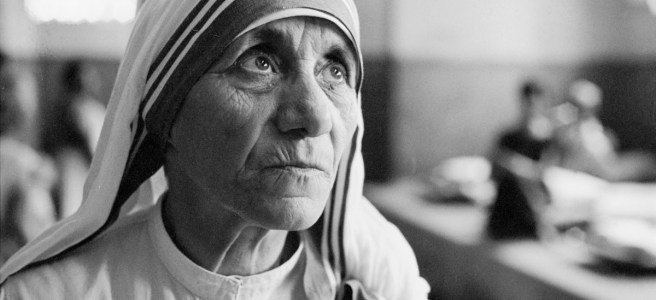
In the end, I want to grow in holiness no matter how uncomfortable it feels, so I decided it was time to read my first official work by a Saint. Since Mother Teresa of Calcutta (now Saint Teresa) was my confirmation Saint, it made sense for me to start there. I received a couple of books for my confirmation, and they’d been staring at me from my bookshelf for far too long. I read Where there is love, there is God over the course of about two weeks. It’s more a collection of things Saint Teresa wrote and said than a book she wrote from start to finish, but I got such an intimate glimpse into the person she was through it. I could see her simple, yet poignant theology in the stories she repeated, in the phrasings she came back to time and time again.

A few points that have particularly woven their way into my heart:

Humility is to accept humiliations. Wiping my baby’s diaper. Letting someone say something short to me without saying anything back. I had never really thought of humility like that before, and it was refreshing and rang so true.

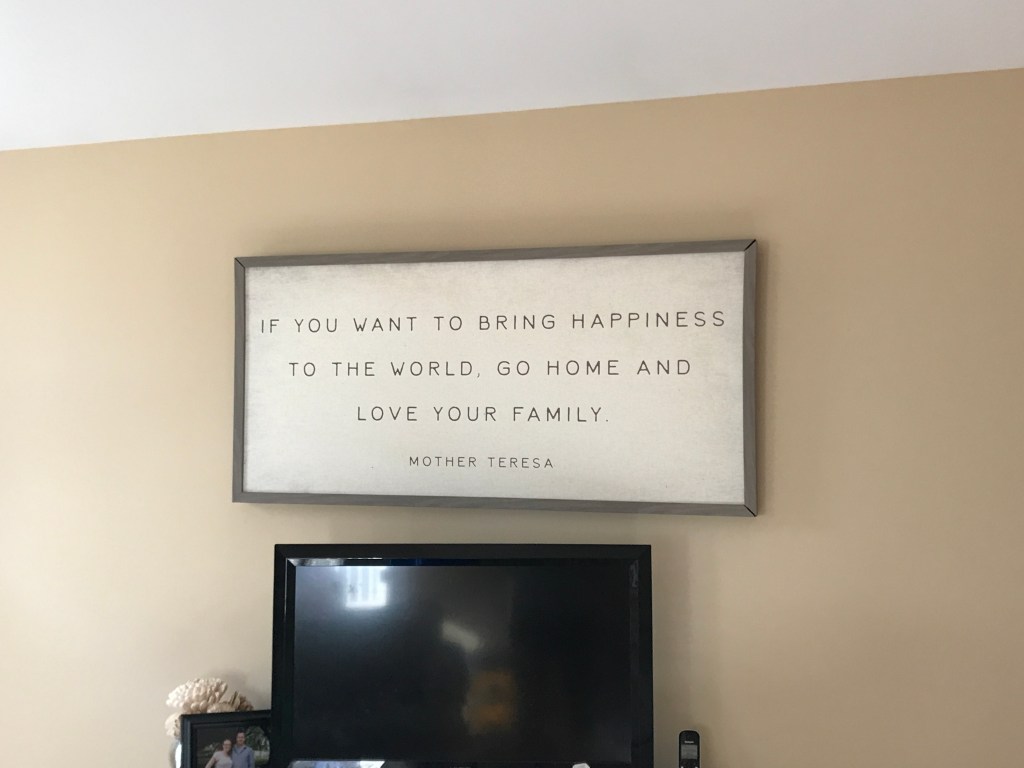
Love starts in the family. This was especially meaningful to me. I struggled for many years if staying home to raise my kids was ‘meaningful enough’ work according to some mysterious earthly standard. We have a framed piece of art in our living room with a quote from Mother Teresa, and we look at it every single day.

Seeing her broader perspective on this sort-of Theology of the Domestic Church, encouraged me in the truth I’ve been coming to accept more and more as time goes on: that my work here is vitally, beautifully important. Jesus says that when you feed the hungry and clothe the naked, that you’re doing it to Him. Saint Teresa helped me grow to understand that the little children living under my roof are the hungry one and the naked one too, and that by loving them, I’m also loving Jesus.

I also see my own sin the most at home in my family life, because I show it the easiest here. They’re the ones I lose patience with, or snap at if I’m stressed out. Because my interactions with them are such a clear mirror to my heart, they’re also the ones who give me the best chance to become a Saint. They’re the ones who I can learn to love well and patiently and fully, no matter what. They’re the ones I can most often offer dignity to in the big things and small, because they’re the ones I’m most often with.

Jesus thirsts. On the cross, Jesus said “I thirst.” While I’ve learned there have been different approaches to understanding His words, Mother Teresa’s is my favorite. Those words are displayed in each chapel of the Missionaries of Charity. Mother Teresa’s saw Jesus’s “I thirst” as a deep expression of how much he desires each and every one of our love, our souls, our all. And, therefore, she concluded, every act of love that we do is, in some mystical way, quenching the thirst of Jesus on the cross. It begs the question: have I quenched Jesus’s thirst today?

For love to be real, it has to hurt. This isn’t about staying in an unhealthy or unsafe situation, but it is about self-sacrifice and what it means and what it takes. We have the ultimate example of Jesus on the cross, because that was His love, full and true, given for us. And it hurt. My opportunities to love until it hurts are frequent but so much smaller than that- getting up when I’m exhausted to comfort a crying child, admitting that I was wrong and apologizing for it. The world has it so backwards when it comes to love- the world tells us that love should make us feel good, that it should serve us well. But it’s really the other way around. Realizing that to truly love means that I hurt because selfishness and sin is being put to death in me, well, it changes everything. I’ve been familiar with this way of looking at love for a while, but Saint Teresa put it so beautifully, and it made such an impression on my heart.

Do small things with great love. I think many of us have heard this quote from Saint Teresa a time or two. My three year old asked God to help her become a Saint yesterday, and a few minutes later I asked her to pick up a blanket from the floor and put it on the couch. She wasn’t sure she wanted to help, but I had the thought that she could probably understand what the idea of “small things with big love” meant. So I told her that one way to become a Saint was to start doing small things with really big love. Like even picking up that blanket for her mother. If she does that little thing with big love, then she’s letting God’s love into her heart more and more. Mother Teresa’s life was marked by some really big moments, but it was filled with many more small moments where she fed a hungry person, or washed a dirty person, or smiled at someone who needed to be seen. Even washing a dish or sweeping the floor can be done with love. That was a challenge to me, in a good way. It’s something small but significant that I can do in the dozens upon dozens of small, seemingly insignificant tasks set before me through the day.

Simple, Yet Profound

The funny thing is, Saint Teresa didn’t even feel close to God for most of her life. She felt his absense from her, but loved him with all of herself regardless of that. She used that sense of absence to unite herself with the lonely and abandoned in the world and to fuel her love.

And her theology was fairly simple compared to some. JP is reading the Summa Theologica right now, and it’s quite a bit heaftier both in weight and in wording than what I just read. But I think that’s one of the really amazing things about the Saints. Saints have been made from all kinds of people, all over the world, with such a diverse array of experiences. The Saints didn’t all start out holy, but they proved that it can be done. Here, now, while we live on earth. If they could do it, then maybe there’s hope that we can, too.

Turned out, reading Saint stuff wasn’t that scary at all. In fact, it was lovely, and challenging and inspiring. I haven’t fully decided who I’ll read next, but I’ve got my eye on Saint Zelie. We named our youngest after her, and I know I’m inspired by her life as a worker, mother, and wife. I think we have a lot in common, I’d love to gain some deeper insights into the person she was.

-Lorelei

Purchase Lorelei’s Books Here:

What’s The Deal with Catholic Guilt?

I think we’ve all seen or heard someone make a joke about “Catholic Guilt” at one point or another.

This article explores what Catholic Guilt is, really. And if it’s actually funny. Or, on the other hand, if it a misrepresentation of something meant for our good.

What is Sin?

It’s important to get on the same page about sin before we even attempt to talk about this issue. Let’s turn to the Catechism to get our definition.

1849 Sin is an offense against reason, truth, and right conscience; it is failure in genuine love for God and neighbor caused by a perverse attachment to certain goods. It wounds the nature of man and injures human solidarity. It has been defined as “an utterance, a deed, or a desire contrary to the eternal law.”121

1850 Sin is an offense against God: “Against you, you alone, have I sinned, and done that which is evil in your sight.”122 Sin sets itself against God’s love for us and turns our hearts away from it. Like the first sin, it is disobedience, a revolt against God through the will to become “like gods,”123 knowing and determining good and evil. Sin is thus “love of oneself even to contempt of God.”124 In this proud self- exaltation, sin is diametrically opposed to the obedience of Jesus, which achieves our salvation.125 

(emphasis mine)

Using this definition, I often break down the idea of sin to conclude it is any time where I choose to serve myself rather than another. It’s desiring my perceived good over my actual good. It’s refusing to love. And in refusing love, I am refusing God because God is Love itself.

Sin wounds my relationship with God, because I’m actively rejecting Him. It hurts my soul. It makes me sick.

When I think about sin now, I think about any one of us, if we gave in freely to our own passions, distorted from God’s good intent, might even find ourselves on earth in our own sort of personal hell.

Sin is serious business. But, thankfully, that’s not the end of the story.

My Protestant Practice

Before becoming Catholic, I didn’t spend a lot of time thinking about the ways I rejected  or blocked God (Love) out of my life. Some of the churches I attended would have a moment for such reflections. But it was usually just that, a moment. And, to be honest, in those moments I most often thought “meh- I think I’m doing pretty good, comparatively speaking.” I shake my head at my past self now. And I’m still not exactly sure who I was comparing myself to… those convicted of crimes against humanity? The people in pews beside me, as some sort of holiness version of keeping up with the Joneses? Just the general sense that, in the grand scale of humanity, I was doing okay?

And then the service would move on and I would move on and I continue along my merry way. I knew I could ask God for forgiveness, but as someone who had come from a Once Saved, Always Saved tradition (for much of my life), I didn’t have an ingrained sense that my confession mattered. I had ‘invited Jesus into my heart’ as a child. And if you are Once Saved, Always Saved, then the moment you say that prayer, it’s a done deal.

Now, you can read more about how I learned that perspective didn’t fit with my actual life experience in my Coming Home Network conversion story by clicking here, but suffice it to say, I had accepted Jesus as a child, then possibly crossed over into rejecting Him as a young adult before I made my way back through the Catholic Church.

I learned through that journey that my choices do matter. They have eternal impact. And yes, everything good I do is by the grace of God, but I’m not an automaton. God can work through me to show his love and healing to this world, but He needs my yes to do it.

And so I’d better pay attention to the areas in my life where I’m letting Love in, and also to the areas in my life where I’m not.


The Value in Examining Our Conscience

I worry about the fading of the concept of confession in general as the trees of Christian separation continue to branch farther and farther away from their historical roots. And I have personally found immense value in examining my conscience on a regular basis, followed by a good Confession.

But first, what is an Examination of Conscience?

An Examination of Conscience is a beautiful exercise we do as Catholics, where we take stock of our lives and our heart. We spend time praying about and thinking about the areas where we are letting God (Love) lead the way, and the areas where we are turning from Him (Love) and choosing to serve ourselves first. We take an honest look at where we are being selfish, or prideful, or fearful, or careless, or impatient, or any number of things.

There are many ways to examine our conscience. Click here for a link to some excellent resources that walk you straight through the entire process.

But we don’t just leave it there when we’re done. We aren’t meant to just acknowledge our shortcomings and sit around feeling bad about ourselves. We know we have the ability to make a change. We can grow in virtue and holiness. We can turn our “No” to God, into a resounding “Yes.”

Once we have examined ourselves, we are ready to make a Confession.

Confession: A Healing Sacrament

It’s no secret how much I love Confession.

Confession is so many things. But one thing it is not. It is not a rote recital of our wrongs just for the sake of checking an item off a list.

It is a Healing Sacrament. And for good reason.

When we go to Confession, we sit before a Priest, who is standing in place of Jesus for us. We share with him those struggles we identified in ourselves. And we receive, not only God’s forgiveness to us, but we also receive penance, our medicine to help heal the wounds created by our sin.

We leave Confession with the Grace of God to continue to say yes to Him. And if and when we fail, we know Confession is always there, to help us right our path. To help us to learn to love others better than we could on our own. To help sanctify us, and to flood us with God’s Amazing Grace so we can effectively live as His hands and feet.

Back to Catholic Guilt

Nothing about the Catholic Church desires for us to hobble around, eternally burdened by our shortcomings. And long story short, anyone who has been haunted by Catholic Guilt in their life, has taken these beautiful practices meant for our own good, for our own healing, and for whatever reason, allowed them to become distorted.

When I’m carrying some burdens inside my heart, I might know it’s time to go to Confession. So I just set up a time and go. I know I want to let as much of God (Love) into my life as possible, and if I can be honest with myself about when I’m not doing that, then I can experience healing and let His Grace help me make different choices.

There’s a huge difference between the conviction we need to make something right, and then doing something to heal what we’ve broken, and the notion of “Catholic Guilt.” Guilt, when left to its own devices and void of the connection to healing, can turn us inward and makes us focus dangerously on ourselves. And when we focus on ourselves, we are entering a realm that is unhealthy for our souls. We are entering the realm of sin. 

So, no, Catholic Guilt isn’t funny. It’s actually probably a sign that someone has experienced pain in some form or another inside the Church, and have not yet found their way to the healing. If we know people who struggle with this, or who have left the Church because of it, it is so vital that we live Grace in our own lives. Forgiveness in our own lives. The joy of healing in our own lives.

We have the opportunity to be an example to those who misunderstand our faith, to those who are seeking, and to those who might be confused. Let us be an example of the Church’s beauty as we seek, more and more each and every day, to choose Love.

-Lorelei


Purchase Lorelei’s Books Here:

Being “Gift” In A “Take” World

The Disease of What’s Best for Me

There is a disease rampant in our world today. A disease called “What’s Best for Me.”

Entertainment programs are filled with tips on how to make our lives better. How to get the best deal. How to make ourselves look good. How to advance in our careers. How to make more money. How to improve our existence.

And we absorb that culture, particularly if we live in a part of the world where we are saturated with it. Unless we actively counteract the messages we receive, they absorb into us, and we end up reflecting the approach of the world instead of the approach of our faith. Unlike what we see and read and hear every day, happiness isn’t found in improving our lives and seeking our benefit. The Catholic Church teaches that happiness is found in seeking to improve the lives of others, through a sacrificial donation of self.

To Will the Good of Another

At the core of this question is the idea of love.

To love, according to the Catholic Church, is to “will the good of another.” (Catechism of the Catholic Church, 1766). That’s it. It sounds so simple.

If we are married, love is to will the good of our spouse. If we are parents, to love is to will their good too. Whatever phase of life, to love is to will the good of those we encounter.

It rings so true when we hear it, but it’s so different from the culture we live in! And it is less easy to apply to our relationships each and every day than it seems. But if we live our faith, if we put our energies into absorbing the truths the Catholic Church teaches, living as gift becomes more and more natural, more and more a part of how we function and view the world. Our lives become all the more beautiful for it.

Being Gift in Choosing Life

Our parish Knights of Columbus just distributed baby bottles for us to collect change in, and that will go towards Right to Life causes. The tragedy of abortion is great in our world, and this is another example of where so many have bought into the lie of What’s Best for Me so much, that they are willing to support the legal right to end a human life.

The reality is that women have this awesome opportunity to live our lives as gift in a way unique from men. We give our bodies as a sacrifice to grow and nurture life. And pregnancy and raising children is, indeed, a big sacrifice.

But we have an amazing example of bodily donation as gift for another in Jesus.

Jesus lived as the ultimate and perfect self-gift. His own words, which we hear at each and every Mass, are: “This is my body, given for you.” He gave his whole self for us, and it’s a beautiful parallel to what happens when a woman sets aside her own comfort to bring life into the world.

“This is my body” is such a popular phrase in pro-choice culture. But they distort the beautiful meaning of the phrase. Those who fight for legal abortion say, “This is my body, and I get to do what I want with it. No one has the right to stop me.” Jesus says, “This is my body, and I am going to give of myself fully to turn the power of sin on its head and to heal the world.”

There is a clear winner between the two uses of that phrase. In goodness, in beauty, and in the truth of what our bodies are meant to be.

Living as Gift is life-giving. Living for self is life-taking, sometimes in the very real and literal sense in issues like abortion. But also, in the sense that each time we choose self over another, we take the essence of life – truth, beauty, love, from those we wound with our sin.

Living as Gift within Marriage

I spent more years than I’m proud of watching the popular TV show, The Bachelor.

That show sends the message that love is meant to make us feel good. That it’s exciting and thrilling. There is the unspoken belief that love will be like that forever. Like a fairy tale, it will make me feel good forever.

It sets up extremely unrealistic, unhealthy expectations. Nothing about even the concept of that show is willing the good of the other – one person dating upwards of 20 men or women at one time is not good for anyone involved. That’s one of the reasons I won’t watch the show anymore.

It’s distorted. It’s sending a lie about love. It perpetuates a belief that I can do what’s best for me, no matter how many people get hurt in the process.

If we understand what the Church teaches about love and Catholic marriage, the idea of Gift is one of the keys to living a marriage that stands as witness to God’s love for humanity. This occurs when the husband and wife are living as Gift to each other in all areas of the marriage.

When we encounter any situation with our spouse, and we ask the question “Am I doing this for his/her good?” we are letting God into our decision with our spouse. Before we say that sharp word, before we lose our patience, before we assume the worst, we can think about our partner’s good.

This applies in a special and beautiful way to our sexuality, too. Catholic teaching on sexuality isn’t meant to be repressive, and it isn’t without reason. The things we are not allowed to use/do in Catholic marriage – contraception, climax without intercourse, pornography, etc., are all forms of believing the “What’s Best for Me” lie. Contraception says “I’m going to give myself to you, but I’m not going to give myself fully.” Climax without intercourse says “I’m going to take from you, rather than give myself to you.” And pornography says “I’m going to take pleasure without giving anything at all.”

But when we live as Gift, when we respect the whole person of our spouse, including our fertility, when we give mutually and fully to each other, each and every time, that is where the beauty lies. The joy of sex isn’t in finding the best way to feel good for ourselves. It’s in mutually seeking the good of the other in an all-encompassing and powerful way. A way that mirrors the life of the Trinity and foreshadows heaven.

A Disease of Humanity and the Cure

Reaching for goals and working to improve are all positive things. But when those things are distorted, and we start pursuing our own betterment even when it is to the detriment of others, then we do have a problem. When we seek our own comfort first, or own best first, when we forget to be Gift to those around us, then we have become sick.

If we live with a What’s Best for Me mindset, we will never be as happy as we could be. We will never have the peace we could have. We will never find the joy. We weren’t meant to be satisfied with the things of this world. We were meant to be satisfied with God. It follows that living life as God intended will bring us the greatest true fulfillment.

The ultimate way we can serve God is by living our lives as a gift in gratitude to our Creator. All of the above examples help to lead us in that direction. The realization that our lives are, ultimately, not our own, that each and every day is a gift from God helps us release any false control we have tried to cling to. None of this is ours. Life is gift from God. It’s meant to be lived as Gift to God and others.

The Me First disease is more than just an American problem. It’s a humanity problem. A result of original sin, when Adam and Eve were the first to believe the lie that eating the fruit was what was best for them and their own personal goals and advancement.

But the Church gives us this beautiful remedy to the sickness. The remedy for the poison that is What’s Best for Me is a firm commitment to What’s Best for You, to living life as Gift. It turns selfishness to selflessness, greed to generosity, and taking to giving. Living life as gift reverses the darkness of sin and let’s God’s light shine through. That is a powerful witness to a world that has absorbed a dangerous lie.

For more information on living life as “Gift,” please see John Paul II’s Theology of the Body, or check out Theology of the Body for Beginners by Christopher West.

Note: This article was originally published on Catholic Stand.

Why Are Catholic Sermons So Short?

This letter is free for you to read, but it wasn’t free for me to produce. If you’re interested in supporting the work of This Catholic Family, I would be honored if you would prayerfully consider upgrading your subscription. Or, you can always buy me a coffee here.

They’re so Short!

Something that was always strange to me as a Protestant attending Mass was how short Catholic sermons are. Well, technically we call what happens when the Priest speaks after the gospel reading a homily, but homily isn’t a word seen too often outside the Catholic realm.

The priests seemed to have varying degrees of preparation in their message, and it varied from a minute to about ten minutes at most. It varied greatly in level of depth. Sometimes it was more an encouraging word than a message at all.

I thought, what’s the deal with this?

At every single non-Lutheran Protestant Church I attended, there was a sermon. And the sermon was comparatively long. 20 minutes was normal. Some could go over 30. If the sermon was good, I left church feeling challenged and uplifted. If it was just okay, I might have been disappointed.

Expositional Preaching vs. The Homily Objective

There is a big movement right now in the non-liturgical Protestant realm towards expositional preaching. Where a pastor delves deep into a passage of scripture, often going through entire books of the Bible in an extensive sermon series. The pastor delves into the historical, cultural context, along with the original language and preaches on what he or she concludes after that extensive study.

This makes sense in the Protestant world because in Protestant churches, the sermon is the pinnacle of the service. Everything, the music, the offering, the reading (if there is one before the sermon itself), builds up to the sermon. The sermon is, structurally, the main event.

The homily, on the other hand, is meant to be an application of the readings for the day.

More in-depth study of the Bible is available to Catholics, (and should be used!), in a variety of different formats. There are Bible Studies, books, and video and online resources for in-depth delving into scripture. The readings for each day are thematically connected, and resources are readily available each day from a variety of different sources that delve into the readings. It’s been amazing to learn how connected the Old Testament is to the New via utilization of these resources. Here’s a link to one.

But the Mass isn’t ever going to be a place for lengthy, expositional study of Scripture.

But why???

Simply put, in a Protestant service, everything builds up to the sermon.

But in Catholic Mass, everything builds up to something else.

The Eucharist

Christian Mass, and living the Christian faith, from the time of the earliest Christians, focused heavily on Holy Communion. Another word we use for that as Catholics is The Eucharist. The earliest Christians called it that too.

In many Protestant Churches, communion is served once a month, or twice a month in some instances, but this wasn’t always the case in the history of our faith.

As a Catholic, though we need to be in attendance on Sundays, there is actually Mass held every single day. And at every single Mass, the Eucharist is there.

josh-applegate-301321
Photo by Josh Applegate on Unsplash

The preparations for the Eucharist begin in concrete form after the prayers of the faithful.

Then, the liturgy of the Eucharist begins and takes us to the completion of the Mass.

Why is that important?

It’s important because Catholics, like the early Christians, believe Christ is truly present in Holy Communion. We believe we actually receive Jesus: body, blood, soul and divinity when we receive the Eucharist.

We believe this is one of the most intimate ways we can interact with our Creator while we walk on this earth. We believe there is grace there. We believe receiving the Eucharist on a regular basis helps strengthen our walk of faith, helps unite us to other Christians, and that, among other things, it helps us turn our hearts to God. We believe that just as Jesus took the form of a man, that he is with us still, in the form of bread and wine. That he instituted the Eucharist at the Last Supper. That he meant what he said in John 6.

When we kneel before the Eucharist, we kneel before our Savior.

Weirdness

As someone who grew up in a Protestant world, the things I just wrote would have been weird and offensive.

Communion was merely a symbol in my Protestant realm. It was more casually passed out, and more casually received. I ultimately concluded that this Catholic practice was so weird to me because it was unfamiliar. But just because I had never heard of something before, didn’t mean it wasn’t true. Imagine someone living a Pagan existence in a remote location of the world. The Gospel would sound pretty strange to them at first. But that doesn’t mean it isn’t true.

When deciding where my faith would land, I researched a lot of things extensively. Especially this. And I found only solid evidence that the earliest Christians, those closest to Jesus held that exact same belief as the Catholic Church about Holy Communion. That belief as Communion as a symbol was considered heresy. This may not be the case everywhere, but the churches we attended didn’t delve regularly into Church history. Especially not Church history on the Christian beliefs surrounding Communion.

I’ll probably dive more into this in another post, but if it was good enough for Jesus’ disciples, and their disciples after, and on and on through apostolic succession, then it was good enough for me.

Conclusion

So that’s why Catholic sermons, or homilies, are so short. Some are longer than others, and some Priests spend more time crafting them than others do. But Priests are really busy guys. They spend time visiting the sick, and being instruments of grace through the sacraments.

Besides, the sermon isn’t the main event. Jesus is. And, long homily or not, he meets us there, every single Mass, loving us and offering to us himself in the bread and the wine.

-Lorelei

Want to hear more from This Catholic Family?

Join us on Facebook!

Purchase Lorelei’s Books Here:

When Advent Doesn’t Go As Planned

Advent Interrupted

You guys, Advent was going to be so much fun! I was excited, and wrote this Very Catholic Mom Post about all the cool Advent family traditions we were going to start this year.

Now, before I write any further, I still am very excited for these traditions we (attempted) to start. They are concrete ways our kids can understand the season, and they are ways we as a family can come closer together and anticipate Jesus’ birth.

But… this Advent, almost nothing went as planned. But the toughest part was the health issues we dealt with as a family over the past two weeks.

Our Sunday Advent family dinners were interrupted Week 2, when Felicity (age 6) had a stomach bug. Several of the rest of us went down with a mild virus that week, which included several changes of sheets #ifyouknowwhatImean.

Our Sunday Advent family dinners were interrupted Week 3, when Mary got sick in her high chair. And the rest of us battled a stronger stomach bug through the first half of the week.

But then things took a scary turn. We had a hard time getting Mary’s fever down for over a day, her breathing was rapid, and she was not looking well. So I took her into the ER.

She was diagnosed with RSV and Pneumonia, and we were admitted for what would turn out to be a two night hospital stay.

Let me tell you… anyone who has ever had a sick child… you know. And my prayers are with anyone whose kiddo has a longer, more harrowing hospital stay than ours did. Because…

It broke me.

She’s so little. She can’t talk. She can’t explain how she’s feeling. She can’t fully understand. She was hooked up to fluids and an oxygen monitor, and poked and prodded and given medication.

Through that first night as her levels dropped, I stayed up holding an oxygen mask on the face of my sleeping child. As she worked hard to breathe, and fought to fight fever, I held her so she knew her mother was near.

There we were. Work, and school, and plans aside. Spending the some of the final days of Advent…

Taking care of a helpless baby that we love more than our own lives.

I would have traded places with her if I could. I wanted her back stressing me out by climbing on the coffee table, and on chairs, and finding hazardous things and otherwise keeping me on my toes.

Advents Past

In Advents Past, I have thought about Mary, heavy laden with child, preparing to give birth. That’s what I had hoped to do this Advent as well.

But, as the fluorescent hospital lights filtered through the blinds onto my chair where my baby slept, I thought of a different Mary.

A Mary who saw her baby suffer. Who stayed by his side. Who knew the anguish of watching her child in pain.

Sometimes knowing you aren’t alone helps. But I also knew I had someone who understood who could pray for me while I could barely summon the words to pray myself.

And it’s all connected, really, isn’t it?

Welcome To Our World

There’s a song by Chris Rice called Welcome to Our World that I watched with Mary on Praise Baby Christmas while she was sick, but before we took her in to the hospital.

One of the verses strikes that connection in a powerful way.

“Fragile finger sent to heal us

Tender brow prepared for thorn

Tiny heart whose blood will save us

Unto us is born”

-Chris Rice, Welcome to Our World

That little baby was going to grow into a man who would right all that is wrong. Who would heal us. Whose suffering would bring about our ultimate redemption.


And as Mary now sleeps peacefully in her own crib, there is so much to be thankful for. We’ve had a rough couple of weeks, but we are overall healthy, and we will heal. We have time together as a family coming up through the end of the year, so we can enjoy each other’s company. We have years to build our family traditions together. And so much more.

So whether our Advent is filled with family traditions that help us joyfully anticipate His arrival, or whether we have fallen upon some harder times, let us give thanks.

He is coming.

He is coming to fix all that is broken.

Come Lord Jesus.

-Lorelei


Purchase Lorelei’s Books Here:

Embracing The Crucifix

When I was growing up in various Protestant churches, and in all the Protestant churches of my adulthood, one of the few symbols on display in each church was an empty cross. Usually inside the sanctuary, front and center.

Catholic churches, as most probably know, are known for their use of the Crucifix. This practice is odd to some, and unacceptable to others outside of the Catholic faith.

This is why I have embraced the Crucifix.

What’s Missing In The Empty Cross

To start, I would like to share why I’ve come to the conclusion that the empty cross is a less-than-ideal representation of our faith. I’ve been told a few reasons why Protestant churches display only the empty cross. One reason is the idea that Catholics leave Jesus on the cross because we for some reason don’t focus on His resurrection… and that Protestants do focus on his resurrection, hence not leaving Jesus hanging up there. And another reason is that the idea of making “graven images” is clearly forbidden in scripture.

I remember even as a little girl, thinking that the empty cross didn’t make a lot of sense to represent our belief in and focus on the resurrection. Namely, the fact that when Jesus was taken down off the cross, and the cross was indeed empty … he was dead. It feels like to me, wherever there is an empty cross, we are basically displaying an empty instrument of torture. The cross was used to execute many, many people over the ages, including 2 others at the time of Jesus’ crucifixion itself. The cross is how Jesus died, but apart from Jesus being on it, it is an execution device upon which many others died as well.

I always thought that some sort of symbol of the empty tomb, or the stone rolled away from the door would be more appropriate to represent the resurrection. If we want to reflect Jesus risen, let’s make a symbol of the place He rose from, right?! No one else rose from the dead under His own divine power like Jesus did. Lazarus, too, rose, but it was only under the power of Jesus that he did that. So the idea of the empty tomb symbolizing Christ’s resurrection, if that is the ultimate aim of those who leave Jesus off the cross, would probably be a better fit.

Graven Images

And then there is the graven images argument. In my new life as a Catholic, I am so enjoying learning about the Old Testament and how Judaism points to The Gospel in so many different ways. But, as I’ve learned, when one looks specifically about God commanding the Israelites not to make graven images in Exodus, he’s telling them not to make graven images to worship. Not that they can’t make images ever. In fact, shortly after issuing that command, God tells the Israelites to construct two statues of angels for either side of the tabernacle. The Israelites were to make statues, or images of angels. They just couldn’t, and shouldn’t worship them.

Similarly, Catholics don’t worship the crucifix. What a crucifix does is help us focus our minds on Christ, and the love that he poured out for us in his redemptive suffering. Worship is reserved for God alone.

Love in Action

While I still like the idea of the empty tomb, I believe a cross depicting Jesus on it helps remind us of how great the cost of our salvation was, and how great God’s love is for humanity at the same time. Especially in America, we are generally so comfortable. Many, though not all, of us don’t have a context for extreme suffering. And the cost for our salvation was so, very great. Every time I look at a crucifix I see the love of my Savior and I am so thankful.

And, honestly speaking, sometimes, also, the Crucifix is hard for me to look at. I don’t like picturing Jesus up there on the cross and knowing that he needed to do that because of my sin. I also believe that just because it’s difficult to look at doesn’t mean I shouldn’t. I can’t imagine what it would be like to be Mary, seeing her Son up there, dying, and staying by his side. Not even all the disciples were there with Jesus at the cross. I wonder if I would have had the strength to stay. When I pray through the Sorrowful Mysteries on the Rosary, the crucifixion is by far the most difficult decade for me to meditate on. But I also take comfort that Peter, who denied Jesus 3 times and likely was not at the crucifixion, was still the man God called to be the first Pope of the Church.

Even though it is difficult to look at, the Crucifix reminds me of the abundant grace of God then, and now, and forever. Seeing the Crucifix enables me to raise up my eyes and be willing to carry whatever cross I have before me during any particular moment of any particular day. It helps me think on God more. And it helps me grow in my faith and joy at what was accomplished on Calvary and 3 days later. All good, faith building and life giving things.

Embracing the Crucifix has been another of the gifts of my Catholic faith.

-Lorelei

Note: This article appeared in its original form on my conversion blog, ProtestantInterrupted, in April 2016, and has been updated for This Catholic Family in November 2017.

Purchase Lorelei’s Books Here:

What Is Love?

I have to admit, whenever I think about this question the first thing that pops in my head is this:

https://giphy.com/gifs/saturday-night-live-jim-carrey-parody-12mgpZe6brh2nu

But Night At The Roxbury is not what we are here to talk about today. And, just a hunch, but I’m not sure those guys would be able to contribute too much to the conversation we are about to have on the true definition of love.

Love and Infatuation

Full disclosure: I watched every season of The Bachelor/Bachelorette for nearly ten years.

Most people (I hope) don’t take shows like that too seriously. But they really are a unique microcosm of the Infatuation Effect. The whole “I’m obsessed with you, you are my whole world” phase of relationships that are just getting off the ground.

But, as a culture, I think we do misunderstand infatuation for love in our own real lives. Infatuation is chemicals and hormones, and is wonderful and exciting.

But it isn’t love.

Love and Utility

I’ve been writing a fair amount about utility lately… the idea that we only give people value when we find them useful to us in one way or another.

I think, though, unless we actively counteract our tendency to relate to people in this way, the idea of seeing people for their usefulness is unfortunately rather innate.

A few examples:

In Childhood:

  • Befriending a slightly more popular girl in school in the hopes of raising your own social status.
  • Making a “trade” with a friend for a piece of candy because they have something you want, rather than because you want to give them something they desire.

In Adulthood:

  • Befriending people who might help give you the image of status/social life you hope to convey.
  • Relating your own kindness or generousity to a spouse in terms of how much they do for you.

Valuing people for their utility also  isn’t love.


So, What Is Love?

According to Aquinas, to love is “to will the good of another.”

If we love, we want the other’s good. This could be a friend, a spouse, a child, a relative, a stranger. We love them if we want good for them.

It seems so simple.

Tonight, my son fell and cut his chin on a sharp edge of plastic. I held gauze to his chin to stop the bleeding. It was a deep wound. We were at church, and I left immediately to go to the nearest pharamacy to get what I would need to take care of my boy. I wanted him to not be in pain. I wanted to help him heal, and quickly. In those moments, I loved him well.

I don’t always love well. This is something I’m sure I will be working on my entire life. Far too often I want the bigger piece of cake, the more comfortable situation, the first place in line. To be the receiver of good rather than the giver. It is something I think about and pray for. To love better. To will the good of others.

That’s one thing I love about the Examination of Concience. It helps us think about the ways where we put ourselves first, or had selfish motives. And it helps us turn back towards the true definition of love.

Some of my favorite Examination of Conscience questions are:

  • Do I work to protect the dignity of others when it is being threatened?
  • Do I recognize and respect the economic, social, political, and cultural rights of others?
  • Do I live in material comfort and excess while remaining insensitive to the needs of others whose rights are unfulfilled?
  • Am I disproportionately concerned for my own good at the expense of others?
  • Does the way I spend my time reflect a genuine concern for others?
  • Do I see all members of the human family as my brothers and sisters?

Reflecting on these parts of myself help me to know areas where I am self-focused, rather than other-focused. Areas where I will my own good first and above all else.

Truly loving another person is not easy for those of us who tend to like comfort. Who tend towards self-preservation. It is not for the faint of heart. Love takes faith, humility, perserverance, and the laying down of self for another.

In our faith, we have the perfect example of what it means to lay down a life for another. Jesus loved perfectly. He willed the good of all humanity above his own and thus redeemed it. And while we are not perfect, we can continue to turn our hearts towards that which is good, and seek to emulate the example set for us. There is unfathomable redemption in love.

And knowing the true definition of love is a good place to start.

-Lorelei


Purchase Lorelei’s Books Here:

Why I Pray To Saints

Praying to Saints is one of those big dividing lines between the Catholic and Protestant worlds. I was very against it as a Protestant. But what I found as I first began to explore the Catholic faith, is a lot of the confusion stems from different definitions of the same word, and an answer that can be found in Scripture about whether or not those in heaven can hear us at all.

The Meaning of The Word

‘Prayer’ is the word a Protestant uses when they talk to God. There is a connotation of worship when a Protestant uses the word ‘prayer’. This is why, as a Protestant myself, I firmly believed prayer was something reserved for our communication to God alone. I certainly didn’t want to worship anyone other than God, and therefore I wouldn’t be found praying to Saints or to anyone else in heaven.

When a Catholic uses the word ‘prayer,’ and are talking about prayer to God, then yes, we mean the same exact thing.

But I think the misunderstanding stems from a second use of that very same word. Because when a Catholic is “Praying to a Saint,” he or she is asking for someone in heaven to pray for us, just as we would ask a friend at church to pray for us. We are not worshipping Saints, or attributing anything divine to them. But, since they are already in heaven and are without the distractions of this life, Saints are actually great people to intercede on our behalf. Yes, we should and do pray directly to God, Jesus and The Holy Spirit. We begin and end all our prayers addressing the Trinity. But, just as we ask our friends on earth to pray for us, so, too, do we ask our friends in heaven.

Can They Hear Us?

This was another big one for me. Okay, sure, if we define Praying to Saints as simply asking for their prayer on our behalf, it isn’t such an odd practice. But, all that is a moot point if those in heaven can’t hear us.

A big scripture for me that addressed this issue was Revelation 5:8.

“Each of the elders held a harp and gold bowls filled with incense, which are the prayers of the holy ones.”

This verse makes it at least clear that those in heaven are aware of our requests to God, as they are holding up the bowls. Whether or not we ask the Saints specifically, I found it inarguable that they know our prayer requests, and also play an active role in presenting them to God. By offering the bowls up, they are in fact interceding for people on earth.

This is not to mention that those throughout all of Early Church history found it acceptable, and good, even, to ask for the intercession of the Saints in heaven. I found myself time and time again on my own personal journey, assenting the Early Church knew what it was doing.

Because of My Weakness

Another reason I pray to Saints is because of my own weakness.

I have three little kids running around at home. I’m often busy, and sometimes overwhelmed. It is really difficult for my brain to simmer down.

But I know the Saints are there. They don’t have those burdens. They can fervently intercede for me while I’m changing the baby, or while I’m at the grocery store, or tending to a scraped knee. I can pray then, too. But I fully admit I am weak in the area of praying without ceasing. All to often, I’m consumed by the task at hand and I simply don’t remember. It is a discipline I know I need to improve. The Saints, I hope, intercede for me on that issue as well. But, in the meantime, I know they are there, and the prayers of the faithful are powerful prayers indeed. I know I am in good hands.

Conclusion

There are many Catholic things I never thought I’d do. I’ll share more on that another time. Praying to the Saints is definitely one of them. But I am so thankful now for the souls in heaven that can intercede for me in my weakness.

I talk to St. Anthony when something is lost. I talk to St. Teresa of Calcutta about social justice issues. I talk to Mary, our Lord’s Mother, about being a mom, and raising kids. And I talk to Jesus about all that stuff too. Because by being Catholic, it isn’t always either or. This is another example of the very awesome Catholic “Both And.”

Just another of the many things I am thankful for as a convert to The Church.

Resources

Praying to Saints

Intercession of the Saints

Purchase Lorelei’s Books Here: