
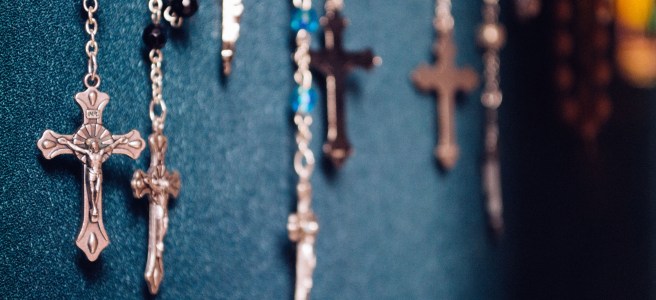
Embracing The Crucifix

When I was growing up in various Protestant churches, and in all the Protestant churches of my adulthood, one of the few symbols on display in each church was an empty cross. Usually inside the sanctuary, front and center.

Catholic churches, as most probably know, are known for their use of the Crucifix. This practice is odd to some, and unacceptable to others outside of the Catholic faith.

This is why I have embraced the Crucifix.

What’s Missing In The Empty Cross

To start, I would like to share why I’ve come to the conclusion that the empty cross is a less-than-ideal representation of our faith. I’ve been told a few reasons why Protestant churches display only the empty cross. One reason is the idea that Catholics leave Jesus on the cross because we for some reason don’t focus on His resurrection… and that Protestants do focus on his resurrection, hence not leaving Jesus hanging up there. And another reason is that the idea of making “graven images” is clearly forbidden in scripture.

I remember even as a little girl, thinking that the empty cross didn’t make a lot of sense to represent our belief in and focus on the resurrection. Namely, the fact that when Jesus was taken down off the cross, and the cross was indeed empty … he was dead. It feels like to me, wherever there is an empty cross, we are basically displaying an empty instrument of torture. The cross was used to execute many, many people over the ages, including 2 others at the time of Jesus’ crucifixion itself. The cross is how Jesus died, but apart from Jesus being on it, it is an execution device upon which many others died as well.

I always thought that some sort of symbol of the empty tomb, or the stone rolled away from the door would be more appropriate to represent the resurrection. If we want to reflect Jesus risen, let’s make a symbol of the place He rose from, right?! No one else rose from the dead under His own divine power like Jesus did. Lazarus, too, rose, but it was only under the power of Jesus that he did that. So the idea of the empty tomb symbolizing Christ’s resurrection, if that is the ultimate aim of those who leave Jesus off the cross, would probably be a better fit.

Graven Images

And then there is the graven images argument. In my new life as a Catholic, I am so enjoying learning about the Old Testament and how Judaism points to The Gospel in so many different ways. But, as I’ve learned, when one looks specifically about God commanding the Israelites not to make graven images in Exodus, he’s telling them not to make graven images to worship. Not that they can’t make images ever. In fact, shortly after issuing that command, God tells the Israelites to construct two statues of angels for either side of the tabernacle. The Israelites were to make statues, or images of angels. They just couldn’t, and shouldn’t worship them.

Similarly, Catholics don’t worship the crucifix. What a crucifix does is help us focus our minds on Christ, and the love that he poured out for us in his redemptive suffering. Worship is reserved for God alone.

Love in Action

While I still like the idea of the empty tomb, I believe a cross depicting Jesus on it helps remind us of how great the cost of our salvation was, and how great God’s love is for humanity at the same time. Especially in America, we are generally so comfortable. Many, though not all, of us don’t have a context for extreme suffering. And the cost for our salvation was so, very great. Every time I look at a crucifix I see the love of my Savior and I am so thankful.

And, honestly speaking, sometimes, also, the Crucifix is hard for me to look at. I don’t like picturing Jesus up there on the cross and knowing that he needed to do that because of my sin. I also believe that just because it’s difficult to look at doesn’t mean I shouldn’t. I can’t imagine what it would be like to be Mary, seeing her Son up there, dying, and staying by his side. Not even all the disciples were there with Jesus at the cross. I wonder if I would have had the strength to stay. When I pray through the Sorrowful Mysteries on the Rosary, the crucifixion is by far the most difficult decade for me to meditate on. But I also take comfort that Peter, who denied Jesus 3 times and likely was not at the crucifixion, was still the man God called to be the first Pope of the Church.

Even though it is difficult to look at, the Crucifix reminds me of the abundant grace of God then, and now, and forever. Seeing the Crucifix enables me to raise up my eyes and be willing to carry whatever cross I have before me during any particular moment of any particular day. It helps me think on God more. And it helps me grow in my faith and joy at what was accomplished on Calvary and 3 days later. All good, faith building and life giving things.

Embracing the Crucifix has been another of the gifts of my Catholic faith.

-Lorelei

Note: This article appeared in its original form on my conversion blog, ProtestantInterrupted, in April 2016, and has been updated for This Catholic Family in November 2017.

Purchase Lorelei’s Books Here:

Bill Cosby, Harvey Weinstein, Louis CK and Why We Need Theology of the Body More Than Ever

Scandals

I was too young to know much about the scandals surrounding Bill Cosby the first time around. Then, as time went on the media storm subsided and Cosby emerged as someone still able to find affection in the public eye. He was, if not The American Father, at the very least in the running for it. I remembered him as Dr. Huxtable, as the guy on the Jello commercials, and as the host of Kids Say The Darndest Things.

I saw him live with my family to watch his comedy routine in person- it was a fun, family friendly night.

But, when the accusations burst forth again in 2014, I was old enough to pay attention. Even without a conviction, and with only the knowledge of what Cosby has admitted to doing, there is something we as a whole find incredibly disturbing about his conduct.

Then, as name after name of male celebrities comes into the public eye, and similar, equally disturbing stories are told, we have to wonder… what is it exactly about this behavior that we know is wrong? Lack of consent? Yes. Abuse of power? Yes. A distorted sense of immunity? Yes. These and a myriad of other things.

But, I suggest, there is also a deeper underlying issue at the core.

Let’s Talk About Sex

What’s the point of sex? Well, it is the means by which we continue our species. But procreation is not the only purpose of sex. The other point of sex is that it is for the good of the spouses.

The Catechism of the Catholic Church states:

Sexuality, by means of which man and woman give themselves to one another through the acts which are proper and exclusive to spouses, is not something simply biological, but concerns the innermost being of the human person as such. It is realized in a truly human way only if it is an integral part of the love by which a man and woman commit themselves totally to one another until death

And how is that aim of benefit to the spouses achieved? Here’s the Catechism one more time:

“The acts in marriage by which the intimate and chaste union of the spouses takes place are noble and honorable; the truly human performance of these acts fosters the self-giving they signify and enriches the spouses in joy and gratitude”

Sex as Self-Giving


Jesus gave his body fully for us. He sacrificed himself for our good. And that is exactly what sex is meant to be. It is meant to be a husband giving fully of himself for the good of his wife, and a wife giving fully of herself for the good of the husband. It is an ultimate appreciation of the dignity of our spouse, through a total gift of ourself to him/her.

Anytime we do something other than that, we turn sex from a self-gifting act to an act of self-seeking. From giving to taking. From whole to broken.

Marriage and Church/Marriage and the Trinity

Marriage is often referred to in the Bible as a reflection of Christ and the Church. Jesus is referred to as the Bridegroom, and the Church as the bride. If we play that relationship out to its logical conclusion, we see the beauty in Christ’s sacrifice for us, and realize our job within marriage is to reflect the beauty of what Christ did for us as a witness to the world.

Marriage is also reflection of the Trinity.

God is a burning inferno of love, and that love between the Father and the Son ushers into being a Third, the Holy Spirit. And when a husband and wife love each other, it has the potential to bring about a Third. That love becomes so real and so tangible that another life is brought into existence from it.

Sex is powerful stuff. Not because we have a right to indulge for our own sake or pleasure, but because we have the ability to give the gift of ourselves wholly and fully to another human being.

When that gift is profaned and becomes a selfish act, it undermines the dignity of the humans involved and can cause great hurt and pain. People feel used, something inside us becomes broken.

Sex is meant to be a total gift of self. Nothing about it is meant to be selfish.

The Distortion of Sex In The News

That’s partly why the news stories coming out about famous celebrity males taking advantage of females in incredibly disturbing ways hits home. Those behaviors are the result of a myriad of things. Privilege, a hunger for power, pride. But they also stem from the view of sex as being something that ultimately we deserve. Sex is for us. Pleasure is something we take instead of something we mutually give. Sex becomes a carnival house mirror instead of a pure and true reflection of God and his love for humanity. A cracked and distorted facimile of beauty.

We can see so clearly in those examples that something, and yes, many things are broken.

But a distortion of what is meant for good can occur even within a Christian marriage. All Christians would benefit greatly from an exploration into Theology of the Body and diving deeply into the power of the purpose of human sexuality. If our marriages are meant to be a living reflection of the Free, Total, Faithful and Fruitful love of God, then it is vitally important that we know what we are being asked to reflect, and that we take seriously the responsibility and honor to live as Gift to our spouse.

If you are interested in learning more about the foundational Christian views on sex and marriage, please check out:

Or…

And, when we see these examples when good is perverted, let us know why it is we know, at the root of it all, that selfishness in any expression of sexuality, in any situation at all, is harmful and wrong.

-Lorelei

Purchase Lorelei’s Books Here:

Is Anyone Sola Scriptura? (Catholic Stand)

Note: This article originally appeared on Catholic Stand.

Coffee Shop Calvinism

I recently came across a group of men from the Reformed Church we left to become Catholic who were gathered at our local Starbucks. They were discussing theology, and didn’t notice I was sitting next to them for several minutes while they talked about things like “once saved, always saved,” TULIP, and other Calvinist doctrine. It was interesting to listen in on this discussion on some of the very issues that led me from that church and into a life as a passionate Catholic.

This is a group of men who are adamantly Sola Scriptura. But they left the coffee shop that day, not with Bibles in hand, but with thick-as-the-Catechism sized copies of Systematic Theology by Wayne Grudem clutched to their chests.

Is Anyone Sola Scriptura?

The belief in the sufficiency of Scripture, wherein one believes Scripture is sufficient to tell us all we need concerning the theological truths God desired to reveal to mankind, can only be believed to be true in light of accurate interpretation. Even to a non-Catholic it has to be, at the very least, Scripture + accurate interpretation.

The longer I look into these issues, the more I am convinced of the impossibility of truly being Sola Scriptura. Even the men from that Reformed Church, implicitly, are living out their faith through the interpretive lens of Grudem and his Calvinist interpretation of Scripture.

Now, this practical reality does not stretch as far as to encompass a Protestant substitute for the Catholic belief in Tradition and the Magisterium – and of course a Calvinist, for example, would say that even Grudem’s words are not infallible. But it does indicate heavily an implicit acknowledgement that Scripture requires an interpretive authority. We need to look at Scripture through some sort of lens. The importance of the accuracy of that lens cannot be understated because if we have a Bible, but can’t interpret it correctly, then we are in big trouble. And we can’t interpret it correctly on our own.

Who Do We Trust?

Even the strongest adherents to Sola Scriptura caution against a “Me, God and the Bible” approach to scriptural interpretation, though for many Protestant Christians, this is essentially what Sola Scriptura has become as denomination after denomination has diverged since the origins of the Reformation. What necessarily results is thousands upon thousands of Christians who are divorced entirely from any authoritative source, and they themselves become their own interpretive authority.

Others realize that we can’t divorce Scripture from its historical and cultural context, nor can we divorce it from the intent of the original authors, or the meaning of words in the original written language.

For those Christians, the question becomes: Who do we trust? How do we sift through the myriad of opinions on this section of Scripture or that? If the Bible is sufficient, how do we know what it is actually saying to the world? We are left on our own, or on the recommendation of our pastors, or the books of Christian authors and theologians like Grudem, Tim Keller, and others to help guide us in, what we hope, is the truth.

The “Ordinary Believer”

Reformed theologian Robert Godfrey writes: “The Protestant position, and my position, is that all things necessary for salvation and concerning faith and life are taught in the Bible clearly enough for the ordinary believer to find it there and understand it.”

But is this what we practically see in the Church? How does sufficiency come into play with issues that are clearly addressed in the Bible, but differences in interpretation lead people to different conclusions? Take baptism, for example. Are we meant to baptize infants, or should we only baptize those old enough to make an independent profession of faith? It’s clearly addressed in Scripture, but we cannot agree on a meaning. Or what about Holy Communion? Is the bread and wine truly the Body and Blood of Christ, or is it meant to be a symbolic representation of the same? It’s addressed in Scripture. But what does it mean? We cannot understand these things unless we have an interpretive source we can trust.

I do agree that the “ordinary believer” can find what he/she needs to know to understand the basics of the gospel and salvation in the Bible. My 5-year-old can understand that foundation. She knows we have sinned, and Jesus died for us and rose again so we can be with Him. She knows we need to live for God. All things we can find and understand at a basic level in Scripture. But, I don’t agree that all things necessary concerning faith and life are clear enough for the ordinary believer to find it and understand it. The “ordinary believer” does not have a thorough enough understanding of the historical and cultural context of Scripture, nor does he/she have an understanding of the original language of Scripture to understand all things necessary concerning faith and life.

A Protestant Christian living in America with an ESV translation of the Bible will come to some different interpretive conclusions than a Protestant theologian who has access to and understands the original languages of the text. This is why it isn’t a matter of whether or not we need an authoritative interpretive source. It’s a matter of in which interpretive source we place our trust.

The Ultimate Question

Even if a Protestant claims their interpretive source is fallible, they still need to rely on an interpretive source. And it will be the one they think holds most closely to the truth. A truth determined by their own best understanding of how to approach Scripture.

And, in my final months as a Protestant, the ultimate question for me wasn’t whether or not I believed Sola Scriptura. My ultimate question became which interpretive source has the greatest biblical, historical, and logical claim to truth.

When I acknowledged that the Bible requires a trustworthy interpretive source, I didn’t know it then but I was a few months away from receiving the Sacrament of Confirmation in the Catholic Church. I have not found any authoritative person or source to even come close in terms of historical and cultural context, original intent, logical coherence and consistency, and theological and philosophical depth. It is my hope that we as Catholics can truly appreciate the gift we have in the authoritative interpretive teachings of the Church. I also hope that my Protestant brothers and sisters will begin an intentional search to begin to ask the question of who they trust to interpret Scripture accurately, and that they acknowledge the importance of the answer to that question. And when they make those inquiries, I hope they give the Catholic Church an equal chance among the other options out there.

I know it’s changed everything for me.

Purchase Lorelei’s Books Here:

The Prayers of My Children

The Prayers of a Child

My kids, well the ones old enough to talk, talk to God like he’s a friend. They just tell him what they hope for in their own lives, and who they want to intercede for. Felicity for the longest time prayed for her preschool teacher who had a bothersome tooth. Auggie prays for his baby teeth to come out, which I think is his three-year-old way to tell God he longs to be bigger and more grown up. He’s had to show a lot of patience while waiting to be big enough for things like a big boy bike, and to be old enough to play soccer, and to be able to occasionally skip nap. They just lay it out, no holds barred.

Then we have our family prayers. Our kids know The Angel Prayer, where they ask their guardian angel to watch over them, The Lord’s Prayer, Good Night Dear Lord, and a few others, including the Hail Mary.

The Blessing of Continuity

And, though I never in a million years thought I’d send my kids to Catholic schools (particularly in my pre-Catholic days,) we have been so blessed by St. Lucy’s Catholic School, and our kids have only been going there for 3 months. Particularly, I’m loving the continuity between our home life, church life, and school life.

And a couple weeks back our kids came home with a mini rosary. Ten beads strung on pipe cleaners and twisted together at the end. That simple little tool has added a whole new layer to our family prayers at the end of many days.

IMG_2353.jpg

Felicity leads us in the decade, holding on to each bead as she prays, and we join in. I watch the ease with which she asks for Mary to pray for us. I feel peace wash over me as it so often does when praying a prayer I was once so afraid to pray. In the prayers of my child we settle in as a family and draw nearer to Jesus.

Unity At Last

It is such a visible, tangible, audible reminder of the unity of our family in faith. Ten years ago I didn’t know how we would handle our different faith traditions when we had children. I didn’t have much reason to believe that this level of unity would one day be a part of our lives. But I hoped and prayed for it as JP and I found our way.

And, as I listen to the simple and pure prayers of my children, I realize just how deeply that desperate prayer has been answered. And it is such a beautiful thing.

-Lorelei

Purchase Lorelei’s Books Here:

A New Catholic Reflects on the 500th Anniversary of the Reformation

500 Years

500 years ago some crazy business went down in the world of Christianity. And this Halloween, the 500th anniversary of that business, which we refer to as the Protestant Reformation, will be celebrated by some and mourned by others.

As someone who, just a year and a half ago, crossed the Tiber to become Catholic from a pretty solid Protestant background, all this hubbub about the 500th anniversary of the Reformation brings a lot of thoughts and feelings to the forefront for me as well.

I want to preface this article by saying that I have many amazing Christian friends who are Protestant. I love you all, and there is so much I look up to and respect about your faith. But the Reformation anniversary is hard for me, and my writing here details the reasons why my stomach sinks when I see posts celebrating what happened 500 years ago.

It’s the other side of the coin.

The Good Stuff, In Context

In some ways, I’m glad for parts of what happened. The Church did need some reforming at the time, and I believe that reform indeed occurred within the context of the Catholic Church. Some things were brought to light. Changes were made. Good changes. God changes. There is an excellent series by the Coming Home Network on the Reformation, and it touches on the components of the Catholic Church at the time that were in need of reform, along with many other social and cultural components that led Christianity to the brink of what became this massive division. It’s well worth a read.

I’m also thankful for the Catholic/Lutheran communications in recent years that are reopening the dialogue between us and paving the way for potential future reunification.

Sadness

But the rest of me feels sad about it all. About all the other repercussions. The unintended ones. The ones that are still sweeping through our world to this day.

I’m sad that so many of my Protestant brothers and sisters today are disconnected from the history of the Christian Church, with the exeption of some of the liturgical and high church denominations. There are many who can’t describe what worship looked like for the early Christians. The Protestant branch of the Christian church has, in some cases, moved so far from its roots that children being brought up in some Protestant denominations won’t even think that understanding those things is even a relevant question. We tread on dangerous ground when we forget our religion’s own Jewish beginnings, how those who lived in the time of Jesus practiced their faith, and those in the generations immediately following. When we forget the example set for us by those at our roots in the name of cultural relevance and keeping up with the times.

I’m sad that Luther is looked upon as a hero, but his very, very Catholic side is underplayed or ignored. On what authority can we say Luther had some things right, but not others? That his Protestant views were right, but his Catholic views were somehow errant leftovers from his Catholic days? The Reformation itself had absolutely nothing to do with some of his most Catholic views, including his beliefs about Mary and the True Presence (though his application of this belief became an area of division). Those things weren’t called into question until after Protestantism was born, until the church had continued to move far away from any authoritative source, eventually leaving thoughts on Mary to a few songs during advent and a statue in a nativity, and the foundational Christian belief in the Eucharist to Communion as merely a symbol.

Even John Calvin held some surprisingly, and often overlooked, Catholic views.

I’m also sad that Bible Alone Protestants don’t take issue with Luther’s interpretive addition of “alone” to the Bible when it speaks of being saved by faith. “Sola Fide” was not a thing until Luther himself made that interpretive decision and added that word. Was Christianity wrong on that until Luther came around? That’s a pretty big thing to have erroneous doctrine on for over 1,000 years if it’s true. And on what authority did Luther make the claim that all those years of Church history were wrong, but his own personal interpretation was right? I know there is a solid Biblical case for an authoritative source for interpretation, but I can’t find a strong Biblical argument that says each man is his own interpreter of scripture. God didn’t promise to preserve individual Christians in all truth- he promised to preserve the Church (John 16:13).

I’m sad that 30,000 plus denominations have split off since the Reformation and that this division was something Luther himself took issue with during his lifetime, writing:

“This one will not hear of Baptism, and that one denies the sacrament, another puts a world between this and the last day: some teach that Christ is not God, some say this, some say that: there are as many sects and creeds as there are heads. No yokel is so rude but when he has dreams and fancies, he thinks himself inspired by the Holy Ghost and must be a prophet”(citation: De Wette III, 61. quoted in O’Hare, The Facts About Luther, 208.)

I’m sad that few of my Protestant brothers and sisters think it important to seek out the answer to whether Holy Communion is a symbol or the real presence of Christ (the sacrament Luther refers to above). That belief was held firmly by Christians from the time of Jesus until after the Reformation, and is still held by Catholics today. The Bread of Life Discourse in John 6 is, I believe, a challenge for anyone who views communion as a symbol. It’s an important question. A very important one. I know, growing up Protestant, that the True Presence is a completely foreign concept to many who live their entire lives only having been taught that it’s symbollic. It’s sad to me, and again affirms the problem of a Christian denomination being so entirely cut off from the historical roots of our faith.

I’m sad that misconceptions about Catholicism abound. By the end of this month, 10,000 people will have visited This Catholic Family’s blog in 2017. A small dent, joined with the work of many, many others, hopefully can help put honest yet loving faces to this faith that doesn’t need to be so much of a mystery.

So if you have questions. I’m Lorelei. I’m very Catholic. I love to talk about it. I know my faith, and read my Bible, and worship only God, and pray to God in Jesus name, and believe I am saved by God’s Amazing and beautiful Grace alone. I also love Confession, and have Holy Water in my home, and believe in the True Presence, and pray the rosary, and believe that my decisions in this life matter and speak to the state of my soul. Do you have questions about those things? Ask them. I’m so happy to answer.

And finally, I’m sad that this year, division is going to be celebrated.

Jesus said that they may be one (John 17:21).

Not 30,000+.

One.

-Lorelei

Purchase Lorelei’s Books Here:

How This Catholic Family Approaches Mass With Young Children

Many Families, Many Approaches

There are as many ways to manage a family with young children at Mass as there are families that attend. Many people will have something different that works for them. I’m always on the lookout for ideas and have read several articles on what age appropriate expectations are, as well as articles with ideas on how to engage kids in our Catholic faith, both during Mass and throughout the week.

These articles have often been an encouragement to me, and I love picking up new ideas or being able to identify with a family who manages things in a similar way.

So, here is how our family approaches bringing our children to Mass. We have a 5-year-old, a 3-year-old, and a 9-month-old.

8 Ways Our Family Approaches Mass

1- We Bring Them

Each week, our family of five loads up in our car and goes to Mass together. Exceptions for this have been when a kid is sick, one parent stays back and the other parent takes the rest of the family. I think the fact that we do this each and every week, over time, will set a good example of the importance of practicing our faith. Even when we are out of town or on vacation, we find a Catholic Church and attend Mass together.

2- Expectations Vary By Age

When our daughter turned 5, we began expecting that she would follow along with the postures of Mass (sitting, standing, kneeling), and also to join in with the parts of Mass she knew. She now sings along with many of the congregational responses.

Our 3-year-old is expected to be quiet and not distract others. He sometimes joins in during some of the parts, but we aren’t requiring he follow every sit/stand/kneel yet.

More on our 9-month-old in a bit.

3- We Sit Up Front

We’ve tried many different seating positions, but have found, for our children, that sitting up front is the most conducive to a smooth Mass (at least for the older two). They can see what’s happening, and that helps keep them more engaged.

4- We Explain Things

We don’t insist that the kids be absolutely silent during Mass. But we also won’t talk about whether or not we are getting donuts after or other random things. They are more than welcome to ask us questions, quietly, or to point something out they notice in the church, or something relevant to the Mass itself. We also sometimes will explain what is happening, or note something interesting for them to pay attention to. These small things are done in whispers. It is important to me that if my kids have a question or are excited to notice something, that I validate their engagement. When it’s time for the Eucharist, we invite them to join us to come and see Jesus, even though they are too young to receive.

5- Activities

I’m a relatively recent Catholic convert (2016) and my husband is a revert. Just prior to becoming Catholic, we were at a church with a comprehensive children’s program, where our kids never were in church with us. They went to their own classrooms to play and have a Bible lesson for the entire service. So, going from that to having them in with us at Mass every week, was a bit of an adjustment for everyone, though I have come to enjoy having our family together each Sunday.

To start, we brought an activities kit, with coloring and notebooks. We also did some crackers and water. It’s what we saw as the best option to help our kids make the transition. Now, our daughter doesn’t use the coloring much at all because she is participating, and our son sometimes does, but often sits quietly. It was something that helped us. Our daughter also has taken to bringing her children’s Bible with her. We can sometimes turn to the story in her Bible that matches the reading, and definitely can turn to the Last Supper so she can draw connections between that and the Eucharist.

My hope is that parishioners can give families grace in this area. As a teacher, I know each child is so different. One kid might need something to fidget with the whole Mass. Another kid might be able to focus the whole time right away. And every possible thing in between. Having those activities helped our kids transition, and they are weaning off their dependence on them as they grow, and as we gain experience attending Mass together.

6- Taking Turns

Our 9-month-old is incredibly wiggly. She is constantly on the go. Right now, we try to start Mass with her in the pew with us. Typically, we can make it to the Gospel before she starts getting frustrated at the confinement we’ve placed her in. She wants to crawl under the pew, and out the side, and to eat the pew and make noises to hear the sound of her voice. My husband and I are currently taking turns bringing her out to the foyer, where we can hear the service, so she can get her wiggles out until she is old enough to know how to sit still. She’s just an adventurous baby, and she won’t be that way forever. The person who is out with the baby doesn’t experience Mass as fully as the other, but the Eucharist is there, and we are able to receive Jesus into us, even whilst in the phase of baby wiggles.

7- Special Masses

During the Easter Triduum this year, I tried something new that I think I would like to continue. During those special Masses, where some unique things occur (Holy Thursday Mass is an example,) I made my daughter a chart, with pictures noting certain things for her to look out for, like the presentation of the oils, the washing of the feet, the stripping of the altar. When she noticed each thing happening, she checked it off. It was a way to keep her engaged, and to start teaching her about these particularly important moments in our faith.

8- We Make It Special

We make sure to hold hands with the kids, or let them sit on our laps, or put our arms around them, and in general just make it a special family time. We want them to feel close to us, and to experience the faith together. We smile at the big kids when they participate in something new, encouraging them to keep it up. We want Mass to be a positive experience. Something they look forward to, most weeks at least, and something they see as part of our family identity.

Conclusion

Again, there are as many approaches to Mass with kids as there are families. This is just what has been working for us, at this phase of life. It always warms my heart to see other families with young kids at Mass each week. Bringing our children to Mass is one of many things we can do to help our children grow in faith and virtue now and for the long road ahead.

We’re all in this together.

(Note: This article originally appeared on Catholic Stand)

-Lorelei

Purchase Lorelei’s Books Here:

Finding Peace Amidst Chaos In Adoration (Catholic Stand)

(The article below originally appeared on Catholic Stand. Click here to read.)

Letters To God

While sorting through a bin of items from my childhood, I came across several pages of prayer journals. In different phases of my life, I would write my prayers to God in letter form. The letters are written in such familiar language, as though I was writing a letter to a best friend. They made me smile. Some of my letters were written during normal times where nothing extraordinary or desperate was happening. Others were written during relatively difficult periods of time. But they were all very honest and trusting. They were also all handwritten, which means I made the effort to steal away and share my heart with my God.

In particular, these letters reminded me that I am currently far from the place where make such a concerted effort to pray. I pray, yes. But they are shorter, more fleeting prayers: praying with the kids before bed, praying a Hail Mary during the day. There is a place for those prayers inserted into the daily routine, to be sure. But there is also, I think, a need and a place to slow ourselves down and let the world melt away and connect with our Creator on a more intentional level.

How Quickly We Forget

I have to smile and shake my head a bit at how, despite all the changes in technology and industry and convenience, human nature really changes very little. For example, the Israelites witnessed God parting an entire sea to save them from the pursuit of Pharaoh and sustained them with manna. They so soon forgot, however, and built idols made of gold. Similarly, I forget so easily the balance, peace, and joy that is in my life when I intentionally spend time with God.

I know, historically, that the times where I am the most peaceful, the most grounded, and have the most perspective are the times in my life when I make time to pray. There was the summer I babysat several days a week and, while the kids napped, I would spend the time in devotion. There was the spring I went through a break-up and met God daily in my sorrow. There were many times when nothing in particular was going on, and I just acknowledged it was important and made the time.

But then I get comfortable. I let my priorities subtly, yet consistently shift. In those phases of life, when fleeting prayers are all that sustains me, something significant is out of balance. I am quicker to anger. I am more easily burdened by the stressors of life. I lose perspective on what is truly important. The Israelites and I? We have more in common than I’d like to think.

Making God Time A Priority

I am always going to be busy, though as the years go on the business takes on different forms. In high school, it was extracurriculars, and calculus homework. In early married life it was graduate school and learning how to be a teacher. Now, it’s three children aged five and under who are always hungry and who leave a trail of toy wreckage in their wake.

My husband recently (and gently) pointed out that I have many Martha-like tendencies. I spin many plates. Most of them necessary. I spin the plates of meal planning, house-keeping, playing with the kids, writing, and planning ahead so our family has what we need. Anxiety doesn’t rule my life, but there is more of it that I’d prefer when I am always focusing on the plates I spin, instead of looking up beyond the plates, to the One who created these gifts in my life. The gifts of food to eat, and a home to keep, and children to love, and a brain that loves to create and plan.

Amidst the business, there must still be time for God. Yes, he is there with us in the chaos. But he is also there, waiting for us to spend time with Him. He is there, in the quiet of our bedroom, or backyard, or coffee shop. He is there, in the Eucharist at each and every Catholic parish. He waits for us there in a full and real and tangible way.

Finding Adoration

Prior to becoming Catholic, I had access to God in many beautiful ways and many beautiful places through my Christian faith.

But one of the many significant gifts I have access to now through being Catholic, is the gift of Adoration. When I am weary, when I am burdened, I can go to my parish, and sit with my Savior. After our Mary/Martha conversation, I knew I was past due for some time sitting at my Savior’s feet.

So I went to Eucharistic Adoration. I entered to the scent of incense, a symbol of the prayers of the people rising up to God. I didn’t go with any specific agenda, or prayer requests in mind. I just wanted to slow down and remember what it felt like to be with God.

Through the brief time I was able to spend in Adoration, I found it was difficult to slow down my ever quickly moving mind. I realized it’s probably pretty tricky for God to get through to me sometimes when my own brain is moving a million miles an hour. I need to remember to slow down. I didn’t have any lightning bolt revelations, or earth-shattering clarity. But I did have rest. How beautiful is it that God is always there waiting for us? He is there in Adoration, in the Eucharist, in all those created in His image, in the world He set into motion in a universe filled with stars, voids, gravity, and light.

He is so patient with us. He finds us where we are, and makes Himself available for us to come to him. Where he veils himself in something so humble as the bread and the wine. Which, when I think about the immensity of God, isn’t that different from when He veiled His glory in the body of a human man.

It humbles. It inspires awe.

And so, I will go again to the feet of my Lord until I remember how to slow down my mind, to sit and to be, and to let Him fill me with his peace and His love. Then, I know, I will be able to accept with peace whatever it is that may come my way. Perhaps next time, I will once again bring a notebook and a pen, and remember what it is to share my ordinary and extraordinary burdens and joys with my God. And then to put the pen down, be still, and remember what it is to listen and to soak in His love for me.

-Lorelei

Purchase Lorelei’s Books Here:

When Grown Ups Get Embarrassed (A Lesson in Parenting)

It’s been a while since I’ve been straight up embarrassed in public. Though I lean introvert, I can typically handle social situations in an appropriate manner.

This week, I was reminded how awful it feels to be embarrassed in front of others.

We were at the pool for Lissie’s swim lessons. I was sitting on the edge of the wading section, keeping an eye on Auggie (who was wearing a lifejacket), and also trying to keep the baby from freaking out at her lack of freedom while strapped in her carseat.

We’d been attending swim lessons all summer. 14 times to be exact. And I had spoken with a lifeguard a few weeks back about where I needed to be in relation to my son while he swam. I was told I needed to be at the edge of the pool, which is where I was.

I was surprised, therefore, that a lifeguard approached me at the last lesson pretty agressively and told me I needed to be within arm’s reach of my son.

I told him I thought I was doing the right thing, but it wasn’t a problem and promptly waded over to tell Auggie to stay close to me.

But then the lifeguard didn’t stop. He kept explaining the rule to me, loudly, even though I didn’t fight him on where he wanted me to be.

There were a lot of people at the pool.

I felt embarrassed.

I know he was trying to do his job and keep everyone safe, but it’s a weird moment when you think you are following the rules, but then someone keeps explaining it to you like you don’t get it for some reason or are going to fight him on it, even though you’re not.

I’ve never liked getting in trouble. I made it through school without a single detention. I cried once when I got a tally mark against me for talking in 2nd grade. I also cried when a very nice police officer pulled me over for speeding the one time I got a ticket.

I really, really, don’t like being singled out in public for a negative reason. And I think there is a much more respectful way to correct behavior, in both public and private situations.

Dignity and Teaching

I learned very early on in my urban teaching experience that my students responded a lot better to redirection if I did it privately, without embarrassing them.

There are a couple of kids I specifically remember. Kids who other teachers had a hard time getting to listen. Kids who often got phone calls home or one way trips to the office. But not with me. Why? Because the other teachers would scold them publicly, in front of their friends. And they would talk back in an attempt to save face.

When these same kids were approached quietly, privately, respectfully when the other students were working, things were different. They, more often than not, corrected their behavior, dignity intact.

I also tried as best as I could to assume the misbehavior was unintentional. There’s a big difference in approach between “Quit tapping that pencil on the paper- you know it’s distracting everyone!” and “You may not have realized this, but tapping your pencil that loudly makes it hard for me to focus on what I’m teaching. Is there a quieter way you could get your wiggles out?”

Understanding kid’s innate desire to be treated with dignity helped my teacher game more than I ever could have known. Kids felt safe in my classroom. They knew I respected them as people. And they were able to learn and trust that they were in good hands.

Dignity and Parenting

How many times a week does a kid get their behavior corrected? Judging by my own parenting experience, a lot.

I think it was good for my kids to see the pool incident happen. We talked about it on the way home. About how I wanted to say some not nice things to him, but didn’t, and how hard it is to control our tongues. We also talked about how he was in charge of the pool, and how I needed to be respectful of him, even though it was difficult.

We talked about how I just wanted to leave, and how I understand there have been times in the past when they have felt the same way, embarrassed by something so much that they wanted to go home.

I hope this helped, particularly our five-year-old. She is a child of Big Feelings. I hope it helped her see that grown-ups have Big Feelings sometimes, too. That we feel embarrassed sometimes. That we need to respect the people in charge, too.

I also hope this helps me remember to be sensitive to those moments when my kids are embarrased. To those moments when they feel like they aren’t in control of their life. When they are misunderstood. I think I was better at remembering these things in the context of a classroom than I am in the context of my kids at home. I don’t know why this is. Maybe because I don’t always get a ‘prep time’ each day when I can re-focus and re-charge. JP and I get a few hours while the kids sleep each night, but it’s not like there is ever any extended separation from the environment of home like there was when I left school each day and didn’t have to return until the following morning. It’s more constant each day at home. But it’s not an excuse to forget.

Thank You, Mr. Lifeguard

I didn’t like it when it happened, but that brief and uncomfortable encounter at the pool had a lot to teach me, and hopefully, helped me connect with my kids in a deeper way. It was a good reminder to me of what it feels like to have someone assume the worst intentions in you, and to publicly call you out on it.

I think it’s a good thing when we can take an uncomfortable situation and learn something from it. I’m thankful to that lifeguard. Though I didn’t appreciate his approach, I know he was trying to do his job well. His approach gave me an important reminder about how I handle things with the people I’m in charge of as their momma, and was yet another reminder of the importance of maintaining the dignity of those we encounter. No matter how big, or how small.

-Lorelei


Purchase Lorelei’s Books Here:

On Woven Sari Blankets and The Dignity of Man

I have trouble with eye contact. Not during job interviews, not at home with my husband and kids. But definitely in public.

I remember in middle and high school avoiding eye contact with others was a way to deal with my shyness. The subtle yet significant fear that I would look someone in the eyes and they would ignore me. That I would not be seen. So I made the first move, which was to not even try.

A lot of times now, I find myself in a similar boat, except I’m not as much paralyzed by shyness as I am by the fact that I’m wrapped up in my own thoughts about my own life. What I need to do next, what I’m going to write about next, what I need to cook for dinner. The kids, the house, the list of things I need to do.

By doing this, I miss a lot of people, and a lot of potential interactions with other human beings.

In The Image of God

It’s easy for me to look at a baby, or a child, and to see the spark of The Creator inside them. Less so when it’s the person in front of me in line at a busy grocery store, who painstakingly writes out a check a la my grandmother. But instead of noticing that and remembering my grandma fondly, I am mostly irritated I chose this line, and will be delayed a couple of minutes and I have ice cream probably melting in the car from my first stop at Aldi.

The thing is, the lady in front of me, too, bears the mark and the spark of God inside her. And she, therefore, is deserving of a certain and irrevocable level of dignity and respect. So is the slow driver in front of me. The man carrying a 12 pack of beer as he walks home from the liquor store on the corner. The woman on her cell phone waiting for the bus.

Recently, I tried running errands and making an effort to truly look at people. And as I did, to think Image of God every time. There’s still some residual shyness lurking about, and it’s more difficult than I thought it would be. But when I did succeed, when I did pay attention enough to conciously acknowledge someone’s inherent worth. When our eyes met and we smiled. Woah. That was a powerful moment.

People long to be seen. We want to know we have worth.

A Blanket of Woven Saris

I recently hosted a party for a company that sells things made by women survivors of human trafficking. One of the many beautiful aspects of these companies is that women, who once were in a position where they felt they had no choice but to sell their bodies, now make a fair, living wage creating beautiful products for export. In their work, there is now dignity where there once was shame.

I received a handwoven blanket as a thank you for hosting the party. It is made of vintage saris, all beautifully braided together by a woman named Nasima. I know this because she signed the tag. I was able to go onto the website of the company, and to learn a bit about her story, and how her job gives her freedom, and respect.

image-god-dignity-man-sari-blanket
My beautiful blanket.

The Creativity of God

When we, myself included, forget about the dignity within each and every human, bad things can happen. From the smallest to the oldest among us, we all bear the image of our Creator, and this is the primary source of our immense and intrinsict worth. Any time we mess with that, and start assigning importance or value based upon one’s size, or if they are wanted, or if they can help us get something we want, we forget Imago Dei. And we are all the poorer for it.

I am the first one to say it is my goal to look people in the eyes more. It’s a small step, to be sure, but if you take enough steps you end up at a different destination. I want to look at them and think Imago Dei. I want to offer a smile. I want them to know they are seen. I want to spend more time interacting with these image bearers and less time with the neverending lists inside my head.

As I do this, I hope to grow in awe and wonder at the diversity of souls on this earth and at the dignity of man and the creativity of God.

-Lorelei


Purchase Lorelei’s Books Here:

When Motherhood is Lonely

All The Lonely Mommas

Ever feel like you weren’t in the club?

Like people everywhere are talking about how thankful they are for their tribe or posting pictures of themselves online hanging out with their tribe and you feel like you’re standing in a corner of a room tentatively raising your hand, saying “Hey, I’d like one of those.”

I think there should be a parody of “All The Single Ladies,” and instead it could be called “All The Lonely Mommas.” At least then we’d have a cool beat to accompany the solitude.

Suffice it to to say, at times I’ve found this motherhood journey with young kids at home to be lonely. This is not to say that I don’t have friends and acquantences who I count on and like very much. I personally don’t have one cohesive tribe as much as I have packets of friends in a variety of different areas. I’m learning that’s okay, too. I don’t need to spend these years chasing after some mythical tribe where all my friends are friends with each other and we are all inseperable. This isn’t high school anymore, and, for some of us, developing a cohesive tribe has been a bit tricky to accomplish. I’m not really trying to accomplish it anymore so much as enjoy each individual friendship I have, as well as the ones I’m developing.

Working Mom/ SAHM

There’s also the loneliness accompanying whatever a mom’s work situation is. I’ve been both a working mom and a Stay At Home Mom (SAHM) in the past three years.

When I worked, I had some amazing co-workers that I really liked. But we were all teachers. And teachers are busy. So there wasn’t a lot of time to socialize during the day. We were too busy teaching little brains. I also, during that phase, felt disconnected from my mom friends who were SAHM’s at the time. I couldn’t go to the play dates, the play groups, the during-the-day mommy stuff that helps to fill the long days at home with kids. And I was often too tired at night to do anything other than sit on the couch. Especially when I was pregnant. Social engagements became few and far between, which was, indeed, lonely.

When I have stayed home, I’ve been lonely in the long hours and sometimes full days that go by without talking to another adult. I got better at scheduling enough during the week that I didn’t feel like I was going to lose my mind, but the hours, especially at the end of the day, can drag. As much as I love the cuddles and playtimes, and stories, I also acknowledge that it is often lonely too.

It’s Nice To Meet You

For me, its been getting better. Mostly because I have made uncomfortable decisions over the past few years, on and off, to make new connections and put myself in places where new connections are possible.

A co-worker has a kid the same age? Set up a play date. There’s a mom’s group where you live? Try it out. That mom also standing alone on the other side of the park? Say hello. There’s a chance she is feeling lonely too.

Keep putting self out there. Show up. Introduce yourself. Stick hand out, smile and say “Hi, I’m _____. It’s nice to meet you.”

Sometimes that’s all that will come of it. A short, but hopefully pleasant encounter chatting about your kids and the weather and this and that. That’s okay. But sometimes the conversation will flow freely. Sometimes, you’ll schedule a playdate. Sometimes, you’ll make a new friend.

But you’ve gotta be willing to take the hits with the misses. It’s a numbers game. If you keep putting yourself out there, it’s a matter of when, not if before you start making some connections with people that connect with you.

I think we all do each other and ourselves a service when we acknowledge “This is hard.” Or “I’m lonely.” So let me be the first to say “That’s me.” Totally. It’s come in waves over the past five years of motherhood, and it has been getting better but yes I have been and still am lonely sometimes. So let’s do something to change it.

I’ll begin.

Hi, I’m Lorelei. It is very nice to meet you.

What about you? How have you made mom friends? What have been your own challenges at this phase of life?


Purchase Lorelei’s Books Here: