The First Day I Chose to Go to Mass

This December marks the five year anniversary of the first time I ever went to Mass by choice.

I had been to Catholic Masses before…as a baby, for my own baptism and that of my brother. I had been to funeral Masses. A few weddings. I had begrudgingly and awkwardly joined JP’s very devout family at Mass when we visited them so as not to cause ripples.

But there was something very different about the first time I decided I wanted to go to Mass, the first time I chose it for myself.

The Pre-Conditions

First of all, the conditions to led me, a once anti-Catholic evangelical, to seek out a Catholic Mass in the first place.

I had gone from a very fervent young Christian, to a disillusioned young adult inside the walls of various Protestant churches over a number of years. I was struggling to reshape the faith of my childhood into something with the depth required for my adult experiences. My own journey of faith began as a strong believer when I was a child and teen, but transitioned to a life as a near-agnostic in my early 20’s. That shift called into serious question the Protestant doctrine of “Once Saved Always Saved” because my own experience proved that one can start out with true belief but deny it later on. Our foray through a variety of denominations brought me to doubt individual interpretation of Scriptiure- if it’s that clear, why do all these churches disagree on issues both big and small? I grew weary of the hyper-emotional structure of worship, and the expectation that I developed equating a good church service with feeling emotionally fulfilled.

To top it off, no one could tell me what the early Church looked like, just as I was beginning to suspect that the Americanized version of Protestant Christianity wasn’t it. I wasn’t sure if what I was looking for even existed, and if it didn’t, I didn’t think I could remain in good conscience a sola-scriptura, once-saved-always-saved, American Protestant for much longer. Or, if this was all that Christianity was, I didn’t know if I would remain a Christian at all.

Cue me, sitting on my sofa, realizing that among these and many other things, I was possibly starting to think like…gulp…a Catholic. I hungered for a connection to the history of my faith. I wanted something deeper than an emotionally-driven experience could offer. I wanted sound theological depth.

I didn’t really know how to bring this up to JP because I had persuaded him away from actively practicing his Catholic faith early in our marriage. But I sprung the question on him one snowy night in downtown Racine while we were out at dinner. I asked, simply: “Do you want to go to Mass?” Shocked, JP shared with me that he had been praying for our unity in private, and had himself felt like he was being led back to the Catholic Church.

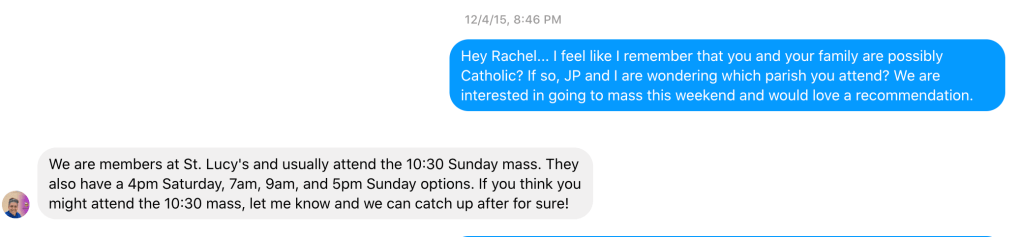
We got home from dinner and I sent a message to one of my friends, who I suspected might be Catholic:
The Mass Itself

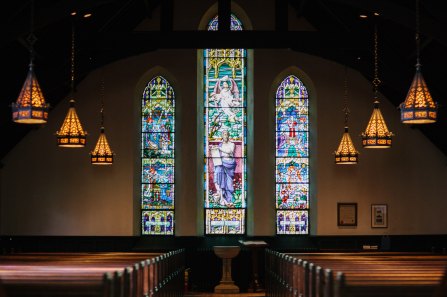
Two days later, on December 6th, JP and I led our (then) two children through the doors of St. Lucy Parish in Racine, Wisconsin for the 10:30 Mass. Even though I had been to Masses here and there, I didn’t really know what to expect, and I wasn’t entirely sure what to do throughout the different components. But, on that Sunday, my experience in a Catholic church that early Sunday in December was markedly different from any Mass I had been to before.

I had chosen to be there. And, at last, my heart was open to what I might find.

I don’t remember a ton of specifics, other than the distinct feeling that if what I was looking for existed anywhere at all, it likely existed here. The very Church I had sometimes ignored and other times argued against, certain that it was filled with irrelivant, extranneous, anti-Biblical teachings, now might just be my only chance to remain in the Christian faith.

I do remember that there were many families with young children sitting altogether in the pews, which impacted me because at the church we went to a the time, we sent our kids to Sunday School in different rooms. I remember that there wasn’t any sense at all that this service was designed to cater to me, another marked contrast to the hip coffee-house, welcoming committees of the Protestant churches we had recently attended. The music was traditional. The components themselves were somewhat foreign, and yet oddly familiar too. I caught in them some echoes of the fragments that Protestant churches have held onto- Scripture readings, an act of contritian, Communion. But here, inside the Catholic Mass, they weren’t fragments of some lost, greater whole. I remember trying to piece together how it was I grew to be so anti-Catholic in the first place, when it was clear I knew so little about it.

The Aftermath

My friend met us after Mass and, after expressing my continued interest, she helped us get connected with RCIA at St. Lucy’s. We enrolled immediately. Inside the walls of that little RCIA room, I asked every question my heart had been wrestling through, knownig that I had to leave everything on the table. Based on what I had seen in multiple Christian churches over nearly 30 years, if the answers couldn’t be found in the Catholic Church, then they probably couldn’t be answered by anyone, and the Christian faith was a sham. One week later, we attended my last church service at the Protestant Church we had been a part of. I have many friends who love Jesus who remain Evangelical, but I could no longer look at it the same way as I once had.

And the rest, as they say, is history. That early December night, where the snow fell like wisps of cotton outside the restaurant window, when I asked JP if he wanted to go to Mass, was less than four months away from the day I’d stand in front of a full Cathedral in St. Paul Minnesota. Easter Vigil, 2016, when I was confirmed into the Catholic Church.

Protestant churches do a really good job of making new guests feel welcome. They greet you, connect you with a small group, offer you donuts and coffee. They give you great concert-quality music and an inspiring message. My first intentional visit to a Catholic Mass didn’t contain any of those things to the same extent I had been used to before. But I didn’t need any of that to be drawn in to the Catholic Church, at least not once my heart was open to it. The Mass drew me in, not with bells and whistles and trends and the promise of friendship with other people like me. It drew me in with beauty, and history, and, above all, rock-solid Truth.

-Lorelei

Purchase Lorelei’s Books Here:

10 Tips for Those Entering The Catholic Church This Easter

Two years ago this Easter Vigil, I entered the Catholic Church. Here are 10 things I found helpful when approaching my own Confirmation. I hope they are helpful to any of you out there who will be Confirmed this year! Several of the items on this list are helpful for us all to remember, no matter how many years we have been a part of the Catholic faith.

1. Go to Confession

This is a good idea for anyone as we come up to Easter. Let us make sure we are turning towards God in our lives, with our choices and our heart, so we are ready to receive Him and celebrate the joys of Easter Sunday. Let us bring our struggles before God, and let him help us change. Let us get right with our God.

2. Go to as Many Services as You Can

The days leading up to Easter Sunday can be a profoundly spiritual experience for someone entering the Catholic Church. If you can attend the Triduum services, that is amazing. It helps put our faith into context as we approach this most significant celebration. It gives you time to pray, to connect with God, and to prepare your heart.

3. Look Around

When you stand in front of the congregation on Easter Vigil in the moments after you are anointed with oil and confirmed into the Catholic Church, take a moment to look around you. Take a moment to appreciate that you are in full union with the Church established by Jesus himself 2,000 years ago. The Church that has remained connected to its history and its source through apostolic succession. You are connected, in the most powerful way on earth, to the roots of your Christian faith.

4. Take Pictures

I am so thankful to have pictures from the night of my Confirmation. I can just see the joy on my face. It takes me right back there, right back to that moment when I knew I was finally, and fully home- as much as I am going to be before heaven. Whatever your path to get here, it’s worth recording and remembering and celebrating. It’s a hugely significant moment in your life. Document it.

Lorelei_Savaryn_Easter_Vigil
Yay Catholic!!!

5. Reflect

When my own Confirmation approached, I took some time to look back and was so, so thankful for all the bits and pieces along the way that led me to find peace, and Truth, and such a firm foundation. So, take some time. What was your path like to get here? Was it smooth, difficult? Did you wrestle through doubts or did you walk a path of peace? Where do you see God’s hand leading you? Who were the people who helped you along the way? How would you tell your story? However you got here, it’s beautiful. It’s amazing. Give it the weight it deserves, and be sure to give thanks.

6. Get Connected with Other Converts

One of the things that helped me the most,both when things were good and when things were difficult in my transition to the Catholic Church, was being connected with other converts. Regardless of how similar or different our backgrounds were, I found I had so much in common with those who walked the path before I did, in so many ways. This gave me encouragement and strength. It still does to this day. This connection can take many forms. I read stories of converts in books like Journey’s Home. I joined the Coming Home Network, which provides resources, articles, and community online and in print for those of us making our way back to Rome. Watch Journey Home episodes on EWTN. Keep an eye open for other converts in your parish. We all share a common bond. Let’s continue to walk alongside each other even after Confirmation.

7. Go Big

One of the most fun things for me around the time of my Confirmation was getting caught up on my Catholic “Swag.” I was so excited to receive some Rosaries. We got a Mary statue for our backyard. Bought some books on the Saints. Put up a legitimate crucifix in our home. Holy water font. Had things blessed by a priest. I gotta be honest, the weeks leading up to Easter still get me excited and I just bought this Nerdy Catholic Tee (not making fun of it- that’s what the company is called!)

mockup-57853159.jpgMy lovely, but cradle Catholic husband asked me what on earth that meant. When we become Catholic, we call it Crossing the Tiber. And this shirt is awesome. So, if you are feeling inspired, add some of those items to your own life and home. They are tools to help us keep our faith in our hearts and minds at all times. They are tools to help us reflect, remember and pray. And, at least in my case at the time, I had some serious catching up to do.

8. Study up on Easter Vigil

Friends, if you have never been to an Easter Vigil service before. It is amazing and beautiful and symbolic and The. Best. It is also long. It will help so much if you can take some time to understand what is happening and why at each part of the service. Here’s a primer on the USCCB website. I found I was able to embrace the beauty of the Catholic Church once I understood what it was. You will be able to get the most out of the service if you do too.

9. Be Patient

If you are already connected to your parish community- great! If you don’t yet feel connected, I encourage you to keep pressing on. Sometimes it takes time to get to know people in a Catholic parish. This is a huge, global church. Depending on the background you are coming from, and depending on the parish you attend, many things might be different from what you’re used to. There might not be an active home/small group structure, there might not be donuts and coffee after Mass. But there will be people there that you will connect with. It might just take some more time. Two years in, JP and I have found some very dear friends in our parish, and in the Catholic community in our town. We recognize people at Mass on Sunday and stay for a bit and chat. It didn’t happen overnight, but somewhere between year 1 and year 2 we got there. We weren’t feeling lonely anymore. Not only do I now know I’m spiritually home, but going to Mass actually feels like home in the way of the fact that our parish family is there with us too. Be patient. Connection will come.

10. Celebrate!

Whether you will be alone with your sponsor at Mass on Easter vigil, or if there will be pews filled with people who have come alongside you on that day, Confirmation is something to celebrate. Celebrate in whatever way is right for you. A dinner before Mass, some time in Adoration, taking a walk, announcing it to the world. Stay true to yourself, but celebrate. Celebrate the beauty of Easter, the beauty of our faith, and the beauty of crossing the bridge into full unity with the Catholic Church.

-Lorelei

Purchase Lorelei’s Books Here:

3 Awesome Tools To Help Children Engage in Mass

Engaging Kids In Mass

We love that our kids are in Mass with us on Sundays, but it’s always helpful to find tools that help them understand more of what is going on and that support them as they grow in their ability to engage.

Below are three tools This Catholic Family has found that do just that.

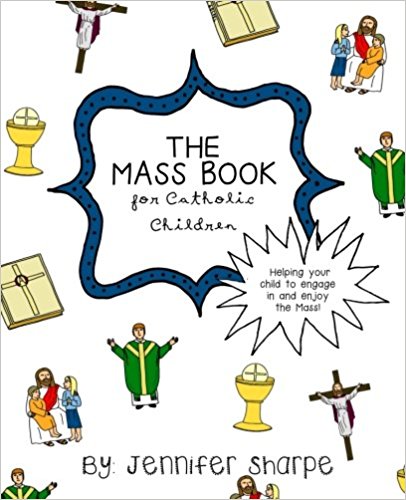
1- The Mass Book For Catholic Children, by Jennifer Sharpe.

51gohkzvDxL._SX404_BO1,204,203,200_

This guided journal has been very helpful for our six-year-old.

She isn’t yet an advanced reader, but there are many components of the book she can use now, as well as some that she could grow into. I love how both writing and drawing are incorporated. For example, she can write in a prayer intention for the day and also draw a depiction of the gospel reading. Some of Felicity’s other favorite parts are coloring the vestments on the Priest and tallying the number of times “Jesus Christ” is said in Mass. The checklists for preparing to enter Mass and for preparing to leave Mass are also great tools.

Felicity is a very active girl, both in movement and in using her brain. Felicity says The Mass Book for Catholic Children helps her have fun and gives her something to do during Mass, but in a way that also helps her pay attention.

As a teacher, I know many children need concrete tools rather than just observation to help them develop a deep understanding of a concept, event or topic. This book is a great way to help support children as they grow in their understanding of our faith.

2- My Mass Kit

My kids love to play pretend. We have princess costumes, firefighter costumes, builder costumes, and all sorts of tools for imagination fun. Dress up and games of pretend helps them internalize the real world, and find their place in it through play.
product_weeDiscover_mymasskit_1_grande_7c08d718-3874-4bea-96d4-6d118d20d025_1024x1024.jpg

Now, they can use this sturdy kit to reenact what they see happening each Mass, and gives them a way to internalize Mass through playing pretend. We love to talk about what each of the different items is used for. One of our favorite Mass Kit memories is when JP’s siblings were over and the kids lined us up to distribute communion. Such a great tool!

3- Our Example

This one is totally free. 🙂 When our children see us looking forward to and engaging (as much as we can with young kids) in Mass, it sets an example for them to follow. Our lives and actions speak louder than our words, and our attitude towards Mass and participation in it will stick with them in a very powerful way.

Conclusion

We hope you found these tools helpful! It’s always good to give kids tangible ways to connect with their faith. One of our deepest prayers is that our kids will grow up with a living and active faith of their own. Incorporating these things into our family life is one way we are helping build for them a solid foundation.

-Lorelei and JP

Purchase Lorelei’s Books Here:

Why Are Catholic Sermons So Short?

This letter is free for you to read, but it wasn’t free for me to produce. If you’re interested in supporting the work of This Catholic Family, I would be honored if you would prayerfully consider upgrading your subscription. Or, you can always buy me a coffee here.

They’re so Short!

Something that was always strange to me as a Protestant attending Mass was how short Catholic sermons are. Well, technically we call what happens when the Priest speaks after the gospel reading a homily, but homily isn’t a word seen too often outside the Catholic realm.

The priests seemed to have varying degrees of preparation in their message, and it varied from a minute to about ten minutes at most. It varied greatly in level of depth. Sometimes it was more an encouraging word than a message at all.

I thought, what’s the deal with this?

At every single non-Lutheran Protestant Church I attended, there was a sermon. And the sermon was comparatively long. 20 minutes was normal. Some could go over 30. If the sermon was good, I left church feeling challenged and uplifted. If it was just okay, I might have been disappointed.

Expositional Preaching vs. The Homily Objective

There is a big movement right now in the non-liturgical Protestant realm towards expositional preaching. Where a pastor delves deep into a passage of scripture, often going through entire books of the Bible in an extensive sermon series. The pastor delves into the historical, cultural context, along with the original language and preaches on what he or she concludes after that extensive study.

This makes sense in the Protestant world because in Protestant churches, the sermon is the pinnacle of the service. Everything, the music, the offering, the reading (if there is one before the sermon itself), builds up to the sermon. The sermon is, structurally, the main event.

The homily, on the other hand, is meant to be an application of the readings for the day.

More in-depth study of the Bible is available to Catholics, (and should be used!), in a variety of different formats. There are Bible Studies, books, and video and online resources for in-depth delving into scripture. The readings for each day are thematically connected, and resources are readily available each day from a variety of different sources that delve into the readings. It’s been amazing to learn how connected the Old Testament is to the New via utilization of these resources. Here’s a link to one.

But the Mass isn’t ever going to be a place for lengthy, expositional study of Scripture.

But why???

Simply put, in a Protestant service, everything builds up to the sermon.

But in Catholic Mass, everything builds up to something else.

The Eucharist

Christian Mass, and living the Christian faith, from the time of the earliest Christians, focused heavily on Holy Communion. Another word we use for that as Catholics is The Eucharist. The earliest Christians called it that too.

In many Protestant Churches, communion is served once a month, or twice a month in some instances, but this wasn’t always the case in the history of our faith.

As a Catholic, though we need to be in attendance on Sundays, there is actually Mass held every single day. And at every single Mass, the Eucharist is there.

josh-applegate-301321
Photo by Josh Applegate on Unsplash

The preparations for the Eucharist begin in concrete form after the prayers of the faithful.

Then, the liturgy of the Eucharist begins and takes us to the completion of the Mass.

Why is that important?

It’s important because Catholics, like the early Christians, believe Christ is truly present in Holy Communion. We believe we actually receive Jesus: body, blood, soul and divinity when we receive the Eucharist.

We believe this is one of the most intimate ways we can interact with our Creator while we walk on this earth. We believe there is grace there. We believe receiving the Eucharist on a regular basis helps strengthen our walk of faith, helps unite us to other Christians, and that, among other things, it helps us turn our hearts to God. We believe that just as Jesus took the form of a man, that he is with us still, in the form of bread and wine. That he instituted the Eucharist at the Last Supper. That he meant what he said in John 6.

When we kneel before the Eucharist, we kneel before our Savior.

Weirdness

As someone who grew up in a Protestant world, the things I just wrote would have been weird and offensive.

Communion was merely a symbol in my Protestant realm. It was more casually passed out, and more casually received. I ultimately concluded that this Catholic practice was so weird to me because it was unfamiliar. But just because I had never heard of something before, didn’t mean it wasn’t true. Imagine someone living a Pagan existence in a remote location of the world. The Gospel would sound pretty strange to them at first. But that doesn’t mean it isn’t true.

When deciding where my faith would land, I researched a lot of things extensively. Especially this. And I found only solid evidence that the earliest Christians, those closest to Jesus held that exact same belief as the Catholic Church about Holy Communion. That belief as Communion as a symbol was considered heresy. This may not be the case everywhere, but the churches we attended didn’t delve regularly into Church history. Especially not Church history on the Christian beliefs surrounding Communion.

I’ll probably dive more into this in another post, but if it was good enough for Jesus’ disciples, and their disciples after, and on and on through apostolic succession, then it was good enough for me.

Conclusion

So that’s why Catholic sermons, or homilies, are so short. Some are longer than others, and some Priests spend more time crafting them than others do. But Priests are really busy guys. They spend time visiting the sick, and being instruments of grace through the sacraments.

Besides, the sermon isn’t the main event. Jesus is. And, long homily or not, he meets us there, every single Mass, loving us and offering to us himself in the bread and the wine.

-Lorelei

Want to hear more from This Catholic Family?

Join us on Facebook!

Purchase Lorelei’s Books Here:

Are Catholics Just Going Through The Motions?

The Protestant Worship Experience

As a Protestant, worship took on many forms. But corporate worship in the context of a church setting was typically an emotional experience.

The worship leaders, of which I was one, sang sometimes with eyes closed, hands raised, voice impassioned and face exuding feeling.

catholics-going-through-motions-lorelei-savaryn

There was this connotation that in sincere worship, one felt something. We were reaching out to God in song. Sometimes we smiled, sometimes we cried, but we wore our emotions on our sleeves. Worship music was, in many cases, tied to an outward expression of feeling.

In America, this is how Protestant worship often functions. Not in all denominations, as there are several denominations that follow a more liturgical structure to the service, but in enough that it has become a common Protestant norm in many cases.

The Catholic Mass

Contrast that with the worship we see during Catholic Mass. There’s a stereotype that has become aimed at those more traditional services, but I think especially towards Catholics in regard to the sincerity of Catholic worship.

catholic-going-through-motions-savaryn.jpg

Part of this comes from the fact that the Mass is more structured. Things happen every single time in the same order. If we switched things up or changed things around or added to it or left things out, it wouldn’t be the Mass. It’s the same every time out of necessity. The Mass knows what it is. Christians have been celebrating the Mass since the beginning of our faith. It doesn’t change.

Also, in Mass, people are kneeling, sitting, and standing, saying things at the same time, and in general, we don’t look or sound too excited.

So the question becomes: If we don’t look the part, are we engaged in worship?

Gather round, my friends, whilst I tell you a story.

When I was a worship leader in the Protestant Church, particularly during the period of my life where I was questioning my faith, I looked the part. I raised my hands at the right times, I crunched my face up, I closed my eyes, I smiled. All at the right times, all designed to give the impression of impassioned worship.

Each time I did that, I hoped to draw others in to impassioned worship as well, regardless of how I was feeling. But there were times when I was singing those words and doing those things when I didn’t even think I believed in God. Or at least not a personable God as Christians know him.

And no. one. knew. it.  At that time, I was too scared to tell anyone I was having serious doubts. I was too scared to step down, even though I knew I should, because I knew I would have to answer the inevitable “why’s?” that would follow.

I was, quite literally, putting on a show. Not to bring glory to myself, but to cover the darker reality that was hiding underneath.

Today, when you see me at Mass, my face is probably, more often than not, neutral. My hands are not raised in the air unless I’m inviting the congregation to join in while singing as a cantor.

But, even though outwardly I am less emotional and more stoic, my heart is much closer to God while I worship during the Mass than it was in those months of doubt and darkness when I appeared otherwise to everyone around me.

So, Which Is It?

Is it possible that the things we recite in Mass sound so boring and our faces look so stoic because our hearts really aren’t engaged? Sure. I’m sure there are people in each Mass whose hearts are far from God. But I spent a decent amount of time looking the part in a public position in my Protestant church, and my heart was far from God too.

When I go to Mass, I still have a lot to learn. But there are many things I know and appreciate. I know when we are quoting Revelation when we sing. I know the meaning of the Creed and believe it with all my heart. I know why we kneel, sit, and stand when we do. Those postures all help put my heart in the frame of mind for prayer, for listening, and for worship.

And sometimes, quietly, and to myself, I wipe a tear from my eye during Communion as I am so moved by God’s love for humanity. You just probably won’t see it, because you’ll be in quiet contemplation and prayer yourself.

The point of this is to say worship does not necessarily have to be tied to an emotional experience. And we shouldn’t be so quick to judge those who connect with God in a different way than we do. And we can’t assume that just because a person looks a certain way, or looks like they are feeling a certain thing, that they are. And we can’t assume that just because a person looks disengaged, that he or she is.

So no, Catholics, are not just going through the motions. We worship through the liturgy. And our worship looks different than the Protestant Churches in America who express their love for God with outward feeling and passion. God cares about our hearts. Not about how high we raise our hands or how much we bounce up and down with a worship song.

I’ve found such peace in worshipping through the Mass. And I will never again trade calm sincerity for false fervor.

-Lorelei


Purchase Lorelei’s Books Here:
How This Catholic Family Approaches Mass With Young Children

Many Families, Many Approaches

There are as many ways to manage a family with young children at Mass as there are families that attend. Many people will have something different that works for them. I’m always on the lookout for ideas and have read several articles on what age appropriate expectations are, as well as articles with ideas on how to engage kids in our Catholic faith, both during Mass and throughout the week.

These articles have often been an encouragement to me, and I love picking up new ideas or being able to identify with a family who manages things in a similar way.

So, here is how our family approaches bringing our children to Mass. We have a 5-year-old, a 3-year-old, and a 9-month-old.

8 Ways Our Family Approaches Mass

1- We Bring Them

Each week, our family of five loads up in our car and goes to Mass together. Exceptions for this have been when a kid is sick, one parent stays back and the other parent takes the rest of the family. I think the fact that we do this each and every week, over time, will set a good example of the importance of practicing our faith. Even when we are out of town or on vacation, we find a Catholic Church and attend Mass together.

2- Expectations Vary By Age

When our daughter turned 5, we began expecting that she would follow along with the postures of Mass (sitting, standing, kneeling), and also to join in with the parts of Mass she knew. She now sings along with many of the congregational responses.

Our 3-year-old is expected to be quiet and not distract others. He sometimes joins in during some of the parts, but we aren’t requiring he follow every sit/stand/kneel yet.

More on our 9-month-old in a bit.

3- We Sit Up Front

We’ve tried many different seating positions, but have found, for our children, that sitting up front is the most conducive to a smooth Mass (at least for the older two). They can see what’s happening, and that helps keep them more engaged.

4- We Explain Things

We don’t insist that the kids be absolutely silent during Mass. But we also won’t talk about whether or not we are getting donuts after or other random things. They are more than welcome to ask us questions, quietly, or to point something out they notice in the church, or something relevant to the Mass itself. We also sometimes will explain what is happening, or note something interesting for them to pay attention to. These small things are done in whispers. It is important to me that if my kids have a question or are excited to notice something, that I validate their engagement. When it’s time for the Eucharist, we invite them to join us to come and see Jesus, even though they are too young to receive.

5- Activities

I’m a relatively recent Catholic convert (2016) and my husband is a revert. Just prior to becoming Catholic, we were at a church with a comprehensive children’s program, where our kids never were in church with us. They went to their own classrooms to play and have a Bible lesson for the entire service. So, going from that to having them in with us at Mass every week, was a bit of an adjustment for everyone, though I have come to enjoy having our family together each Sunday.

To start, we brought an activities kit, with coloring and notebooks. We also did some crackers and water. It’s what we saw as the best option to help our kids make the transition. Now, our daughter doesn’t use the coloring much at all because she is participating, and our son sometimes does, but often sits quietly. It was something that helped us. Our daughter also has taken to bringing her children’s Bible with her. We can sometimes turn to the story in her Bible that matches the reading, and definitely can turn to the Last Supper so she can draw connections between that and the Eucharist.

My hope is that parishioners can give families grace in this area. As a teacher, I know each child is so different. One kid might need something to fidget with the whole Mass. Another kid might be able to focus the whole time right away. And every possible thing in between. Having those activities helped our kids transition, and they are weaning off their dependence on them as they grow, and as we gain experience attending Mass together.

6- Taking Turns

Our 9-month-old is incredibly wiggly. She is constantly on the go. Right now, we try to start Mass with her in the pew with us. Typically, we can make it to the Gospel before she starts getting frustrated at the confinement we’ve placed her in. She wants to crawl under the pew, and out the side, and to eat the pew and make noises to hear the sound of her voice. My husband and I are currently taking turns bringing her out to the foyer, where we can hear the service, so she can get her wiggles out until she is old enough to know how to sit still. She’s just an adventurous baby, and she won’t be that way forever. The person who is out with the baby doesn’t experience Mass as fully as the other, but the Eucharist is there, and we are able to receive Jesus into us, even whilst in the phase of baby wiggles.

7- Special Masses

During the Easter Triduum this year, I tried something new that I think I would like to continue. During those special Masses, where some unique things occur (Holy Thursday Mass is an example,) I made my daughter a chart, with pictures noting certain things for her to look out for, like the presentation of the oils, the washing of the feet, the stripping of the altar. When she noticed each thing happening, she checked it off. It was a way to keep her engaged, and to start teaching her about these particularly important moments in our faith.

8- We Make It Special

We make sure to hold hands with the kids, or let them sit on our laps, or put our arms around them, and in general just make it a special family time. We want them to feel close to us, and to experience the faith together. We smile at the big kids when they participate in something new, encouraging them to keep it up. We want Mass to be a positive experience. Something they look forward to, most weeks at least, and something they see as part of our family identity.

Conclusion

Again, there are as many approaches to Mass with kids as there are families. This is just what has been working for us, at this phase of life. It always warms my heart to see other families with young kids at Mass each week. Bringing our children to Mass is one of many things we can do to help our children grow in faith and virtue now and for the long road ahead.

We’re all in this together.

(Note: This article originally appeared on Catholic Stand)

-Lorelei

Purchase Lorelei’s Books Here:

On Beautiful Churches

The Original Problem

I used to have a problem with ornate churches. I used to think the money would have been better spent elsewhere. I verged, at times, on offended.

Then, I realized, I’ve worshipped in very expensive buildings that weren’t so aesthetically pleasing. Yes, Cathedrals cost a lot more than the average mega-church, but they are both expensive. I’ve also worshipped in some churches that probably weren’t as expensive. I’ve worshipped outside, which is as cost-efficient as you can get. This article isn’t an attempt to argue that worship can’t occur in a variety of settings. It’s an explanation of how I’ve come to love beautiful churches, and to understand the value they hold for the practice of my faith.

The Real Presence

But why is there value in beautiful churches? As Catholics, we believe Jesus himself is present in a very real way in the Eucharist. That’s a good place to start.

During my conversion, I read a book called Jesus Shock by philosopher and Catholic convert Peter Kreeft. He argued that only belief in the True Presence could have built such beautiful churches. Only belief in the fact that those churches would be housing the presence of God himself resulted in the aesthetic beauty and astounding architecture of the Basilicas and Cathedrals of the world.

I believe it was Peter Kreeft who also wrote about beautiful churches, and how they help make up for the scandal of the manger. I had never before thought of the manger as scandalous, but our Savior, the God of all things was born into the most humble of places, amidst animal dung and slop. How scandalous indeed. Beautiful churches that house the presence of our living God in the bread and wine provide a much more fitting place for God to reside in the form of the Eucharist. It provides a contrast to the humble state in which Jesus entered the world as man.

Looking Up

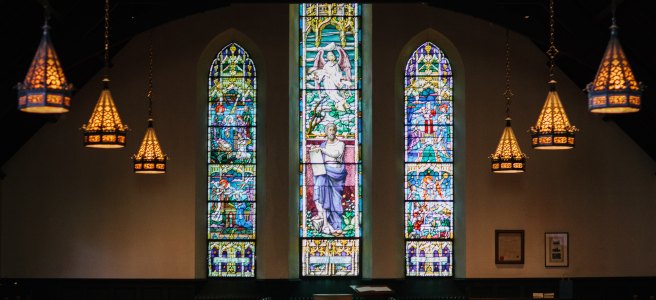
At our current parish, there are a number of amazing stained glass windows that let in the light. At certain Masses at certain times of day, the sun shines its light directly through some of them. It is awe inspiring. I find myself often at Mass, throughout the liturgy, looking up.

I think that’s part of the point. Beautiful churches draw our thoughts and minds heavenward. To help us physically and tangibly connect with the heaven-earth intersection that occurs during the Mass. The incense, the music, the vestments, the tabernacle. They all are helpful in this regard, too. We are a body/soul composite. And all those physical components, including the architecture of the church, help frame and focus our minds on the things of God.

Conclusion

My husband and I visited Paris briefly several years back. We toured Notre Dame Cathedral, with the eyes of tourists. Interested in the architecture and history. I never once thought about the Eucharist that entire trip. I hope to be able to go back someday with the eyes of a Catholic. I think I will appreciate it in a way I wasn’t able to before.

Because before, when I walked into a Cathedral I saw interesting architecture but was concerned of the financial waste. I walk in now and see love. Love of God and his True Presence in the bread and the wine.

I don’t need to be in a Cathedral to worship, but I appreciate beautiful churches now.

-Lorelei


Purchase Lorelei’s Books Here:

5 Things A Catholic Can Do To Help A Protestant Feel Comfortable at Mass

Having a Protestant friend visit Mass may seem like a big deal, or not, depending on you and your friend. But I know, as a Protestant, there was a lot that confused me during Mass, and I often didn’t feel super comfortable. The following things all would have been helpful to me as a visitor, and I hope they are able to help others as well. Because Mass can be a rich faith-building experience for Catholics and other visiting Christians alike.

1- Explain what the Holy Water/Baptism font is and why we stick our fingers in there and cross ourselves.

Hint: It is not a bird bath. But seriously, just a simple explanation that we utilize the font to remember our own baptism, and cross ourselves, which I write more about here, as a recognition of the Trinity, will go a long way in making that particular practice less odd to a visitor.

2- Show them how to use the Missalette (and find one for them).

What we do when during Mass becomes second nature for a practicing Catholic. But, as a former Protestant, speaking from experience, I was lost for a long time when attending Mass with JP’s family. Finding a Missalette for your friend, and showing them how to use it is one of the greatest kindnesses you can do for someone visiting Mass. They can then follow along with the readings, find the songs, follow along with the prayers, and the whole order of service. They will have something to guide them so they know what is coming next, and what words they should be saying during the Creed, for example, or at other times, like the Penetential Rite.

3- Prep them on when we will be standing/kneeling ahead of time.

Just as a general rule of thumb, explain that we will be kneeling in front of the Eucharist (which you might need to explain is Holy Communion. Also see #5 of this article.) Explain we will be standing when we pray and out of respect when we hear the Gospel. And explain we sit when we are listening. My article here goes into a bit more detail about what we do when and why, but a brief overview will help a Protestant friend at least be aware of the general purpose and timing of our bodily postures during Mass.

4- Encourage them to participate! 

There are so many ways a Protestant can participate in Mass. Things just might look a bit different, so might be worth going over.

Here are a few ways Protestants can comfortably participate in a Catholic Mass:

  • The Penetential Rite. Most Protestant churches I have been to have some sort of brief moment to acknowledge our sins. The Catholic version is more extensive, but is basically the same concept.
  • Listening to the readings
  • Listening to the homily
  • The Lord’s Prayer (we all have that one!)
  • The Creed (Protestants can totally recite the Nicene or Apostles Creed. It’s all stuff we agree on. Even the part at the end that says “One holy, catholic and apostolic church.” The word ‘catholic’ there is lowercase, and is referring to all of Christianity, the Universal Church, not only Catholicism.)
  • The petitions
  • Most of the songs. There are times when we sing a song to Mary, or sing about the Eucharist in a very Transubstation-oriented way, and they may prefer to stay quiet during those times. But so many of our hymns are theologically in agreement with all of Christianity. They may find they even recognize one or two from their own faith tradition!

5- Explain the Eucharist.

Briefly share why we kneel in front of The Blessed Sacrament. Share that it is because we believe it is truly Jesus in the form of bread and wine, and kneeling is an appropriate response to being in His presence. Give your Protestant friend grace, though, if they choose not to kneel. Obviously it is the True Presence whether they acknowledge it to be or not. But they don’t know it/understand it. It may even be an entirely new concept to them, as Protestant churches view Communion as symbolic.

I remember sitting in Mass with JP’s family as a Protestant, scooting forward in the pew so I could give the person behind me room to kneel, but myself not kneeling because I just didn’t get it yet. I wasn’t trying to be irreverant to Jesus. I just honestly didn’t know He was there.

Also, explain to them about who is able to receive Communion. That it is appropriate for those who believe in the True Presence, and are in a state of grace. Invite them to come up during Communion time, and to cross their arms over the body and receive a blessing. Encourage them that no one will think they are weird for staying back, or crossing their arms. In fact, they are showing respect for our faith by not receiving irreverantly, or feigning agreement in an area where they disagree.

Conclusion

If we have Protestant friends/relatives visiting us in Mass, these 5 things will go a long way from them feeling like outsiders, to being able to follow along and participate as they are comfortable. I know they would have been helpful to me as a Protestant. They were things I learned over time, but I spent many an awkward Mass as I tried to put the pieces together. Protestant services, especially contemporary ones, can be quite different than Catholic Masses, and helping bridge that unfamiliarity is a great step in helping our Protestant brothers and sisters to better understand all that is mysterious to them about the Catholic faith.

Purchase Lorelei’s Books Here:

Isn’t Being Catholic Repetitive and Boring?

This letter is free for you to read, but it wasn’t free for me to produce. If you’re interested in supporting the work of This Catholic Family, I would be honored if you would prayerfully consider upgrading your subscription. Or, you can always throw a little change in the tip jar here.

I’ve heard the following statements, or some variation, from friends and acquaintences over the years:

“Mass is too long.”

“Catholics always look bored.”

“You guys just do the same things over and over.”

But… is Mass really too long? Are Catholics all super bored? Is doing the same thing over and over again really that bad of a thing? Let’s find out.

Boring

If we are defining boring as not having stage lights, or Hillsongy-music worthy of youtube sharing, or mega video projectors, then, yah, okay… you have a point. But all that stuff just deals with the appearance of things. You have to be willing to go beyond the surface to understand just how exciting Mass actually is.

Case in point. No one looks at the Mona Lisa and thinks its boring because it’s just a picture of some lady. You might not totally understand it, but you know it’s something special. Likewise, you might not understand symphonies. But you probably can at least admit you don’t understand them, rather than jumping immediately to the conclusion that they are boring. Mass is kind of like that. You might not understand it, but it is anything but boring.

And, historically speaking, time has shown that all that flashy stuff in church doesn’t actually help retain people anyway. In fact, here’s a link to an article about someone who left the church after growing up in the “make Christianity relevant” movement of the past few decades. The author makes a good point that if Christians aren’t even convinced the basic truths of our faith are “not boring,” no one else is going to want in, or want to stay. She was so saturated with relevance and excitement, that once she grew out of buying into the Christian marketing package, she left, having never learned the legitimacy of Christianity’s claim to Truth. And Truth is what makes people stay. Truth is what people live their lives for.

One of the benefits (and sometimes frustrations) of Catholicism being such a big entity, is it is like a huge steamship… it turns slowly. So, it hasn’t gone through the same rapid transition that many evangelical churchs have gone through as far as how the message is packaged. And, innately, it can’t really change all that much. Mass is Mass. The structure of Mass has been the same since the beginnings of Christianity itself, and will continue to be the same until the end of time.

And, just because Mass doesn’t have mega projectors, or Hillsong-style worship, doesn’t mean it doesn’t have anything going on.

But, as with the Mona Lisa or any other great piece of art, or music, it means more if you know what you’re looking at. If a symphony puts you to sleep that doesn’t mean there isn’t anything going on worth paying attention to. On the other hand, if you know the nuances and meaning behind that symphony, you are going to appreciate its beauty so much more.

For anyone who thinks Mass is boring, feel free to start by checking out my post on 5 Cool Facts About Catholic Mass. That’s literally just the tip of the iceburg. Mass is amazing, and beautiful, and rooted in the Bible, as well as Christian and Jewish history and tradition. Each and every Mass contains a real miracle in the Eucharist. Each and every Mass is a chance to come physically in contact with our Savior through Holy Communion. There is literally, nothing boring about Mass, if you know what you’re participating in.

And, I no longer have a lot of patience for the “Catholics look bored” argument. Sure, I may not be bouncing up and down and waving my hands in the air at Mass (though I have worshipped in that way for years in other church settings, so no judment here), but that doesn’t mean I’m not worshipping. We can’t know the state of someone’s heart. And, yeah, in Mass, my face looks more serious sometimes. Sometimes I smile, too. Sometimes, Mass brings me to tears. But, mostly, I probably look serious. And mostly, I hope and I pray, my heart is engaged, regardless of the expression on my face.

Repetitive

I am a teacher by trade. Elementary teacher, to be precise. I think the following analogy is helpful in understanding why repetitiveness can actually be good for us.

When teaching a subject like Writer’s Workshop, at the beginning of the year I set up the structure of that part of our day. It always starts with a mini-lesson, then time for the students to practice the skill of the day with support, and then writing time where I go confer with individual students or small groups. We end by coming all back together to share. The structure is the same every. single. time.

Routines are good for us. Within that structure of Writer’s Workshop, I am making sure my students brain power doesn’t have to be wasted on thinking about what is coming next. I want the routine to become automatic for them, so they can focus their energy on the lesson I have for them for that day.

Likewise, within the structure and routine of Mass (or any church that holds to a routine for their order of service), I don’t have to think about what’s coming next. I can spend my time being prayerful, and listening to what God has for me, and I can also focus on giving worship and reverence to God, without unneccessary distractions. Except those from my troup of tiny humans, which is unavoidable at this phase of life. 🙂

The Rosary is another example of repetitiveness within Catholicism that is actually very helpful. I’ll explain more about the specific prayers in the Rosary, including the Hail Mary, in another post (and also why it isn’t weird). In short, however, the Rosary consists of 5 sets of 10 Hail Marys (each set is called a decade) along with a few other prayers. Within each decade, we focus on a specific set of mysteries within our Christian faith. For example, when we meditate on what we call the Sorrowful Mysteries, we spend a decade on each of the following: Jesus in the garden, Jesus being scourged, Jesus being crowned with thorns, Jesus carrying the cross, and the actual crucifixion. There are also many joful and light-filled mysteries, depending on which set you choose to meditate on. And when we pray a decade, saying the Hail Mary over and over again, that prayer itself becomes a sort of meditation. It helps us block out distractions from our mind, so we can stay focused on the parts of Jesus’ life we want to spend time focusing on and remembering. Another instance when being repetitive is a beautiful thing.

Conclusion

So… Is being Catholic repetitive? Sometimes, sure.

Is it boring? Not if you know what you’re looking at.

And, as always, anyone in any setting can go through the motions and be bored while experiencing something meant to be beautiful. If you go into Mass expecting it to be long and boring, your preconceived notion might just be right. But, if you go into Mass expecting to participate in the Kingdom of Heaven on Earth, to join in with the angel’s songs, and to receive Jesus into yourself, body, blood, soul and divinity in the Eucharist… then you are well prepared to receive the many beautiful benefits of your Catholic faith.

-Lorelei


Purchase Lorelei’s Books Here:

Catholic 101: Talking With Our Hands. The Sign Of The Cross In And Around The Catholic Mass

Many aspects of Cathoicism, especially the Sacraments, are meant as a way for us to experience God both spiritually and physically. The idea is that God knows we are a body/soul composite, and therefore has given us the Sacraments for the benefits of both of these parts of our being. In the Sacrament of Reconciliation, for example, we are able to audibly hear that God forgives us. It is a spiritual truth, that we are able to experience using one of our physical senses.

So, to, the Sign of the Cross is another physical/spiritual combination. There are many levels of depth to this gesture, and this article will only cover the surface. Here is how and why we use the Sign of the Cross in and around a Catholic Mass.

What’s The Deal?

Well, simply put, the Sign of the Cross is a way that we acknowledge the Trinity. It’s a way for us to acknowledge our faith, and its a way that we both remember what Jesus did and who God is. It’s a physical sign of our faith in Christ. In fact, since all Christians believe in the Trinity, there is no reason why the Sign of the Cross would need to be limited to only Catholics. And it isn’t. Many Orthodox Christians, as well as Anglicans and Lutherans, also use this symbol.

Before and After Mass, At The Font

If you’ve ever been inside a Catholic church, you may notice little baptismal fonts at the front of the aisles as you enter the sanctuary. Or, some Catholic churches have the big baptismal fonts where they actually baptize people back at the entrance instead of on the altar.

As we enter the sanctuary, we dip 2 fingers in the font and make the sign of the cross over ourselves. We use 2 fingers to help remind us that Jesus was both God and Man. We make the Sign of the Cross with the waters of our baptism to renew our baptismal covenant. In essence, it reminds us of our baptism, and the grace that God has given us through it, and helps to build us up to continue to live our faith out in our lives.

Setting Aside A Holy Time

We begin and end Mass by making the Sign of the Cross together, as a congregation. This is a way that we set aside our time with an intention to focus on God. In Catholic homes, we also begin and end any time of prayer with this sign for the same reason. We bookend time set specifically aside for God with the Sign of the Cross.

During The Gospel, A Variation

There are several scripture readings during Mass. We stand before the Gospel Reading, for reasons explained here. And, just prior to the Gospel being read, we make the sign of the cross with our thumb over our foreheads, over our lips, and over our heart.

The reason for this is that we want to remember, always, to keep the Gospel in our thoughts, and on our lips when we speak, and in our hearts, always.

The Heart of the Matter

As with anything, if we simply go through the motions and do not engage our hearts in what we are doing, then the benefit of our actions is greatly reduced. You could make the Sign of the Cross until you were exhausted, but if you were just going through the motions, the purpose and intention of this gesture won’t be fully realized.

That’s why it is so important that Catholics engage their hearts when utilizing all these beautiful tools of our faith. And, when we do, it makes Mass, and our faith lives outside of Mass, that much more meaningful.

-Lorelei

Purchase Lorelei’s Books Here: