This letter is free for you to read, but it wasn’t free for me to produce. If you’re interested in supporting the work of This Catholic Family, I would be honored if you would prayerfully consider upgrading your subscription. Or, you can always buy me a coffee here.
As I write this, I’m in my late thirties and I’m beginning to notice some signs of age when I look in the mirror. There are a few gray hairs, there are lines on my face that didn’t used to be there. My skin is sagging in places where it never used to sag. There are moments where I see a little glimpse of my grandma in the mirror more than the younger versions of me.
And as I notice these changes, I also am ever aware of the three little girls in my home who watch the things I do, the things that I say. Girls who are getting their roadmap for how to live, for how to be a woman, from me—their mom.
Something that I noticed about myself immediately was that my first thoughts about my aging body were that I need to hide it, I need to fix it, I need to do something about it. I think a lot of that gut reaction comes from the culture I live in. It’s a culture with an entire industry focused on erasing the signs of aging, that’s obsessed with eternal youth. Anti-wrinkle, anti-aging, anti-dark spots, anti-gray hair. The messaging is so loud that I didn’t even have to try for it to embed itself in my mind.
Something that was really helpful for me was to become aware of those internalized reactions, and instead of accepting those messages as true, to question them. To pause a moment and wonder: how do I wish my daughters would think about themselves when they reach this stage of life?
Whatever the answer, I had a strong feeling that I needed to retrain myself so I can model graceful and grateful aging for them somehow.
I know that we are a body and soul composite, and our bodies are deeply a part of who we are as beings made in the image of God. Our bodies matter. They matter in many ways, especially because our bodies are how we experience the world around us, how we live our story. And when I started thinking about our bodies as the keepers of our stories, I began to find a new way to look at the signs of aging in myself.
That, in turn, is helping me talk about aging with my daughters.
As an example, one of my daughters recently pointed to the crinkle lines beside my eyes and asked why I have lines there. I leaned over and smiled and showed her that when I smile, my skin folds into little rays shooting out from the corners of my eyes. I told her that our faces show our feelings, and, after a long time, they remember our feelings, too. The lines around my eyes means that I’ve smiled a lot, and my face remembers it. My face helps to tell my story.
Another time, another daughter asked me about my stretch marks. I was able to tell her that my body had to make room for each of the four babies I made, and that my stretch marks show that part of my body’s story, a part that I’m grateful for every single day.
I think graceful aging can mean different things to different people, but I do know deep down that age is something to be proud of. Not everyone gets to grow old, and I don’t want to pass along the message that we absolutely need to hide our age, or fix it, or do something about it.
In thinking about how I want my daughters to react when they begin to see signs of their own aging in the mirror, more than anything, I realized, I want my daughters to one day look at their aging faces and to be kind. To be grateful for the stories their bodies tell. And I hope to help them along that path, and to help myself, by modeling that now and giving them a different message than the anti-aging industry proclaims. I want them to remember their mother looking in the mirror and smiling, and talking about her wrinkles, and showing gratitude for all the things her body has done and continues to do. And I hope they choose to do the same.
Sign up here to receive an email whenever we publish a new post!
I love learning about the Catholic Church. We’ll be celebrating my 5-year confirmation anniversary in the spring, and the more I’ve lived the faith and studied it, the more I fall in love. It might sound silly, but many times it feels like I’m stepping into the warmest hug in the safest arms when I go to Mass, or study theology, or even see the effects of my faith slowly but surely overcoming my own tendencies towards selfishness and sin. The depth, the beauty, the history, the Truth–it’s all there and it often leaves me in awe.
There were a couple of areas of faith that were a bit more difficult for me as I made my transition. Understanding Mary’s role in the church took a bit more time. And so did my appreciation of the Saints. I used to tell JP that the Saints intimidated me, half as a joke and half as a serious comment.
For some reason, the Saints seemed so out of reach. It was tough to think that people existed who walked this earth let God fill them so much that there wasn’t room for anything else. Meanwhile, I felt so far from that. I lose my patience so easily, and tend to seek my own comfort, and am prone to anxiety and worry about things I can’t control. I feared that I’d read something by a Saint and be frightened off…of what, I don’t exactly know. But I didn’t trust that it would be helpful, at least not for a while.
My Walk with Saint Teresa of Calcutta
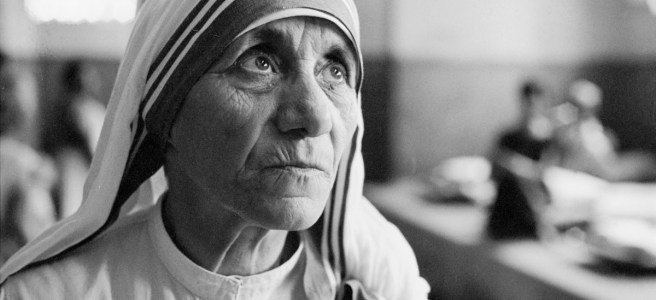
In the end, I want to grow in holiness no matter how uncomfortable it feels, so I decided it was time to read my first official work by a Saint. Since Mother Teresa of Calcutta (now Saint Teresa) was my confirmation Saint, it made sense for me to start there. I received a couple of books for my confirmation, and they’d been staring at me from my bookshelf for far too long. I read Where there is love, there is God over the course of about two weeks. It’s more a collection of things Saint Teresa wrote and said than a book she wrote from start to finish, but I got such an intimate glimpse into the person she was through it. I could see her simple, yet poignant theology in the stories she repeated, in the phrasings she came back to time and time again.
A few points that have particularly woven their way into my heart:
Humility is to accept humiliations. Wiping my baby’s diaper. Letting someone say something short to me without saying anything back. I had never really thought of humility like that before, and it was refreshing and rang so true.
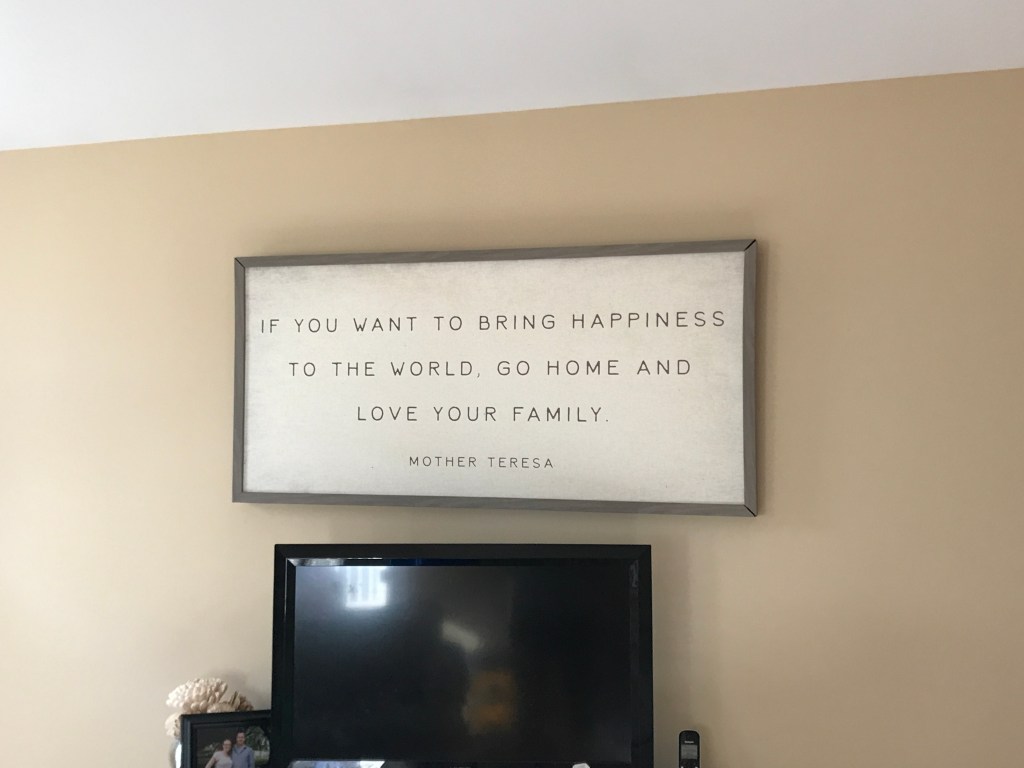
Love starts in the family. This was especially meaningful to me. I struggled for many years if staying home to raise my kids was ‘meaningful enough’ work according to some mysterious earthly standard. We have a framed piece of art in our living room with a quote from Mother Teresa, and we look at it every single day.
Seeing her broader perspective on this sort-of Theology of the Domestic Church, encouraged me in the truth I’ve been coming to accept more and more as time goes on: that my work here is vitally, beautifully important. Jesus says that when you feed the hungry and clothe the naked, that you’re doing it to Him. Saint Teresa helped me grow to understand that the little children living under my roof are the hungry one and the naked one too, and that by loving them, I’m also loving Jesus.
I also see my own sin the most at home in my family life, because I show it the easiest here. They’re the ones I lose patience with, or snap at if I’m stressed out. Because my interactions with them are such a clear mirror to my heart, they’re also the ones who give me the best chance to become a Saint. They’re the ones who I can learn to love well and patiently and fully, no matter what. They’re the ones I can most often offer dignity to in the big things and small, because they’re the ones I’m most often with.
Jesus thirsts. On the cross, Jesus said “I thirst.” While I’ve learned there have been different approaches to understanding His words, Mother Teresa’s is my favorite. Those words are displayed in each chapel of the Missionaries of Charity. Mother Teresa’s saw Jesus’s “I thirst” as a deep expression of how much he desires each and every one of our love, our souls, our all. And, therefore, she concluded, every act of love that we do is, in some mystical way, quenching the thirst of Jesus on the cross. It begs the question: have I quenched Jesus’s thirst today?
For love to be real, it has to hurt. This isn’t about staying in an unhealthy or unsafe situation, but it is about self-sacrifice and what it means and what it takes. We have the ultimate example of Jesus on the cross, because that was His love, full and true, given for us. And it hurt. My opportunities to love until it hurts are frequent but so much smaller than that- getting up when I’m exhausted to comfort a crying child, admitting that I was wrong and apologizing for it. The world has it so backwards when it comes to love- the world tells us that love should make us feel good, that it should serve us well. But it’s really the other way around. Realizing that to truly love means that I hurt because selfishness and sin is being put to death in me, well, it changes everything. I’ve been familiar with this way of looking at love for a while, but Saint Teresa put it so beautifully, and it made such an impression on my heart.
Do small things with great love. I think many of us have heard this quote from Saint Teresa a time or two. My three year old asked God to help her become a Saint yesterday, and a few minutes later I asked her to pick up a blanket from the floor and put it on the couch. She wasn’t sure she wanted to help, but I had the thought that she could probably understand what the idea of “small things with big love” meant. So I told her that one way to become a Saint was to start doing small things with really big love. Like even picking up that blanket for her mother. If she does that little thing with big love, then she’s letting God’s love into her heart more and more. Mother Teresa’s life was marked by some really big moments, but it was filled with many more small moments where she fed a hungry person, or washed a dirty person, or smiled at someone who needed to be seen. Even washing a dish or sweeping the floor can be done with love. That was a challenge to me, in a good way. It’s something small but significant that I can do in the dozens upon dozens of small, seemingly insignificant tasks set before me through the day.
Simple, Yet Profound
The funny thing is, Saint Teresa didn’t even feel close to God for most of her life. She felt his absense from her, but loved him with all of herself regardless of that. She used that sense of absence to unite herself with the lonely and abandoned in the world and to fuel her love.
And her theology was fairly simple compared to some. JP is reading the Summa Theologica right now, and it’s quite a bit heaftier both in weight and in wording than what I just read. But I think that’s one of the really amazing things about the Saints. Saints have been made from all kinds of people, all over the world, with such a diverse array of experiences. The Saints didn’t all start out holy, but they proved that it can be done. Here, now, while we live on earth. If they could do it, then maybe there’s hope that we can, too.
Turned out, reading Saint stuff wasn’t that scary at all. In fact, it was lovely, and challenging and inspiring. I haven’t fully decided who I’ll read next, but I’ve got my eye on Saint Zelie. We named our youngest after her, and I know I’m inspired by her life as a worker, mother, and wife. I think we have a lot in common, I’d love to gain some deeper insights into the person she was.
-Lorelei
Purchase Lorelei’s Books Here:
Lorelei is the author of creepy, magical, hopeful stories for children. Her debut, The Circus of Stolen Dreams, released in 2020. Her second book, a magical retelling of The Secret Garden, released in 2022. Both are available for purchase wherever books are sold.
Let me just start by saying this: What a year this month has been.
Just a few weeks ago, we were going about life as usual, and now it feels like almost everything has changed. Where I live- in space, in time- my day-to-day life hasn’t really ever seen this level of disruption. I suspect many others could say the same.
Missing Mass
I miss Mass. I miss it so much, it’s one of the few things that’s brought me to tears ever since COVID-19 started rearing its ugly head in our country. Facebook just popped up my memories from four years ago when I was confirmed at the Cathedral of St. Paul, and my stomach just sunk knowing that we won’t be able to attend Holy Week services as usual this year. I miss the Eucharist. Felicity is asking if her First Communion is going to be significantly delayed. We’re watching Mass each Sunday on the computer, and it’s been a blessing to attend Mass virtually with priests and family that we might not get to often in real life, but when the source and summit of our faith is accessible only through a screen, it is achingly clear how much things are not the same.
I know this won’t last forever, and I am going to rejoice so very much when I can receive Jesus again in the Sacrament of the Eucharist. When I can go to confession. My soul longs for these things.
I’m going to spend some time over the next week thinking about how to celebrate Holy Week as a family in our home. I found a good post here on Catholic All Year that I’ll use as a reference point to start with. My goal won’t be to do more than I can handle, but will be to do a few things that will make the week meaningful in this strange situation.
Missing People
I’m an introvert by nature, and there are a lot of people in my house, which means sometimes mommy goes and hides for a couple of hours, and that mommy also is sneaking a lot of chocolate in the pantry, haha, but mostly we’ve been enjoying time at home together.
Even my introvert self misses the ability to enjoy face-to-face interaction with family and friends. Video has been a huge blessing, but just knowing we can’t visit with family in person, or share a glass of wine with our friends just doesn’t feel great.
Anxiety
A lot of what’s going on right now is anxiety-producing! It was really unnerving for me to go to the grocery store about a week ago and to see so many shelves empty. The produce and fresh meat, nearly gone. There was a lot of expensive cheese left, and also a lot of ice cream, but so many of the normal, every day things I go into the store and buy each week without even hardly giving it a thought were nowhere to be found. That’s going to be something that will stick with me long after this is all over. This week, the supply at the store was much better, but it’s still strange. People out in masks and gloves. At home, we can kind of live in our little family bubble for days on end. But when I go to the store, it’s very apparent that things are not business as usual for the world right outside our home.
Our family is relatively young and low-risk, but it’s still been scary to hear stories of people our age who have had severe reactions. I don’t want anyone in our family to have to fight for a hospital bed. I want to protect my husband, myself and my children. But it’s hard to know how to protect yourself from an enemy you can’t really see! It’s hard to know how much disinfecting is enough.
All of that has given me some anxiety the past few weeks. I’m thankful for my faith, and for my kids and their snuggles, and the nightly routines JP and I keep up just to hang out and enjoy some normalcy in all the strangeness.
The Good
It’s been helpful to pay attention to the good amidst all that is not right now. Here are some things that are helping us through.
Homeschooling. We’ve been considering homeschooling the kids in the future, and I don’t know, it isn’t exactly a ‘trial run’ because of all the stress and isolation, but it’s been a chance for us to see what educating at home would look like, at least to some degree, and it will aid us for sure in our discerning process. And, honestly, I’m no homeschooling supermom, but I’ve been having a mostly lovely time digging into some fun learning and projects with the kids.
Connection. We’ve been using this time to connect with family and friends over video. We’ve had a few virtual dance parties, and we have an extended family Rosary on the calendar for tomorrow evening, which I’m looking forward to. I feel like we’re investing a bit more into creative, meaningful modes of connection, which I hope will continue when this is all over.
Here are 2 videos our family has made, hoping to bring a smile to our friends’ faces while we are apart:
Dignity
I feel like for once our world is shouting about the dignity of the human person, with a special focus on the aged and vulnerable among us. We are being called to sacrifice our personal freedoms for the good of the other, for the health of the other, for the life of the other. And, as someone who believes in the dignity of the human person, from the smallest to the largest, the youngest to the oldest, the strongest to the most vulnerable, it’s been a refreshing side to all the stress. Yes. Sacrificing our personal comfort, our desires, what we want for the good of the other is of the utmost importance in this time. May we translate this care moving forward into other areas of life, to protect the vulnerable around us, no matter the personal cost.
Let us Pray
Our family is praying special intentions right now for those who are critically ill, who have died from the virus, those who are alone, lonely, and frightened. For the healthcare workers on the front lines, and all those who are keeping things afloat while we shelter at home. The grocery store workers, postal workers, truck drivers, first responders. For the scientists working on medications and vaccines. And so much more.
If you or anyone you know is feeling despair, please reach out for help.
National Suicide Prevention Lifeline
1-800-273-8255
This won’t last forever. You matter. So very, very much.
Hang in there friends. We’ll talk to you soon.
Lorelei
Purchase Lorelei’s Books Here:
Lorelei is the author of creepy, magical, hopeful stories for children. Her debut, The Circus of Stolen Dreams, released in 2020. Her second book, a magical retelling of The Secret Garden, released in 2022. Both are available for purchase wherever books are sold.
National Suicide Prevention Lifeline: 1-800-273-8255
Donate to the American Foundation for Suicide Prevention:https://afsp.org/
Grieving Suicide
Grieving my 47-year-old aunt Jeannine’s suicide has been different than any other grief I have experienced in my time on this earth. It is heavy, it is dark, it is slow, it is hard.
Me and Neen before.
She left so many things behind. Family, friends, loved ones. We all must live now with a story that ended in a nightmare. We hurt for our grief, but we also hurt for the pain Jeannine felt in those final minutes. We want the chance to go back in time, to take some of that pain off her shoulders. To write a different ending.
Sometimes suicide grief is weird. I’ve had so many thoughts and emotions. Anger, compassion, pleading, confusion, an insatiable hunger for answers. I’ve been mad at the inanimate objects that were in her apartment because they witnessed her die and did nothing. I’ve had to think long and hard about which of the items that were in that room I wanted to keep. A million weird things have passed through my head as I frame our life ‘after.’
She left so many things behind. Her gemstones, her clothes, her records, her movies, her furniture, her art, her jewelry, her dishes, cookie cutters, board games, pictures, books.
And journals.
We have an abundance of journals. Part of my grieving process has been, in small pieces, to read her heart on those pages. At first, I wanted answers. Sometimes, I was mad. Now I am trying to understand.
You see, to many who knew her, Jeannine was a bright spot of sunlight on a cloudy day. She paid attention to the little things. She saw people, and helped make their day better. She cooked delicious food, and baked, and made her own amazing chocolates. She loved being silly. She planned elaborate trips for me and my friends on multiple occasions to visit her in NYC. We laughed a lot. We had deep conversations.
I, like many others, had no idea my aunt was chronically depressed.
But there it is, on the pages of her journals. She wondered what was wrong with her, why she was always so tired. She thought cruel things about herself and her self-worth. More than once, she considered ending her life.
And no one knew she was depressed. Not even herself.
I haven’t read a page yet where she connected her struggles to depression. She wanted to snap herself out of it, she felt like she was watching her life go by, she was really, really sad a lot of the time and thought it was because something was intrinsically wrong with her. But, except for to a very few people on extreme occasions, she put on a smile and lit up the room.
My Why
I’ve journaled in the past, on and off, but particularly when I’ve been going through a struggle. When I look back on my journals during those difficult times, I am struck by how similar her journals sound to mine. Like, eerily similar.
And it’s hard not to wonder what the difference was, that I came out of it okay and Neen lost her life. Was it that I identified it as depression? That I had someone close to me who saw the problem? But I isolated myself and put a happy face on plenty, too. Was it that my depression was more situational/hormonal, and hadn’t been following me for decades? That I had years of relief between relatively short depressive seasons and for her it was relentless?
In the end, for my aunt, we know it was the perfect storm of trauma on a terrible, awful night. All the wrong pieces came together in the absolute worst possible way, and she was left without hope.
In light of this, or, perhaps to try and make some sense of it, I’m going to briefly describe my own experiences with depression in the hopes to shed some light on the variety of faces depression can take. No matter how many pages of journal I read, I will never have all the answers about why my aunt didn’t survive her depression. But I can work to understand my own experiences, and be a voice that breaks the silence.
Depression Three Times
In my adult life, I have had three seasons of depression. As mentioned above, mine have been either circumstantial or hormonal/body chemistry related. Here is a summary of what those seasons looked like form me.
1- Between the ages of 20 and 21, I worked at a small company in a small office with three men. The owner of the company was also a man, and the only woman I interacted with there was his wife. The three men who worked in the office asked me inappropriate questions about intimate things, and joked about inappropriate sexual things while I was working, or eating lunch with them, or whenever.
I scheduled a meeting with the boss and his wife to share that the work environment had gotten uncomfortable for me. They listened intently and I left that meeting believing I now had some advocates on my side.
The next time I went to work, the men apologized. But only days later, I got a call from the wife of the boss telling me I was being let go.
The quality of my work hadn’t changed, and the company was pretty busy, which was why they had hired me as extra help. The only thing that had changed was I spoke up about their inappropriate sexual comments at work.
After that, I suffered low moods, some hopelessness, and feelings of being helpless. Within a couple of months, my life had moved onto other things, and there was much in my life that was going well, and the depression subsided on its own.
2- After giving birth to my children, I had mild to severe postpartum depression, and it was a bit different with each child. It varied from low mood and pervasive sadness after Felicity was born, to very, very scary thoughts of self-harm after August was born. I felt like I was watching my life through a pane of glass and couldn’t get in. I didn’t think I was good for my children. I thought the world would be better without me.
After we diagnosed the postpartum depression, I took Zoloft for approximately 6 months in combination with therapy, and reading books about postpartum. I followed all the directions for how to take care of myself and I began noticing an improvement after I had been on the medication for 2-4 weeks. Things started feeling better, I was able to smile and enjoy my children again, and I knew I would be okay. I wrote in detail about my experience with postpartum depression and anxiety here.
3- Three years ago, a woman broke into my home while I was alone with our then two children. I was on the phone with 911 for just under 6 minutes before they arrived, hiding in an upstairs bedroom as I watched this person peep around my backyard and ultimately gain entry. When they police came, she was in my kitchen. To this day I don’t know what her intentions were, but I do know that I was home alone with my young kids, without any means of defending myself while someone who was drunk, or high, or both was in my house.
After that happened, I exhibited many symptoms of PTSD. Functioning at work became difficult. Seeing an unfamiliar face in my neighborhood caused a panic. Unexpected loud noises did the same. I slept better once we installed a home security system.
I ended up having to leave a job that was highly-stressful even when I was functioning at 100%. It was hard to leave. I felt like I was letting a lot of people down, and that didn’t help. My thoughts, for a time, grew dark and scary. We were going to buy a gun for home protection. I told my husband not to. I was worried about myself with a weapon like that in my home.
As weeks and months passed from the traumatic event, my depressive symptoms again subsided. Besides that very unique traumatic incident that I couldn’t have controlled, our life was in a very good place. I was able to weather the storm of acute stress probably in part because of that. But, having experienced scary depression prior with the postpartum issues, it was a very unwelcome return to that place for even a relatively short time.
The Other Side
Writing a lot of that feels very weird now, because I am in such a different mental space now, and in general. I’m not someone who struggles with chronic depression, but I have struggled at different times, and in different ways each of those times.
But I am so thankful I survived, because it wasn’t a guarantee. And I now understand what depression is, so even when something happens that is triggering, I can label what is happening and I know where to reach out for help if I need it.
And I wonder how many people could be saved by having access to tools to help them identify what is happening?
It’s been hard not to play the what-if game with Jeannine.
What if she had understood that her depression wasn’t something innately wrong with her as a person?
What if she had been able to put a name to all the things she was feeling and was able to get help?
What if she had taken an anti-depressant?
What if people just simply talked about it more so she would have had a chance to recognize the overlap between others’ experiences and her own?
Walking Wounded
For those of us who have suffered a suicide loss, we walk this earth wounded every day.
I did keep some of her personal belongings, and they now sit in my home. I am thankful to be able to remember her with those items, but I often think how they don’t belong here. They belong with her, in her apartment, with her there to look at them each day.
I’ve also been appointed the personal representative of her estate. There are a lot of things to do with that. Legal things, tax things, things that remind me daily how I wish things had turned out different. I even play out different scenarios in my head while driving or sitting after the house has gone quiet late at night. I imagine what would have happened if I had seen her deactivate her Facebook page the minute she did it and called to check in. If she had answered her phone. If there could have been a different ending to this story.
Jeannine walked wounded every day, too. It’s there, plain as day on the pages of her journals. And so many of us here also walk wounded because of depression.
Breaking the Silence
It’s so important to break the silence. Breaking the silence is a way to start a conversation, to end stigma, to open up avenues of support. And maybe, a way to save a life.
-Lorelei
Purchase Lorelei’s Books Here:
Lorelei is the author of creepy, magical, hopeful stories for children. Her debut, The Circus of Stolen Dreams, released in 2020. Her second book, a magical retelling of The Secret Garden, released in 2022. Both are available for purchase wherever books are sold.
So much of my life is framed by hope. I hope the kids will sleep well, I hope the weather will be nice, I hope I’ll have time to drink my coffee. Hope, hope, hope. Little things like that. And big things, too. I hope I’ll be a published author some day. I hope my kids will grow up to be kind, good adults. I hope JP and I will live long lives and be able to see our children’s children grow.
But there is also a deeper hope than this. And it is also part of my every breath. It is something that brings me such joy, even when things don’t go as I hope on a small scale, or even big.
And it is the hope that there is something more than just the physical world we encounter during our short time on this earth.
A Crutch of Hope
For example, I have to hope that this intense love I feel for my children and my husband is more than just biochemistry for biochemistry’s sake. I have to hope that humanity is an echo of God, and familial love is an echo of heaven. I have to hope that my attraction to beauty and harmony comes from something deep and vast. And that my anger at injustice comes from a connection to an ultimate source of Good.
Some people may say I’m weak for leaning on a crutch like that. But I’m okay with going through my life on a crutch of hope. A few years ago, when JP and I were figuring out the worldview by which we would live our lives, I experimented to see if I could find meaning dissociated from a higher power. And maybe some people can. But I couldn’t do it. I couldn’t get myself to a place where I could believe we didn’t have souls, and that there was no ultimate source of Good, and there was no point, and never would be for our existence, and then along those lines still believe my life had value, or that it mattered how I treat others, or that justice of any kind was important other than to further survival in a segment of our species so we could live long enough to be burned up by the sun.
If I lost that hope, I couldn’t find a way to justify, other than a desire to procreate, why I would have brought three more meaningless souls into the world. But if there is hope, then procreation is co-creating with the Ultimate Creator, who is also the ultimate source of Good. My children, like all of humanity, carry souls and are stamped with the image of the Creator.
So, for these and many reasons, I actively, and with great intention, chose hope.
My True North
Hope in something more is my True North. It is the direction by which everything else in my life is set. It’s how I frame my own minutes spent on this earth. It’s how I frame my actions towards other people. It is at the very foundation of the value and dignity I believe every human inherently carries by virtue that they exist.
It is this same hope that underlies my belief that there is still a chance my aunt, who we lost to suicide in February, has found or is finding peace and healing. That her story doesn’t end with ultimate despair. That all our stories don’t just end.
I choose to believe that Aslan will defeat the White Witch. That Good will defeat Evil. That wrongs done on this earth will be made right in a way that will more than atone for the suffering people faced.
Once I decided to live a life believing something bigger than us out there, I also chose to believe that higher power is all Good, is all Love, and is all Truth. That next step helps me to further frame how I build my life.
If There Is…
Because if there is Good, then it matters that I learn what is Good, and that I choose Good over its opposite.
Because if there is Love, then it matters that I learn what is Love, and that I live a life built around willing the good of those whose lives cross paths with mine.
If there is Truth, then it matters that I learn what is Truth. That I sift through my own personal biases and preferences, and even my own selfishness in order to recognize Truth and assent to it.
A Life Well-Lived
I hope to look back on my life one day, and have peace that it was well-lived. Lived for others, lived in the promise of something more, something beyond, something that is the source of all Good and all Love and all Truth.
It gives me great peace to hope we are all a small part of something bigger, something ultimately Good. It doesn’t matter if someone thinks I’m foolish for leaning on a crutch. That person doesn’t have to answer for the minutes of my life, or for how I choose to experience my existence. But in the name of hope, I will always hope that all those I encounter are able to find their peace. The compass by which they can walk this journey of life.
And that, in a nutshell, is why and how I have chosen to frame my life through a lens of hope.
-Lorelei
Purchase Lorelei’s Books Here:
Lorelei is the author of creepy, magical, hopeful stories for children. Her debut, The Circus of Stolen Dreams, released in 2020. Her second book, a magical retelling of The Secret Garden, released in 2022. Both are available for purchase wherever books are sold.
Men, many of us are being led astray. We all want happiness. But not everyone seems to know where to find it. What’s more, I suspect many of us who think we have it are blind to the possibility that what we have pales in comparison to the real thing.
Those Guys
With the attention sexual misconduct is getting in the media, it is easy to point the finger at ‘those guys’ out there who have done some obviously terrible things. But I want to call attention to all of us, what we might be doing in pursuit of happiness that is equally off the mark. That’s what ‘those guys’ were doing anyway, isn’t it? Pursuing happiness in the way that they knew how, the way that they desired.
So the question becomes, how do each of us pursue happiness?
And how does this manifest itself to those around us?
For example, a group of regular guys get together for an evening away from their daily grind. Beers, conversation, some sort of entertainment – watching the game, having a cookout, whatever. These guys are, on the surface, pretty happy. Spirits are high, small talk is jovial, and the joking abounds. But listen closely to the topics of the jokes, and the spirit of the conversations and there is something not quite right. The jokes are, by in large, sexual in nature.
Now how do we gauge whether that’s ‘ok’?
By what standard am I referring to when I say something is not quite right?
Made To Love
We are made to love. And to love is to will the good of another (Aquinas). When we, as guys, are bringing sexuality into our jovial small talk and jest, I ask all of us to consider whether we are “willing the good of another” in what we’re saying. If our wives were to hear themselves being the topic of sexual jokes at guys’ night, how do we think they would feel: more loved or less loved? And when we ask this question to ourselves, how does the answer we give make us feel? Are we indifferent? Are we offended that I even pose the question? After all, what does it matter how we talk about our wives – or women in general – when they are not around? Right?
Wrong.
Reflection of our Hearts
How we talk about women, especially our wives, is a reflection of the state of our heart. And if we think we are finding happiness in cracking sexual jokes all basically implying that life is nothing more than finding pleasure when one wants it, then we have a serious misunderstanding of where happiness lies.
Our creator wants us to be happy. He made us for himself. And since he is infinte joy, infinite beauty, infinite pleasure, nothing short of him will even come close to the happiness we will experience when we are in total union with God. So to begin our journey to ultimate happiness – total union with God – here on earth, Jesus tells us to live like God now. Real, lasting happiness is found when we live like God lives: indifferent self-giving.
“But I say to you, love your enemies and pray for those who persecute you, so that you may be sons of your Father who is in heaven; for He causes His sun to rise on the evil and the good, and sends rain on the righteous and theunrighteous.”
Matthew 5:44-45
The Challenge
I challenge each one of us to put Jesus’ teaching (live like God lives) to the test. Try treating your wife as more important than yourself in every single aspect of your marriage. Will her good as more than your own. Do this and see what happens. Lorelei and I always had a decent marriage, but then I took the challenge; I tested out how much happiness really does lie in willing the good of the other. I put to the test the claim that Iwas made to love.
The results were breathtaking.
When I started to will Lorelei’s good more than my own in every area of our marriage our marriage went from decent to phenomenal. The more I willed her good, the more I found she willed mine. The more I gave to her, the more she gave to me. It was like resonant feedback from a microphone in front of a speaker, only instead of a harsh noise, it was a beautiful sound, the type you wish would never end. Synergy. 1 + 1 = 3. That kind of result.
Conclusion
Men, it is my firm belief that we will be most happy when we live like our infinitely loving creator – in indifferent self-gift to all those around us. Put this to the test and tell someone you know how it goes. If you experience what I did, I predict our small talk will take on a different tone.
-JP
Purchase Lorelei’s Books Here:
Lorelei is the author of creepy, magical, hopeful stories for children. Her debut, The Circus of Stolen Dreams, released in 2020. Her second book, a magical retelling of The Secret Garden, released in 2022. Both are available for purchase wherever books are sold.
I was too young to know much about the scandals surrounding Bill Cosby the first time around. Then, as time went on the media storm subsided and Cosby emerged as someone still able to find affection in the public eye. He was, if not The American Father, at the very least in the running for it. I remembered him as Dr. Huxtable, as the guy on the Jello commercials, and as the host of Kids Say The Darndest Things.
I saw him live with my family to watch his comedy routine in person- it was a fun, family friendly night.
But, when the accusations burst forth again in 2014, I was old enough to pay attention. Even without a conviction, and with only the knowledge of what Cosby has admitted to doing, there is something we as a whole find incredibly disturbing about his conduct.
Then, as name after name of male celebrities comes into the public eye, and similar, equally disturbing stories are told, we have to wonder… what is it exactly about this behavior that we know is wrong? Lack of consent? Yes. Abuse of power? Yes. A distorted sense of immunity? Yes. These and a myriad of other things.
But, I suggest, there is also a deeper underlying issue at the core.
Let’s Talk About Sex
What’s the point of sex? Well, it is the means by which we continue our species. But procreation is not the only purpose of sex. The other point of sex is that it is for the good of the spouses.
The Catechism of the Catholic Church states:
“Sexuality, by means of which man and woman give themselves to one another through the acts which are proper and exclusive to spouses, is not something simply biological, but concerns the innermost being of the human person as such. It is realized in a truly human way only if it is an integral part of the love by which a man and woman commit themselves totally to one another until death”
And how is that aim of benefit to the spouses achieved? Here’s the Catechism one more time:
“The acts in marriage by which the intimate and chaste union of the spouses takes place are noble and honorable; the truly human performance of these acts fosters the self-giving they signify and enriches the spouses in joy and gratitude”
Sex as Self-Giving
Jesus gave his body fully for us. He sacrificed himself for our good. And that is exactly what sex is meant to be. It is meant to be a husband giving fully of himself for the good of his wife, and a wife giving fully of herself for the good of the husband. It is an ultimate appreciation of the dignity of our spouse, through a total gift of ourself to him/her.
Anytime we do something other than that, we turn sex from a self-gifting act to an act of self-seeking. From giving to taking. From whole to broken.
Marriage and Church/Marriage and the Trinity
Marriage is often referred to in the Bible as a reflection of Christ and the Church. Jesus is referred to as the Bridegroom, and the Church as the bride. If we play that relationship out to its logical conclusion, we see the beauty in Christ’s sacrifice for us, and realize our job within marriage is to reflect the beauty of what Christ did for us as a witness to the world.
Marriage is also reflection of the Trinity.
God is a burning inferno of love, and that love between the Father and the Son ushers into being a Third, the Holy Spirit. And when a husband and wife love each other, it has the potential to bring about a Third. That love becomes so real and so tangible that another life is brought into existence from it.
Sex is powerful stuff. Not because we have a right to indulge for our own sake or pleasure, but because we have the ability to give the gift of ourselves wholly and fully to another human being.
When that gift is profaned and becomes a selfish act, it undermines the dignity of the humans involved and can cause great hurt and pain. People feel used, something inside us becomes broken.
Sex is meant to be a total gift of self. Nothing about it is meant to be selfish.
The Distortion of Sex In The News
That’s partly why the news stories coming out about famous celebrity males taking advantage of females in incredibly disturbing ways hits home. Those behaviors are the result of a myriad of things. Privilege, a hunger for power, pride. But they also stem from the view of sex as being something that ultimately we deserve. Sex is for us. Pleasure is something we take instead of something we mutually give. Sex becomes a carnival house mirror instead of a pure and true reflection of God and his love for humanity. A cracked and distorted facimile of beauty.
We can see so clearly in those examples that something, and yes, many things are broken.
But a distortion of what is meant for good can occur even within a Christian marriage. All Christians would benefit greatly from an exploration into Theology of the Body and diving deeply into the power of the purpose of human sexuality. If our marriages are meant to be a living reflection of the Free, Total, Faithful and Fruitful love of God, then it is vitally important that we know what we are being asked to reflect, and that we take seriously the responsibility and honor to live as Gift to our spouse.
If you are interested in learning more about the foundational Christian views on sex and marriage, please check out:
Or…
And, when we see these examples when good is perverted, let us know why it is we know, at the root of it all, that selfishness in any expression of sexuality, in any situation at all, is harmful and wrong.
-Lorelei
Purchase Lorelei’s Books Here:
Lorelei is the author of creepy, magical, hopeful stories for children. Her debut, The Circus of Stolen Dreams, released in 2020. Her second book, a magical retelling of The Secret Garden, released in 2022. Both are available for purchase wherever books are sold.
It’s been a while since I’ve been straight up embarrassed in public. Though I lean introvert, I can typically handle social situations in an appropriate manner.
This week, I was reminded how awful it feels to be embarrassed in front of others.
We were at the pool for Lissie’s swim lessons. I was sitting on the edge of the wading section, keeping an eye on Auggie (who was wearing a lifejacket), and also trying to keep the baby from freaking out at her lack of freedom while strapped in her carseat.
We’d been attending swim lessons all summer. 14 times to be exact. And I had spoken with a lifeguard a few weeks back about where I needed to be in relation to my son while he swam. I was told I needed to be at the edge of the pool, which is where I was.
I was surprised, therefore, that a lifeguard approached me at the last lesson pretty agressively and told me I needed to be within arm’s reach of my son.
I told him I thought I was doing the right thing, but it wasn’t a problem and promptly waded over to tell Auggie to stay close to me.
But then the lifeguard didn’t stop. He kept explaining the rule to me, loudly, even though I didn’t fight him on where he wanted me to be.
There were a lot of people at the pool.
I felt embarrassed.
I know he was trying to do his job and keep everyone safe, but it’s a weird moment when you think you are following the rules, but then someone keeps explaining it to you like you don’t get it for some reason or are going to fight him on it, even though you’re not.
I’ve never liked getting in trouble. I made it through school without a single detention. I cried once when I got a tally mark against me for talking in 2nd grade. I also cried when a very nice police officer pulled me over for speeding the one time I got a ticket.
I really, really, don’t like being singled out in public for a negative reason. And I think there is a much more respectful way to correct behavior, in both public and private situations.
Dignity and Teaching
I learned very early on in my urban teaching experience that my students responded a lot better to redirection if I did it privately, without embarrassing them.
There are a couple of kids I specifically remember. Kids who other teachers had a hard time getting to listen. Kids who often got phone calls home or one way trips to the office. But not with me. Why? Because the other teachers would scold them publicly, in front of their friends. And they would talk back in an attempt to save face.
When these same kids were approached quietly, privately, respectfully when the other students were working, things were different. They, more often than not, corrected their behavior, dignity intact.
I also tried as best as I could to assume the misbehavior was unintentional. There’s a big difference in approach between “Quit tapping that pencil on the paper- you know it’s distracting everyone!” and “You may not have realized this, but tapping your pencil that loudly makes it hard for me to focus on what I’m teaching. Is there a quieter way you could get your wiggles out?”
Understanding kid’s innate desire to be treated with dignity helped my teacher game more than I ever could have known. Kids felt safe in my classroom. They knew I respected them as people. And they were able to learn and trust that they were in good hands.
Dignity and Parenting
How many times a week does a kid get their behavior corrected? Judging by my own parenting experience, a lot.
I think it was good for my kids to see the pool incident happen. We talked about it on the way home. About how I wanted to say some not nice things to him, but didn’t, and how hard it is to control our tongues. We also talked about how he was in charge of the pool, and how I needed to be respectful of him, even though it was difficult.
We talked about how I just wanted to leave, and how I understand there have been times in the past when they have felt the same way, embarrassed by something so much that they wanted to go home.
I hope this helped, particularly our five-year-old. She is a child of Big Feelings. I hope it helped her see that grown-ups have Big Feelings sometimes, too. That we feel embarrassed sometimes. That we need to respect the people in charge, too.
I also hope this helps me remember to be sensitive to those moments when my kids are embarrased. To those moments when they feel like they aren’t in control of their life. When they are misunderstood. I think I was better at remembering these things in the context of a classroom than I am in the context of my kids at home. I don’t know why this is. Maybe because I don’t always get a ‘prep time’ each day when I can re-focus and re-charge. JP and I get a few hours while the kids sleep each night, but it’s not like there is ever any extended separation from the environment of home like there was when I left school each day and didn’t have to return until the following morning. It’s more constant each day at home. But it’s not an excuse to forget.
Thank You, Mr. Lifeguard
I didn’t like it when it happened, but that brief and uncomfortable encounter at the pool had a lot to teach me, and hopefully, helped me connect with my kids in a deeper way. It was a good reminder to me of what it feels like to have someone assume the worst intentions in you, and to publicly call you out on it.
I think it’s a good thing when we can take an uncomfortable situation and learn something from it. I’m thankful to that lifeguard. Though I didn’t appreciate his approach, I know he was trying to do his job well. His approach gave me an important reminder about how I handle things with the people I’m in charge of as their momma, and was yet another reminder of the importance of maintaining the dignity of those we encounter. No matter how big, or how small.
-Lorelei
Purchase Lorelei’s Books Here:
Lorelei is the author of creepy, magical, hopeful stories for children. Her debut, The Circus of Stolen Dreams, released in 2020. Her second book, a magical retelling of The Secret Garden, released in 2022. Both are available for purchase wherever books are sold.
But Night At The Roxbury is not what we are here to talk about today. And, just a hunch, but I’m not sure those guys would be able to contribute too much to the conversation we are about to have on the true definition of love.
Love and Infatuation
Full disclosure: I watched every season of The Bachelor/Bachelorette for nearly ten years.
Most people (I hope) don’t take shows like that too seriously. But they really are a unique microcosm of the Infatuation Effect. The whole “I’m obsessed with you, you are my whole world” phase of relationships that are just getting off the ground.
But, as a culture, I think we do misunderstand infatuation for love in our own real lives. Infatuation is chemicals and hormones, and is wonderful and exciting.
But it isn’t love.
Love and Utility
I’ve been writing a fair amount about utility lately… the idea that we only give people value when we find them useful to us in one way or another.
I think, though, unless we actively counteract our tendency to relate to people in this way, the idea of seeing people for their usefulness is unfortunately rather innate.
A few examples:
In Childhood:
Befriending a slightly more popular girl in school in the hopes of raising your own social status.
Making a “trade” with a friend for a piece of candy because they have something you want, rather than because you want to give them something they desire.
In Adulthood:
Befriending people who might help give you the image of status/social life you hope to convey.
Relating your own kindness or generousity to a spouse in terms of how much they do for you.
Valuing people for their utility also isn’t love.
So, What Is Love?
According to Aquinas, to love is “to will the good of another.”
If we love, we want the other’s good. This could be a friend, a spouse, a child, a relative, a stranger. We love them if we want good for them.
It seems so simple.
Tonight, my son fell and cut his chin on a sharp edge of plastic. I held gauze to his chin to stop the bleeding. It was a deep wound. We were at church, and I left immediately to go to the nearest pharamacy to get what I would need to take care of my boy. I wanted him to not be in pain. I wanted to help him heal, and quickly. In those moments, I loved him well.
I don’t always love well. This is something I’m sure I will be working on my entire life. Far too often I want the bigger piece of cake, the more comfortable situation, the first place in line. To be the receiver of good rather than the giver. It is something I think about and pray for. To love better. To will the good of others.
That’s one thing I love about the Examination of Concience. It helps us think about the ways where we put ourselves first, or had selfish motives. And it helps us turn back towards the true definition of love.
Some of my favorite Examination of Conscience questions are:
Do I work to protect the dignity of others when it is being threatened?
Do I recognize and respect the economic, social, political, and cultural rights of others?
Do I live in material comfort and excess while remaining insensitive to the needs of others whose rights are unfulfilled?
Am I disproportionately concerned for my own good at the expense of others?
Does the way I spend my time reflect a genuine concern for others?
Do I see all members of the human family as my brothers and sisters?
Reflecting on these parts of myself help me to know areas where I am self-focused, rather than other-focused. Areas where I will my own good first and above all else.
Truly loving another person is not easy for those of us who tend to like comfort. Who tend towards self-preservation. It is not for the faint of heart. Love takes faith, humility, perserverance, and the laying down of self for another.
In our faith, we have the perfect example of what it means to lay down a life for another. Jesus loved perfectly. He willed the good of all humanity above his own and thus redeemed it. And while we are not perfect, we can continue to turn our hearts towards that which is good, and seek to emulate the example set for us. There is unfathomable redemption in love.
And knowing the true definition of love is a good place to start.
-Lorelei
Purchase Lorelei’s Books Here:
Lorelei is the author of creepy, magical, hopeful stories for children. Her debut, The Circus of Stolen Dreams, released in 2020. Her second book, a magical retelling of The Secret Garden, released in 2022. Both are available for purchase wherever books are sold.
I have trouble with eye contact. Not during job interviews, not at home with my husband and kids. But definitely in public.
I remember in middle and high school avoiding eye contact with others was a way to deal with my shyness. The subtle yet significant fear that I would look someone in the eyes and they would ignore me. That I would not be seen. So I made the first move, which was to not even try.
A lot of times now, I find myself in a similar boat, except I’m not as much paralyzed by shyness as I am by the fact that I’m wrapped up in my own thoughts about my own life. What I need to do next, what I’m going to write about next, what I need to cook for dinner. The kids, the house, the list of things I need to do.
By doing this, I miss a lot of people, and a lot of potential interactions with other human beings.
In The Image of God
It’s easy for me to look at a baby, or a child, and to see the spark of The Creator inside them. Less so when it’s the person in front of me in line at a busy grocery store, who painstakingly writes out a check a la my grandmother. But instead of noticing that and remembering my grandma fondly, I am mostly irritated I chose this line, and will be delayed a couple of minutes and I have ice cream probably melting in the car from my first stop at Aldi.
The thing is, the lady in front of me, too, bears the mark and the spark of God inside her. And she, therefore, is deserving of a certain and irrevocable level of dignity and respect. So is the slow driver in front of me. The man carrying a 12 pack of beer as he walks home from the liquor store on the corner. The woman on her cell phone waiting for the bus.
Recently, I tried running errands and making an effort to truly look at people. And as I did, to think Image of God every time. There’s still some residual shyness lurking about, and it’s more difficult than I thought it would be. But when I did succeed, when I did pay attention enough to conciously acknowledge someone’s inherent worth. When our eyes met and we smiled. Woah. That was a powerful moment.
People long to be seen. We want to know we have worth.
A Blanket of Woven Saris
I recently hosted a party for a company that sells things made by women survivors of human trafficking. One of the many beautiful aspects of these companies is that women, who once were in a position where they felt they had no choice but to sell their bodies, now make a fair, living wage creating beautiful products for export. In their work, there is now dignity where there once was shame.
I received a handwoven blanket as a thank you for hosting the party. It is made of vintage saris, all beautifully braided together by a woman named Nasima. I know this because she signed the tag. I was able to go onto the website of the company, and to learn a bit about her story, and how her job gives her freedom, and respect.
My beautiful blanket.
The Creativity of God
When we, myself included, forget about the dignity within each and every human, bad things can happen. From the smallest to the oldest among us, we all bear the image of our Creator, and this is the primary source of our immense and intrinsict worth. Any time we mess with that, and start assigning importance or value based upon one’s size, or if they are wanted, or if they can help us get something we want, we forget Imago Dei. And we are all the poorer for it.
I am the first one to say it is my goal to look people in the eyes more. It’s a small step, to be sure, but if you take enough steps you end up at a different destination. I want to look at them and think Imago Dei. I want to offer a smile. I want them to know they are seen. I want to spend more time interacting with these image bearers and less time with the neverending lists inside my head.
As I do this, I hope to grow in awe and wonder at the diversity of souls on this earth and at the dignity of man and the creativity of God.
-Lorelei
Purchase Lorelei’s Books Here:
Lorelei is the author of creepy, magical, hopeful stories for children. Her debut, The Circus of Stolen Dreams, released in 2020. Her second book, a magical retelling of The Secret Garden, released in 2022. Both are available for purchase wherever books are sold.












 This Catholic Family: Catholic Womanhood, Family, and Conversion