Catholic 101: 5 Cool Facts about Catholic Mass

This letter is free for you to read, but it wasn’t free for me to produce. If you’re interested in supporting the work of This Catholic Family, I would be honored if you would prayerfully consider upgrading your subscription. Or, you can always buy me a coffee here.

For some, Mass is a beautifully rich time of spiritual reflection and growth. For others, Mass is confusing! Sit, stand, sit, stand, kneel stand. Lots of sayings and responses that are difficult to follow along with if you aren’t Catholic.

So, in light of a desire to shed some light on Mass, here are 5 cool Mass Facts that you may not have known.

1- Mass is modeled after the book of Revelation

4717e1a4!h.300,id.2107,m.fill,w.jpg

I think there is this stereotype that Mass is  antiquated, or ritualistic. However, interestingly, much of the content of Mass is based on the book of Revelation, which is a book all about the future, and of that which is to come. For example, each Mass we sing the “Holy, Holy, Holy,” which is straight out of Revelation 4:8. The idea is we are joining in with those in heaven in their unending hymn of praise. So that’s a real profound moment, if you think about joining in singing the same song those in heaven are singing, and the connection between the physical and the spiritual that is occurring. And that’s just one tiny example. You can do an entire study on Revelation and the Mass. The more you know, the more amazing Mass becomes.

2- There are 4 Scripture readings throughout Mass,and the readings are the same globally. 
Outdoor_Mass_Tanzania_642px.jpg
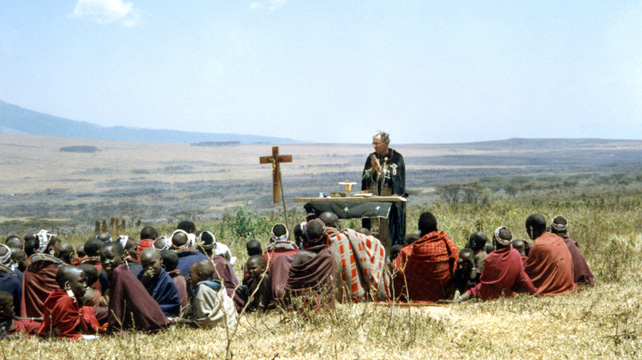
Outdoor Mass in Tanzania.

There’s a lot of Bible each Mass. First, there is often an Old Testament reading (except during the season of Easter, when we read through the whole book of Acts.) Then, there is a Psalm, except instead of it being read, the Psalm is typically sung. Which is cool because the Psalms are originally songs. So, in the Mass we put them to music, and it’s sung responsorally, where a lead singer, or cantor, sings part of it, and the congregation joins in throughout. After that, there is a New Testament reading. And, finally, we conclude with a reading from the Gospels. Often, there is a theme that connects many of the readings, and there are studies available to further dig into the readings of each week. Also, the Catholic readings cycle over 3 years, throughout which, if you are attending daily Mass, you’ll have read through pretty much the entire Bible! And finally, the readings are the same globally. So each Mass, I am hearing the same readings as Catholics in my own town, in Minnesota, Africa, Europe… everywhere! This is cool because I can discuss something about the readings with JP’s family or a friend of mine from a different parish, and we all have heard the same Scripture each week.

3-We say the Creed every Mass. 

Nicaea_icon.jpg

Christians have shared a creed, or set of beliefs since the earliest days of Christianity. The Nicene Creed was formalized in 325 A.D. It’s a series of “I believe” statements, and is a beautiful, easy to understand representation of Universal Christian teachings. Every single Mass, we stand up together and state our beliefs corporately. That’s a cool moment- publicly affirming your beliefs among others who are affirming the same.

4- Mass is offered every day. 

chalice paten.jpg

Anyone looking to attend Mass can find one any day of the week, often offered at different times in different parishes. An interesting thing about this is if you think about time zones, and that daily Mass has been a global practice since the days of the Early Church, there is pretty much a Mass being offered somewhere continually on Earth at all times… and has been for… well a really long time!

5- The Making Present of the Last Supper. 

Leonardo_da_Vinci_-_Last_Supper_(copy)_-_WGA12732.jpg
The real one. Not the painting. 🙂

Catholics believe Communion is more than just are representation, or symbol, or what Jesus did in the Upper Room. And Catholic belief on Communion actually goes wayyyy back into Jewish culture and history. Historically, when Jewish people celebrated the Passover of Moses’ day, they didn’t believe they were just symbolically representing what happened; they believed they were participating in a “making present” of that actual one time historical Passover event. That they too, somehow, mysteriously, were also participating in the Passover of Moses. In Mass, we believe that Communion is a “making present” of Jesus’ Last Supper with His disciples. That we, too, are participating, mysteriously, in that one time event. There are a lot of connections to Judaism in Catholicism and in Mass as well. This is only one of them.


I hope you’ve found these 5 Cool Facts about Mass interesting, at least, and educational at most! I know I didn’t get to all the sit, stand, kneel stuff in this post- but I can write about that another time. There’s a lot of meaning behind each of those postures as well.

Until next time!

-Lorelei

Purchase Lorelei’s Books Here:

What is Truth?

maxresdefault.jpg

Recently Lorelei and I found ourselves in a lovely conversation with a dear old friend of ours from years back – although we only knew each other for a brief time before he left the state for a career move, it only took a few minutes of conversation to be right back in the thick of it. Why do we get along with this friend so well? Because he is open to exploring life. He is open to seeing something from multiple perspectives. He is open to disagreeing, and not having to be right. You see, in this way, we all get to share why we think something is the way it is, and then we look at that thing from as many vantage points as possible without feeling the need for everyone around the circle to think the same thing. Man, I really love doing this. In fact, a hallmark of my dearest friends in life is the proclivity to do just this, to look at something deeply and to investigate it from as many sides as possible. It’s really fun!

So what does this have to do with Truth? Well, first off, what is Truth? During this lovely conversation a nice set of analogies were presented to define Truth (I keep capitalizing the word for a reason, to indicate the ultimate “what is”). Here in our lives, in our physical world, we see things and we think about things, and we form opinions of things – man, do we form opinions about things. But do our thoughts and opinions equate to “what is”? Just because we think a certain way about something, does that mean we actually know “what is” about that something? I don’t think so.

We got to talking and came up with three analogies that I really liked. The first one I must credit our friend – thank you friend (you know who you are if you’re reading this). The first is this: multiple people are looking at a table. One person sees a yellow shiny surface and describes these said features. The other person sees a black rough surface, and describes these said features. But they’re both looking at the same table, how can this be? Easy. They are looking at the same table from two different vantage points, one where the sun is hitting it making it look shiny, the other where shade is hitting it making it look dark and rough. Each person’s perspective describes some aspects of the table, it gives a glimpse of the table, but not the comprehensive view.

The second analogy I can credit Lorelei for bringing up, but not for inventing. The second is this: multiple blind men are feeling an elephant – not knowing it is an elephant – and trying to figure out what it is that they are touching, without of course their sense of sight. One person who is touching the trunk concludes he is touching a tree trunk. Another person who is touching the ear concludes he is touching a sheet of leather. Another person who is touching the tail concludes he is touching a snake. And on and on, each man concluding he is touching something else depending on what part of the elephant he touches.

The third analogy I can thank myself for bringing up, but not for inventing – for that I can thank Catholic RCIA class, where the seven sacraments were likened to the seven main colors of light when refracted through a prism. Here in this analogy we have light, the source in which all the wavelengths are found, that spread out into the different colors we see, all a portion of the whole of light prior to its passing through the prism. To take this analogy farther, and as a result of listening to St. Thomas Aquinas describe God as “that than which no higher thing can be thought,” I find it beautifully satisfying to liken all of creation – every thing that has being – as a wavelength of the ultimate source of light: God.

OK, so what to make of all this? The common theme of each of these analogies is the notion that we see only in part. One application note from this is to consider this when forming an opinion and deciding how strong to hold to it. Can you see it from another perspective? I challenge you to try; trying to see it another way has made life very intellectually stimulating for me for about 9 years now. The second application note is this: how do we ever know the whole of the matter, Truth? How do we know Truth, “what is?”

The answer to “what is Truth” is shocking, for the answer is knowable, and that is shocking enough. But what’s even more shocking is the adjustment to the question it causes; we now also can answer “who is Truth?” Answer to both of these: Jesus Christ. Let this sink in. That is what he claimed. He claimed to be God – God is Truth. He also said “I am the way, the truth, and the life.” He didn’t say he knows the way, the truth, and the life; he said he is the way, the truth, and the life. Let this sink in and the scene in the Gospels where Pontius Pilate has Jesus standing in front of him and asks “what is truth” will likely never be the same for you.

Truth was standing right in front of him!

-John Paul

Purchase Lorelei’s Books Here:

Children are Life

I write this as my 4 year old daughter is screaming and crying and stomping her feet in the middle of a time out. So, if I can still write this now, you know I mean it.

IMG_0434.JPG
Felicity, our first little gift of life.

I hope to explore this further as time goes on, but I’ve been thinking a lot about how parts of our society view children. The decisions about how many children to have, how far to space them apart, what kinds of sacrifices are involved, seem to revolve more around the convenience and desired lifestyle of the parents than really looking at the matter from the perspective of a Christian, or, Catholic worldview.

I think those are important things to consider when deciding when or how many children to have, and the Church acknowledges that there do exist grave situations where limiting or delaying family growth is prudent. JP and I have no plans to need a school bus to cart our family around. But, there is a moral and ethical way to go about that planning that doesn’t wrap our fingers so tightly around the control that we shut out God’s movement. But my concern is that we are all too often addressing the issue from the view of society, and not from the view of the Church.

Example- the idea that having more children is going to postpone our life’s plans, are going to make it more challenging for us to have the lifestyle we desire, etc. Thinking about family planning from that perspective is looking at things from the point of view of society- that our goals and ambitions come first, and we somehow fit our child bearing into that plan for our lives. Somehow, bringing children into the world has become about us.

The Church comes at child bearing from a completely different angle. And this is the angle we should be using when evaluating issues in regard to family planning. The idea that children are not a barrier or a cause of delay in our own lives… children are life! They are life created in the image of God. They are life endowed with an immeasurable intrinsic value. In addition to that, the Church believes that marriage is most fully expressed in the way God intended when it is a marriage lived open to the possibility of creating life. We have found that openness to life to be transformative in our own marriage. When you live like that, the perspective necessarily shifts away from what we get out of our marriage, to what we give, and then, ultimately, what we receive from God as a result of our own self-giving.

I think there is a possibility that one might decide to have fewer children than originally thought, in order to pursue one’s life goals more quickly… but then decades later wonder “what if…” Whereas, I don’t think it’s likely that many people, deciding to allow for the blessing of children in their lives at God’s timing, would,decades later, wish that they hadn’t had one or more of their children. Or that they would regret delaying a “life’s goal” in exchange for the existence of their child.

Why is that? Because, while we have plans for our “life,” in the sense of what we want to accomplish, children actually are life. Period. And actual life, God-imaged life, is one of the most precious gifts our Creator has given us. Children are the beautiful life-filled result of the loving, giving union between a husband and a wife. And there are few things more beautiful in this world than that.

Purchase Lorelei’s Books Here:

Why We Started This Blog

First of all… we’d like to introduce you to our family. Minus the little peanut currently in the oven (due Dec 30th).

2015.10.24-Savaryn-Family-Photographer-Milwaukee-Wisconsin-3309
There’s me (Lorelei) and JP, Felicity (Lissie), and August (Auggie), who was having a “mad day.”

Hello there, it’s nice to meet you.

There are two primary reasons that JP and I decided to start this blog.

One of the reasons was because of all the loud, shouting voices in the world today. So, we thought, let’s yell too!

Haha. Just kidding.

Actually, we’ve been increasingly disheartened that we a live in a world where people can spurt out their anger in a single status update or tweet, saying something that could immediately isolate and hurt people you might never know have been isolated and hurt because they are just invisible friends scrolling a newsfeed and reading that one update that is sarcastic at them. That is aimed at them. That is generalizing who they are. Those kinds of posts leave no room for what seems to be a fading art, the art of dialoguing with people who have different opinions than you. People either stay silent or they argue. Neither of which are good. It’s been especially sad for us to see Catholic friends post things that seem aggressive on social media. We of all people, should speak truth but in love and humility, not in sarcasm, or ranting, or aggression.

We know not everyone holds extreme positions on things, or that everyone hates those who think or live differently than them, but many of these social media soundbites tell a different story. And it’s everywhere – liberal and conservative, Christian (Catholic and Protestant), non-religious… everywhere.

We’ve found that it is becoming more difficult to find our worldview and our opinions expressed respectfully, or in many cases, at all. I think amidst all the extremism and polarization, there is a large group of people coming at things from a gentler and more middle-ground place- not in truth, but in approach. Many of whom just stay silent among the chaos, and thus, those voices are lost. Part of the goal of this blog is to change that. We will have opinions, and we will be writing about how we are living out our Catholic faith within our own family. And our beliefs and decisions might be different than others. But I hope that we are able to express ourselves always coming from a place of respect and love, and a willingness to dialogue with others. I know it’s impossible to live a life, unless it’s a very timid one, without ever offending anybody, but when truth and thoughts and opinions come from a place of love, you are starting from a much better place. We need to follow the example of our Savior in how we approach matters that deal with humanity- all people who are created in the image of God and therefore deserve respect and mercy.

The second reason we started this blog is simply because we just love our Catholic faith and our family, and living out this beautiful journey of life within that context is something we love to share with others. I (Lorelei) recently culminated a several years-long journey that landed with my confirmation in the Catholic faith this Easter vigil.

12376653_10100453148714987_7798398772341748162_n.jpg
Me and Archbishop Hebda on one of the best nights of my life.

I documented my conversion story here. Becoming Catholic has brought more life to my faith, an abiding peace and inner joy that I can’t attribute to anything other than God’s leading me to the Church He founded. JP was raised Catholic, left the Church shortly after we married, but was drawn back through the past few years. We took a separate yet simultaneous journey to Rome, a mercy and beauty and Christ-filled home in which we can live out our Christian faith for the rest of our lives. Learn more about us here. It’s been a beautiful journey. And we hope to share some of that beauty with others.

-JP and Lorelei

Purchase Lorelei’s Books Here: