As someone who has spent most of my life in the Evangelical world, and who has spent the last few years in the Catholic world, ‘homemaking’ is something I’ve heard often in both places. There are books written about homemaking and podcasts about it. People talk about it—and we seem to all know what the idea of homemaking means.
When I think of the word homemaking, it conjures up images of throw pillows, and softly slung blankets across the arms of chairs. Fresh baked muffins and clean floors. Cute little artsy things on the walls and mantel that were probably purchased from Target or Hobby Lobby. A friend and I were talking recently about how even those more ‘surface’ level connotations are kind of difficult to swallow sometimes, especially if there are stains all over your pillows and couches from grubby little fingers, or if you don’t enjoy hanging cutesy things on the walls.
But there are some deeper connotations, too, and I wonder if other women feel the same way.
It’s not that I don’t want to make my house a home, it’s that I don’t want to feel like ‘home’ has to look a certain way for me to fit my identity as a Catholic Christian woman.
We stopped homeschooling in January, and that has been the best thing for our family. I haven’t always been a stay-at-home mom. I’m currently the owner of a mobile children’s bookshop and an author of middle-grade novels, but I’ve also been a teacher. Our home has looked different in all of those seasons, but I don’t think that at any point it has been any more or less a home.
Sometimes my husband does the laundry. Never do either of us iron any of our clothes unless we’re going to a wedding. I can’t sew anything more than a button. I am horrible with yeast. Do not ask me to make anything that requires ‘rising’ because it will not work. But these are all things that I’ve felt, at one time or another, has been presented as the proper way to make a home by women in faith communities, both Evangelical and Catholic.
I think it may be helpful for us to reframe our idea of what homemaking means. To broaden it, and give it room to breathe. To create space for the diversity of women of faith, our unique gifts and strengths, and the different phases of our lives.
What about leaving the floor for later and going outside to play with your kids? That’s homemaking too. Really, really good homemaking. What about letting the grubby little fingerprints on the fridge go so you can sit down with a coffee and read a book? That’s homemaking, because our peace of mind impacts everyone else. What about letting go of the expectation that we need to entertain our kids all the time to the point that we burn out, and accept that creating a stable home with a predictable routine is also making a home?
While I personally love a good throw pillow, having seasonal throw pillows does not make a home. I am a big fan of creative ways to display pumpkins in the fall, but having decorative pumpkins is not in any way the essence of homemaking either. I’ve seen too many situations that look amazing on the surface, but when you peel back a few layers, you see a lot of brokenness and hurt. A pretty house can be an indicator of a true home, but it also can cover up struggle. And when we equate these superficial, first world Christian Woman expectations with being a Good Catholic Mother, then I think that leaves room for us to hide the struggles, or puts pressure on us to do things that may not be our strengths.
In the end, true homemaking is about a safe, and joy-filled, and peaceful home where hearts are safe to grow into what God made them to be.
That’s it, that is homemaking. That is making a home.
I’d love to hear what you think about homemaking—if it’s a concept you’ve embraced (which is great, if that’s you!), if it’s a word that you also struggle with, or if you just have never carried the emotional burdens like I have (haha). I’d love to know your thoughts.
My mom, Linda, is an amazingly strong lady. She’s known for her hospitality and service to the community. She’s fought many battles and won them. And she’s being asked to fight a familiar battle once again.
We found out recently that she has breast cancer for the second time, unrelated to her first cancer from 9 years ago. She will soon be undergoing surgery and weeks of radiation following.
I’m sending this out as a prayer request for all the surgery and treatment to go well, for things to be simple and straightforward, and for her recovery to be swift and complete. I had the honor of being my mom’s confirmation sponsor a few years back as she became Catholic, and Mom’s spiritual foundation is strong. I know it will help her through, especially with the prayers of others joined in with our own. Unless something changes, surgery is scheduled for Sept 1.
I’m also sharing an additional need. Her and my step-dad are owners of The Astor House Bed and Breakfast in Green Bay, Wisconsin. They receive so many five star reviews about their welcoming home, and they serve the most amazing homemade breakfasts to guests each morning. Many of Mom’s baked goods have won ribbons at the County Fair :).
Because of this diagnosis, they will have to operate on a limited capacity as Mom undergoes treatment. The unexpected loss of revenue from this, on the heels of recovering from Covid closures, will be a challenge. My brother and I set up a GoFundMe for her, to help bridge the income gap. If you are able to share or donate, we would be so very grateful.
This letter is free for you to read, but it wasn’t free for me to produce. If you’re interested in supporting the work of This Catholic Family, I would be honored if you would prayerfully consider upgrading your subscription. Or, you can always throw a little change in the tip jar here.
The topic of contraception has been very much in the spotlight lately, perhaps more than usual, and it seemed like a good time to share a bit more about how we navigate family planning in our marriage in the hopes that it will be helpful. It feels especially fitting to share this during NFP week this year!
Please note that nothing in this article is meant as a substitute for official training in NFP methods. It is intended as an introduction and brief overview. If you’re interested, please reach out to me or connect with one of the resources below to learn more. I will also be using the terms NFP and fertility awareness interchangeably in this post, since they are both terms to describe the same thing.
Why I Don’t Use Birth Control
To start, I utilized hormonal contraception, as some of us are prescribed to do for other things, long before I used it for contraceptive purposes, and long before I ever imagined I’d be Catholic. There are religious reasons that contributed to why we decided to stop using this form of contraception, but I’m going to steer clear of those here and focus on the other reasons why I stopped, which are plentiful as well.
You don’t have to do more than a simple Google search to get a list of side-effects of hormonal contraception. The list is long. I had a lot of the side-effects. It wasn’t great.
I also started to question the concept of hormonal contraception in the first place. My fertility is a healthy, functioning part of my body, and I couldn’t think of any other heathy, functioning parts of a person’s body that we artificially and long-term suppress. We usually treat conditions in which our bodies are sick, or not functioning like they are supposed to. Why was I acting like my fertility was something that needed treatment vs. something to be understood?
This is all not to mention my general discomfort in putting artificial hormones into my body on a consistent basis for years at a time. Or the fact that hormonal contraception puts the responsibility for not getting pregnant squarely on the woman’s shoulders, which didn’t feel equitable.
I kept questioning why there wasn’t anything better out there? Something that was, perhaps, respectful of my fertility, and let me understand my body so I could make effective decisions on when I did or did not want more children?
Good News
Turned out, there is something better out there. Fertility Awareness, or as it is also known, NFP.
(I will immediately add the disclaimer that I am not going to be talking about an app that tracks your fertility. You can use an app if you want to help record your data, or you can do it on paper, but apps themselves cannot tell you accurately when you are and are not fertile. More on what you can do to know that information below.)
A bit of background. My husband holds a PhD in biomedical science. I have a Master’s degree, and work as an author. I am of the opinion that fertility awareness is something that would benefit so many women, but is not discussed among family planning options nearly as much as it should be. It’s also incredibly easy to do for most women. Once you learn it, it becomes part of your routine and doesn’t take much time at all.
A bit of data. When used accurately, fertility awareness is statistically as effective as an IUD or perfect use of the pill. Sources at the bottom of this post.
Fertility Awareness teaches a woman to understand her body, which can help her achieve pregnancy or avoid it. Anecdotally, we have been utilizing Fertility Awareness since 2016, and have had 2 children intentionally and have avoided pregnancy the rest of the time with success.
How Does It Work?
We use a combination of sympto-thermal and Marquette methods for tracking my fertility. Here’s a sample month, starting on day 10 of my cycle until the end.
A sample partial month of fertility charting
3 Things To Note:
At the very bottom you can see the letters L, H, and P. I use the Clear Blue Fertility Monitor starting a few days into my cycle (the monitor prompts you on which day you need to begin to test). It reads L for low, when it does not detect estrogen. It reads H for high when estrogen is detected, and this lets me know that my body is preparing to ovulate and I’m potentially fertile. It reads P for peak when it detects luteinizing hormone, which means that ovulation is imminent. This is wildly helpful for family planning purposes whether or not you are hoping to get pregnant, for obvious reasons.
The information in the middle of the chart (The colored bars, circles, etc.) relate to cervical fluid changes and other related pieces. Cervical fluid changes in consistency leading up to ovulation, and you can see peak cervical fluid (the yellow bars) just before my monitor reads peak, which is wonderful corroboration.
And finally, my favorite piece, are the lines and dots at the top, which track my BBT or basal body temperature. You can use an actual thermometer for this, or there are rings and wristbands you can use to digitally track this for you. Basically, your resting temp (after 3-4 hours of sleep), taken before you get up and move around, can help confirm if you’ve ovulated. In this sample chart, my temp is consistently below a certain point until just after peak. That rise lets me know that I’ve ovulated, and it is caused by an increase in progesterone after ovulation. I am past fertility on the evening of the 3rd day of the temp rise in this chart because the unfertilized egg is gone. If you are pregnant, this temp will actually stay high, and can be an early way to know if you’ve conceived. If you are not, it will drop back down as progesterone drops and your period approaches. I can not only confirm ovulation via my BBT, but I can also know with a high level of certainty when my cycle is about to start and I’m never caught off guard.
Fun fact- The amount of time between a new cycle starting and ovulation can vary greatly! It can be impacted by travel, sickness, interrupted sleep, stress, etc. With Fertility Awareness you never have to stress out if your period doesn’t arrive on its usual schedule. You can know from the data that you ovulated late, and therefore that it will be a longer cycle overall.
But, the other part of that fact is your luteal phase- from ovulation to a new cycle starting, doesn’t vary much. It’s pretty consistent within a day or so no matter what. If you have a really short luteal phase (shorter than 10 days often), it may be time to check with your doctor though to make sure that your progesterone levels are normal.
If this is something that you are interested in learning more about, please feel free to message, comment, or email. Or check out the resources below for training. Paying attention to my body and recording this data has become such a natural, small, easy part of my daily rhythm. I have pretty regular cycles, but Fertility Awareness can also be for those who have irregular cycles too. It can even be a tool to help you figure out what’s going on in there instead of putting a band-aid on the problem.
Why Check out Fertility Awareness/NFP?
And now, a bit of my personal story. Since using Fertility Awareness, I feel like I know my body better, and that I am respecting how my body works, which is very empowering. There is nothing wrong with my body and my fertility, and changing from suppressing it to understanding it has been amazing.
This is a team effort. If you have a partner or a husband, they can get involved in many ways, from recording the data, to running the monitor each morning. It also increases communication between couples on a regular bases about their family planning goals, which is a beautiful, healthy thing.
I also have friends who, through Fertility Awareness, were able to identify hormonal issues that would have likely led to miscarriage if they were not addressed (often, low progesterone). They were able to get medical care and remedy those issues and not lose their children from a preventable cause.
Now that I’m here and have seen the benefits, I would never in a million years go back. I’m happy to answer specific questions too if you have them! Feel free to get in touch.
Book: Taking Charge of Your Fertility (Not a Catholic book, I skipped over the portions that dealt with areas that would be in conflict with my faith, but the overall book was very helpful.)
As someone who is a wife, mom of four, and who also writes books for children, I get asked a lot how I “do it all.”
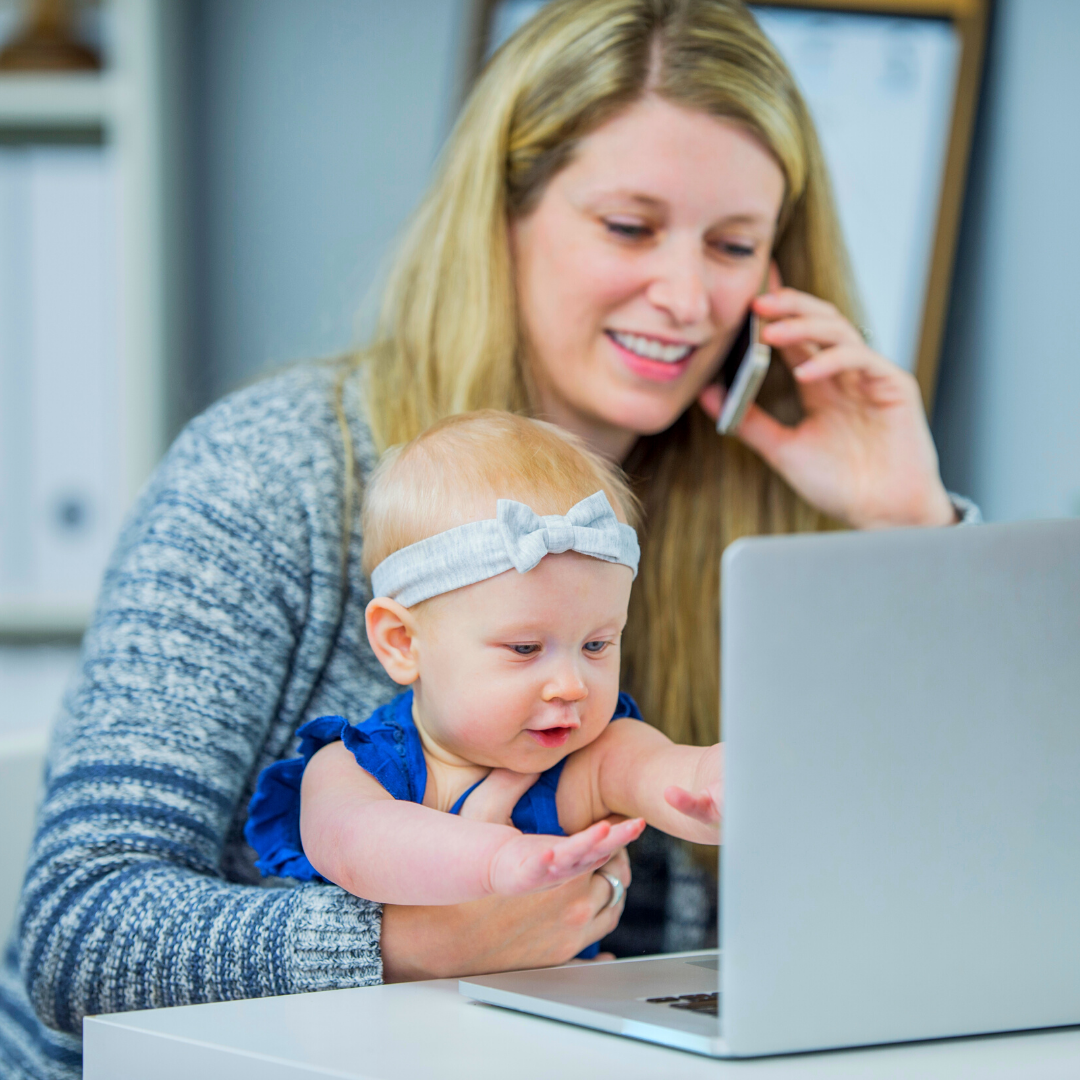
And on the surface, I do a lot of different things, wear a lot of different hats. However, I don’t do it all, and I don’t do everything all the time. There are ebbs and flows to this season of life. Times where I must lean into one thing and lean away from the other. As I’m writing this, my kids are running around the house with a frantic energy that will likely lead to tears from someone any moment. But I do think that it’s important for us to talk about how much is possible as a mother, especially if you love being a mom and also have big dreams of some kind—whether they be creative, or business related, or both.
There’s this idea in our culture that babies and dreams are two separate entities entirely. You can be a mom, or you can pursue your passions. There’s the notion that we must set our dreams aside during the years that we are raising little people. While there is a need to be flexible, and to make space for flexibility that raising kids requires, I’ve found it more than possible to have a family and pursue my dreams.
And I think you can too.
My experience has also been one of exuberant support. My husband helps me troubleshoot and make space for the more intense periods of work that come with deadlines and revisions. We’ve adjusted work schedules, negotiating babysitting and help cleaning the house. There were times, before I ever knew I’d make any money selling my books, where we just found ways to fit writing time in, even if it meant a quick trip to a coffee shop in the evening. I’ve written from the driver’s seat of my minivan, and I’ve written while pizza cooked in the oven. My work right now is not often luxurious, and my time is not plentiful. But it is life-giving for my soul to be able to lean into this passion at this stage of life.
I’ve learned that when I’m not able to pursue writing in any way, when weeks go by without any filled pages, that my cup is empty, and I’m not as good for my family as I am when my creative well is full. When I write, I lose track of time, lost in magical worlds and the journeys my characters undertake. When I write, I feel like I’m doing one of the things I was made to do. Kind of like how I feel when reading my kids a bedtime story, or watching them learn about and lean into the things they love. They are both a part of who I was made to be, and I feel closer to God in both my roles as a mother and an author.
If anything, pursuing my dream while I have kids at home has pushed me to do my absolute best. I know my children are watching, and I want to make them proud.
Over the past few years, I’ve often drawn inspiration from St. Zélie, mother to St. Thérèse of Lisieux. She and her husband Louis were canonized together, and in that they represent for me an example of a strong, supportive marriage. Zélie raised holy children, and in that is an example to me of motherhood. She also owned her own lace business, and in that she is an example to me of a woman contributing to her family and doing the thing that she loved.
For anyone who has big dreams but has been too nervous to pursue them, or for anyone who is going after their dream with kids at home, please know you are not alone. It took me ten years before I got brave enough to even try, to even acknowledge that this is part of what I was created to contribute to this world. Your work has value, just as your motherhood has value. The messages about some sort of inherent contradiction between babies and dreams are a lie.
And while it isn’t always easy, at least for me, it’s certainly been worth it.
I’ve been finding great joy lately leaning into my “Catholic Mom-ness.” The list below is built of little, thoughtful things beyond the crucifixes and rosaries that are often found in a Catholic home. They have made me smile time and time again in the middle of the noise that is raising and homeschooling our four kids.
Enjoy!
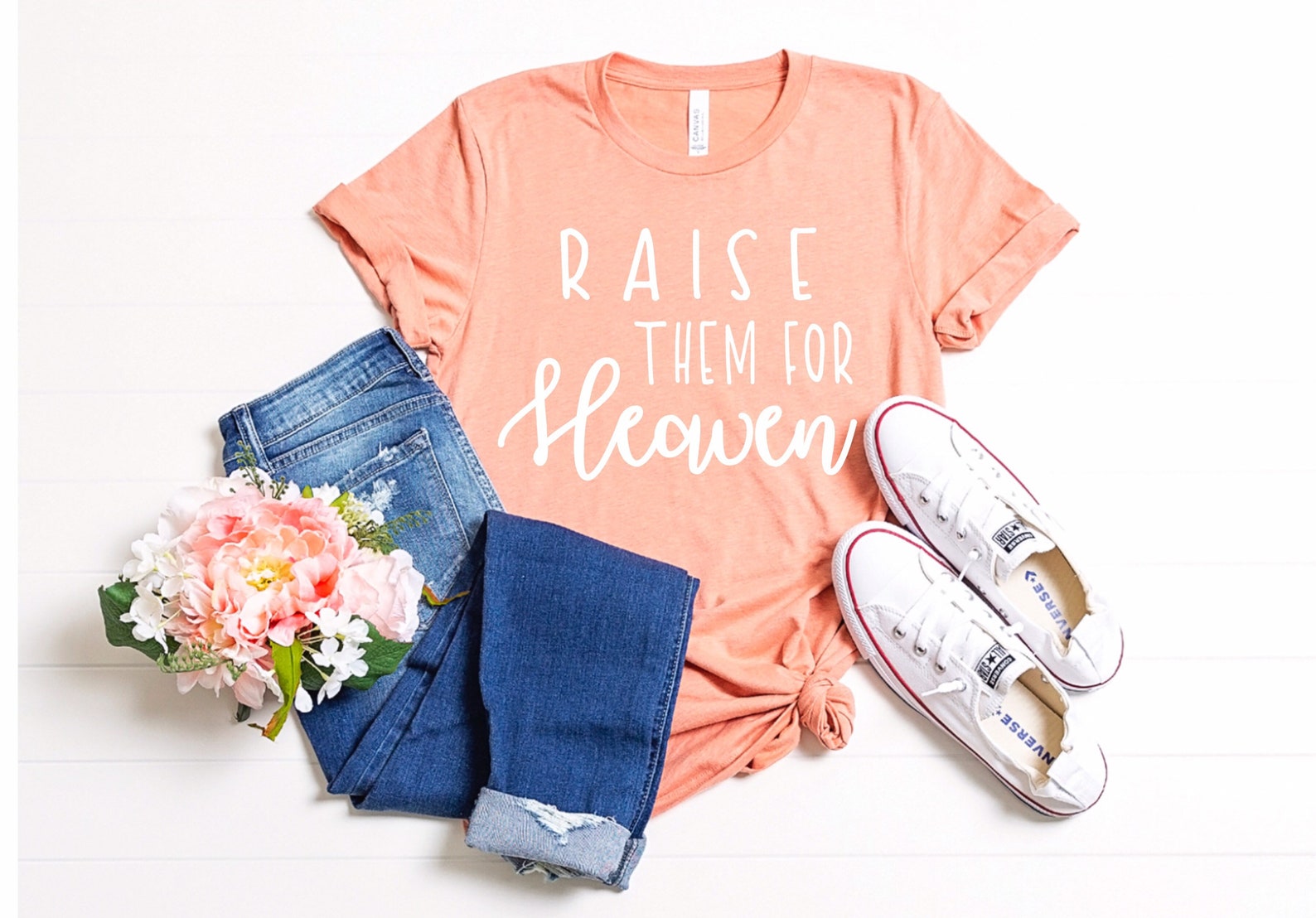
St. Zelie Motherhood T-Shirt
One of my favorite Saints of all time is St. Zelie Martin. In fact, I admire her so much that we have a daughter named Zelie! So when I found this shirt, containing one of Zelie’s quotes that has most inspired me as a parent, I had to put it on my Christmas list this year. The fabric is so soft, which is an added bonus! Available on Etsy and CaelistiCo.com.
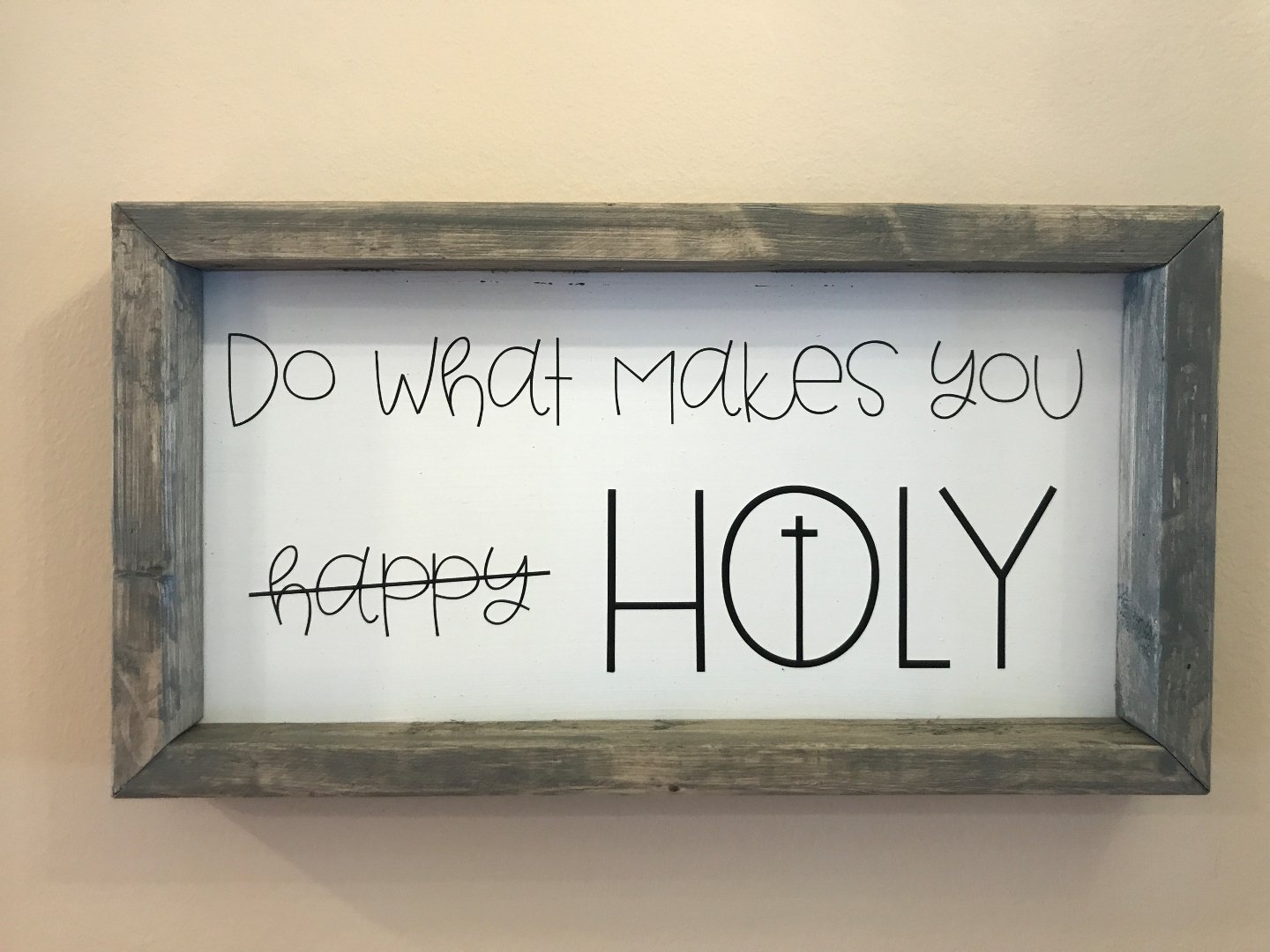
Do What Makes You Holy Wall Art
Our culture promotes the god of happiness pretty much everywhere we look. “This toy will make you happy, this skin cream will make you happy, this car will make you happy.” We’re trying very hard to teach our kids that the only thing that will truly make them happy is God, and growing into the person He created them to be. We’ve hung this wall art in a prominent position in the hall that everyone passes by multiple times a day as a sweet yet poignant reminder.
Hardy Design Boutique, a lovely Catholic shop on Etsy, offers this sentiment as a keychain, sticker, and sometimes wall art as well.
For $5, Rosebud Print Design also offers a printable download of this beautiful truth that you can frame yourself.
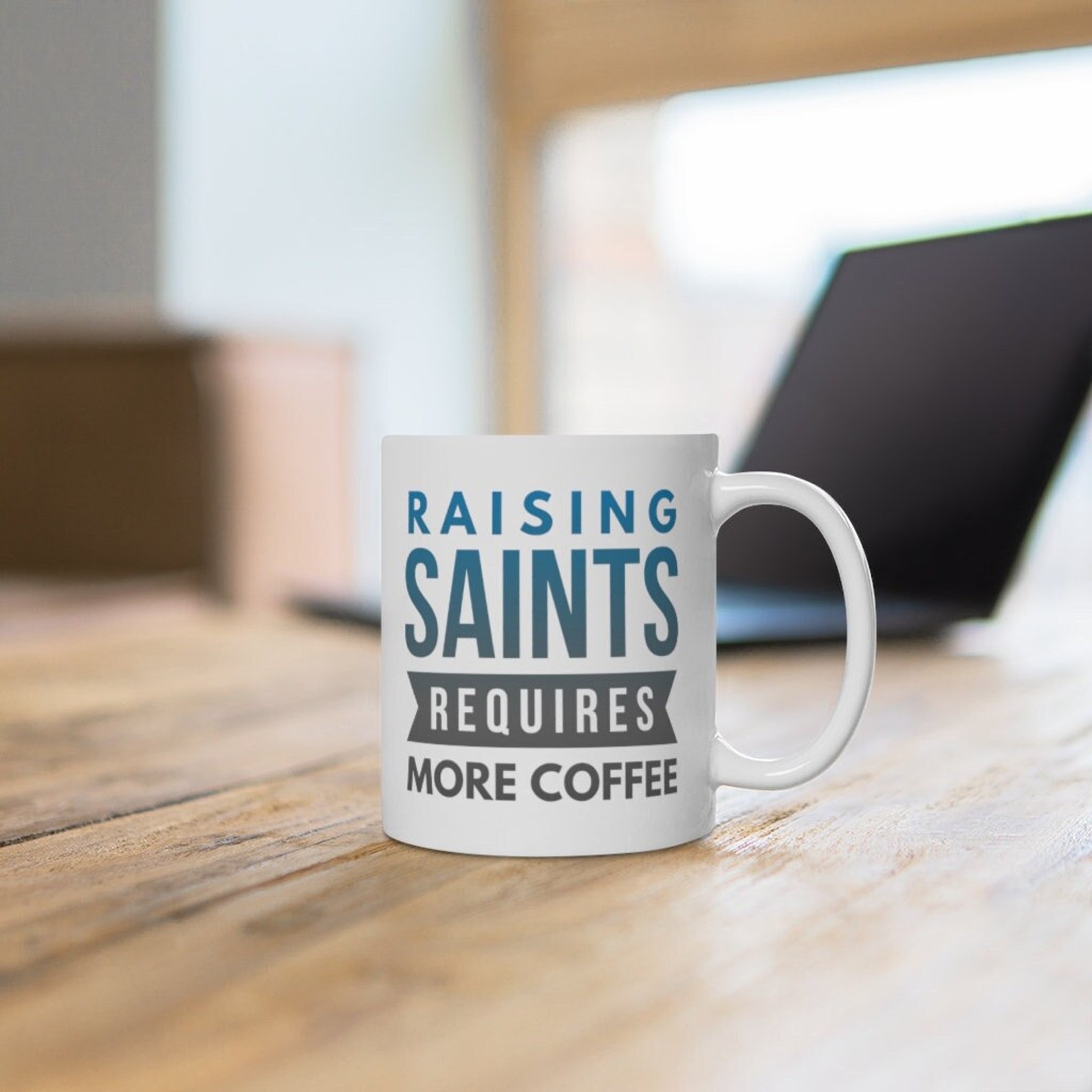
Raising Saints Requires More Coffee Mug
I use this mug from Cause Of Our Joy Studio almost daily! It reminds me of the truth that I am raising my children for God, but that it is a big task, and that coffee can be helpful. And when things get a bit overwhelming, it makes me smile and brings me back to the most important things.
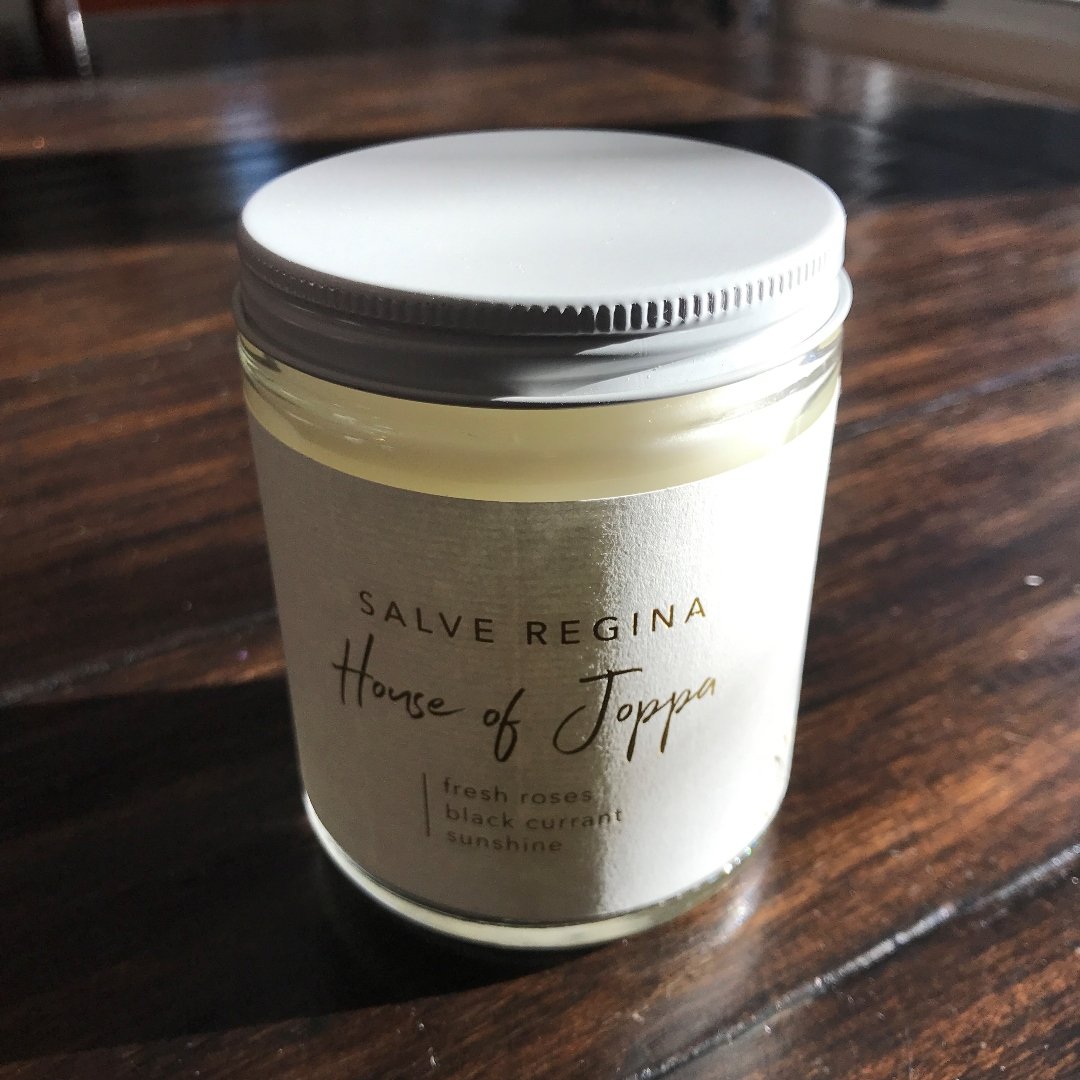
Salve Regina Candle
I think we moms can sometimes tend to brush aside self-care in favor of giving everything to our families. I got this candle from House of Joppa recently in order to remind myself that part of being a good mom is making sure I take care of myself, too. It has become my frequent companion when the 2-year-old is napping and I take a bit of time to sit and read. Little moments can become luxuries with intentional details like the gorgeous scent of this candle, built of roses, black currant, and sunshine.
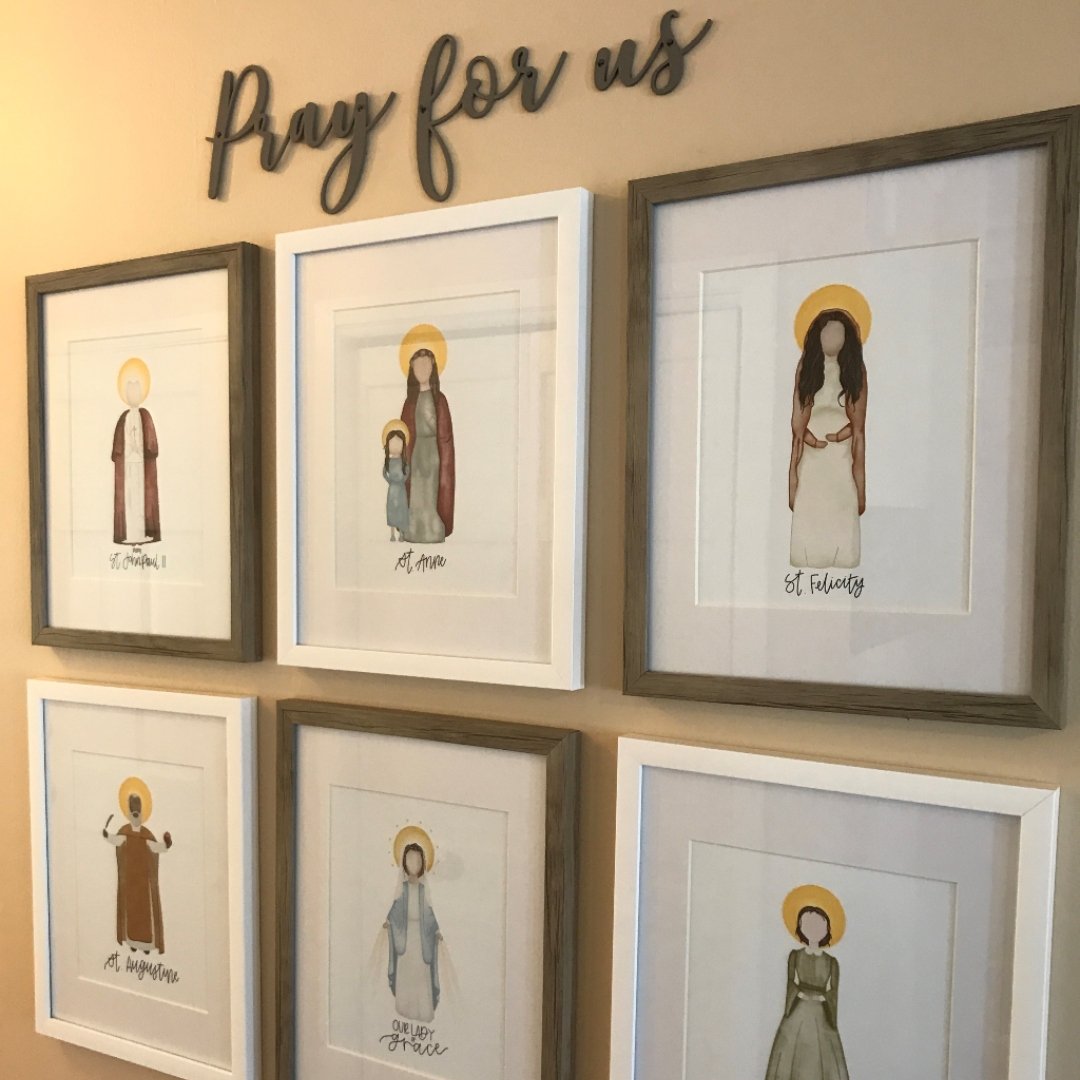
If you’re looking for fresh artistic representations of the saints to display in your home, then MrsTorresCreates on Etsy might just be the shop for you. Each member of our family has either a first or middle name after a saint, and we ordered a beautiful colored print of each saint from this shop to frame and put on the wall of our house, with a metal “Pray for Us” sign directly above it. I love classic representations of the saints as well, but these paintings fit so nicely with the aesthetic of our home, and I was delighted to find the great variety of saints the artist has available.
There are so many fun and innovative ways to embrace Catholic living, direct from amazing Catholic creators! These are only a few, but they’ve made a difference in our home in the best of ways.
Note: This article originally appeared on Catholic Mom.
A few days a week, I get to a point where I ask (usually in exasperation): “Why can’t I even just finish a single thought?!”
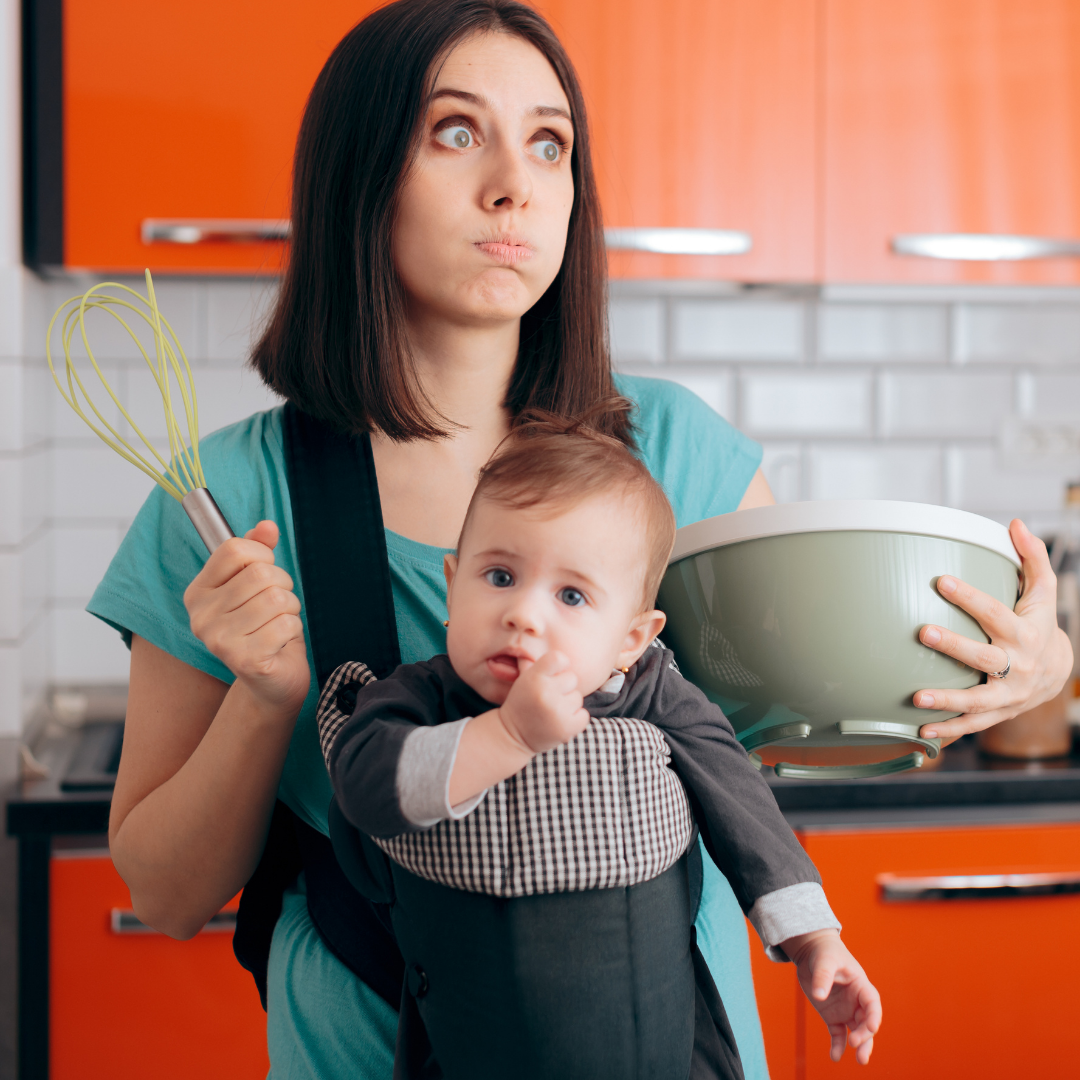
It’s often after hours of homeschooling the kids, trying to place online grocery pick up, folding a basket of laundry, sending a few emails, feeding the children, in a flurry that often feels like a juggling act in a domestic circus. I will freely admit that I sometimes don’t juggle very well. I stare at a few pieces of laundry, sitting folded on the couch nearly all day while the rest of the basket sits untouched. An email languishes, half-composed in my inbox. I’m still in my pajamas at lunchtime because I waited, ever so naively, for a peaceful moment to sneak away.
My brain is even more fragmented than the physical world around me. Four kids at four different developmental stages all ask me different questions and need different things on a near-constant rotation. Someone could scream at any time, or excitedly slam a door, or hurt themselves and need my support.
Once, last month, after planning a very nice Advent activity that got interrupted about five bajillion times, I asked, in front of my children, “Why do I even bother?”
The answer came only seconds later, and I’m glad I ended up saying both the question and the answer out loud.
And the answer was this: “Because I love you. That’s why I bother.”
We all had a moment of exhale after that, and we kept forging on, as we always do.
Sometimes the interruption is to show me something they’re proud of.
Sometimes it’s to ask about something they’re curious about.
Sometimes it’s because they need help with something.
To be sure, not all interruptions even have the potential of being pleasant. A tattle, a fight born out of selfishness, those are the really tough ones for me. How can we just finish talking about being loving and then go off and do selfish things? But even those, no matter how much my heart pinches when I see it, are chances for me to help my kids (and myself) turn back to love.
I’m not very good at accepting interruptions, at least not at the frequency I receive them these days. I like to start tasks and finish them, but the truth is, many of the tasks my kids interrupt aren’t truly emergencies. They aren’t things that are vital for me to complete in any given moment. Truly, sometimes the most important thing is closing my laptop and leaving that email unfinished so I can look at my son’s newest Lego build, or my daughter’s picture. It’s just not always easy, in the moment of the interruption itself, to see it.
I think back over 2,000 years ago when God made what could probably be considered the biggest interruption of all. He literally interrupted time with Himself incarnate. Some people were ready for the interruption, and accepted it gladly. For others, it took a while. For still others, it was hard to accept it at all, and still is to this day. But that great interruption paved the way for humanity to be restored in union with God, through the person of Jesus.
I’m so, so glad, even with all the varied spectrum of reception, that God bothered. And He bothered because He loves us. I hope my kids continue to bother too, because I want to see their creations. I want to hear their hearts. I want to put band-aids on their wounds. I want to keep trying to do cool things with them, even if it doesn’t go as smoothly as I hoped.
Interruptions can be good. And, at least once, a great interruption saved us all.
May we all strive to look a bit more kindly on interruptions this new year, as there are sure to be plenty. May we see the opportunity hidden inside them, and learn to let go of ourselves and lean into what they might have to teach us.
Note: This article originally appeared on Catholic Mom
Purchase Lorelei’s Books Here:
Lorelei is the author of creepy, magical, hopeful stories for children. Her debut, The Circus of Stolen Dreams, released in 2020. Her second book, a magical retelling of The Secret Garden, released in 2022. Both are available for purchase wherever books are sold.
While spending time with my husband and brother recently, I said: “I don’t know if either of you know this, but I can sometimes be a bit rigid.” They laughed, because it’s true. I laughed, because it’s true. It was a good, lighthearted moment.
But now, a few days later, when reflecting on that rare time spent together (my brother lives several states away and was with us for a brief visit), I realize that even my ability to say that, and then to laugh about it, is actually a marker of a significant amount of growth over the past couple of years.
Desiring Control
Some of the pieces of my past have led me to tend toward wanting to control as many variables as possible in my life. Things not going according to plan used to have the ability to send me into a spiral of anxiety. I’ve been doing a lot of work to dig deep into these things in order to not pass them along to my children.
I used to measure success by how many things I accomplished on my to-do list, and whether the kids and I got everything done by sticking to my self-imposed schedule.
Emphasizing the Wrong Things
I’ve been learning, sometimes through fire, that all those things, like getting tasks accomplished when I hoped, or even getting everything done at all, puts an overemphasis on the things of this world, including time, productivity, and what I perceive to be ‘good’ behavior from my kids. I was in danger of sometimes falling into the trap of thinking “My kids are well behaved, so I must be doing a good job as a mom.”
It didn’t leave a lot of room for flexibility, or mistakes, or, the most important of all, all of our journeys to, hopefully, sainthood.
Shifting Focus
My ultimate goal as a mother is to help my children grow into the people God created them to be. To become the saint God intends them to be.
So I’ve been working very hard to flip my normal tendencies on their head. How about, instead of seeing a conflict between the kids as some kind of failure, I see it as an opportunity to teach them how to apologize, forgive, and then make amends. To take a moment of sin or selfishness and support them in facing it head on and doing the hard work to overcome it.
Sticking to a schedule or having everything go exactly according to plan is of such small importance compared to their souls.
A New Way to Measure Success
At the end of the day, I’m working toward measuring success in an entirely different way than I have in the past. Instead of asking if everything went according to my plan, I’m trying a new question.
And that question is this: “Did I support my children in their journey toward becoming the people God created them to be?”
Even if the kids fought every ten minutes. Even if the kitchen is a mess. Even if we only got math done and nothing else for homeschool. Even if I’m exhausted. I want to see my kids in heaven. I want them to go off into the world one day loving God and seeking Him all the days of their lives. That is, unequivocally, the most important thing.
There are so many messages bombarding us mothers these days about what “good” motherhood looks like. It can be so easy to fall into the trap of comparing, of pushing to do more, of measuring up to some standard of success someone else has set for us or that we’ve set for ourselves.
If anyone else struggles with rigidity, or the great tendency to view the immediate moment as the most important thing, please know you aren’t alone. It’s hard, when we’re in this skin and inside of time, to maintain a view of the eternal.
Even Saint Zélie, mother of St. Thérèse of Lisieux, had bad days. In one of her letters, she writes: “Oh well, that’s the day so far, and it’s still only noon. If this continues I will be dead by this evening! You see, at the moment, life seems so heavy for me to bear, and I don’t have the courage because everything looks black to me.”
But she also said this: “For me, our children were a great compensation, so I wanted to have a lot of them in order to raise them for Heaven.” And she did raise her children for heaven.
That is success as a parent. That is the ultimate goal. May we ask God for the grace to see each and every day in light of the eternal, and do the same.
Lorelei is the author of creepy, magical, hopeful stories for children. Her debut, The Circus of Stolen Dreams, released in 2020. Her second book, a magical retelling of The Secret Garden, released in 2022. Both are available for purchase wherever books are sold.
I started homeschooling our school-aged children in March, 2020. I know I am not alone in this timing, though we had planned to start homeschooling in the fall, so I had a bit of a jump on researching curriculum and thinking through what this shift might look like for our family.
I also have a background as an elementary school teacher. I have strong opinions on instructional strategies, and the ways that kids learn best, and I trusted that would serve me well in teaching my own students. It certainly helped me to have confidence in the tools we were using and how I supported the structured learning now going on in our home. But what I didn’t expect was how my background as a teacher would add some struggle and stress into what I hoped would be a (generally) peaceful, enriching time with my kids.
Pressures from the Past
Most of my teaching was done in schools where standardized test-taking was emphasized, partly due to school ratings and funding tied into scores. Most of my students were coming into my classroom “behind,” according to those tests. There was a lot of pressure to catch my students up, and have them make about a year and a half’s progress during their time in my classroom. This had many side effects for me as a teacher and impacted the environment my students were expected to learn in. Some of these I counterbalanced well in order to provide my students with a place where they felt safe to explore and make mistakes and remember to love learning. But as a teacher, under the surface, I felt a lot of anxiety and pressure and like I was climbing a steep mountain without a harness or a rope.
Unfortunately, this carried over into my first year of homeschooling. If we were a bit off-pace for the day, or if the toddler just wasn’t having it, I felt pressure to still somehow “get it all done.” Sometimes that stress rubbed off on my kids. I remember reminding myself, many times, that we weren’t behind, and that one of the reasons, among many, that I chose to homeschool was the flexibility in pacing that it offered. I also remember failing to act as though any of those things were true, and many moments where I didn’t serve my kids or their learning as well as I could due to the anxiety that I carried.
Love Them Well
After going year-round since we started, minus extended breaks for vacations or holidays, we took our first big break from school during July and part of August. As we’re gearing up to start again, I’ve taken some time to think about the goals I have for our technical “second year” of the homeschooling life.
Turns out, I could only come up with one. One single goal that I hope will frame my decisions as my children’s mother and teacher, and move us closer to the homeschooling life I hope to have.
And the goal is this: to “Love them well.”
If my kids can begin and end each homeschool day knowing I love them, and if I can remember that teaching them love is the most important thing, then I think all the academic stuff will turn out okay. If school takes a bit longer than usual, or if our 2-year old makes progress a bit tricky, we can navigate that through the lens of love. If a concept is difficult for someone and it means one lesson takes two days, that’s fine. We can navigate that through the lens of love. I don’t expect that I’ll all of a sudden become the perfect homeschooling parent, but I know this will help us smooth some of the bumps we faced getting started, and I’m looking forward to viewing our days through this goal.
New Beginnings
It’s been tough to break some of the pressures and anxieties of being a classroom teacher in a struggling school, and it makes me sad to think that I probably hid that pressure better from my students than I sometimes do from my own children. But love has conquered so many worse things than this, and God, the ultimate source of love, can help me slow down, see what my kids need in the moment, and give them that grace and room to breathe, or for things to come up, or for us to just have an off-day and come out of it unscathed.
I’m going to write this goal down and remind myself of it often, and see what happens after framing our homeschool life like this after a while as I work to let go of the stressors of the past and focus in on the sweet children right before me now.
Whether you homeschool, or if your kids go to school elsewhere, I’d love to know what your goals are for the upcoming school year!
Hello and welcome to our new series, “Ask a Catholic!” This is a spot where you can ask us anything about Catholicism, and we are happy to answer. I’ve been looking forward to this so much, especially since so many of my friends are Protestant/Evangelical. Firstly, as a way to reduce the misunderstandings between us. And second, as a place to invite dialogue in a world that sorely needs it.
And so, to our first question we shall go!
Question #1: “I’m happily Evangelical. I’m not sure I see the relevence of learning about Catholics at this point in my walk of faith.”
This is a great question, and a wonderful place to start.
I was thinking about it this morning, and I found an analogy that might be helpful. In many ways, I think declining to learn about the Catholic Church, or avoiding it, or even just assuming we understand it enough to know it isn’t for us, is sort of like a child refusing to get to know its mother. The idea of that seems so silly. Of course a child will want to know its mother- as much as he or she can know about her, probably! Because, for one, she is where that child came from. And second, who she is will greatly shape and impact that child for the rest of his or her life.
I think the same is true about the story of our Christian faith and how it grew since its beginning.
As someone brought up in various branches of Evangelicism, my idea of a church was often a relatively plain building or sanctuary that also functioned as an auditorium, or a performance hall, or even a basketball court in some occasions. My idea of church was an opening prayer, a series of songs, an offering…all of which led up to a sermon that was the sort-of pinnacle or focus of the service. Then another prayer and possibly another song at the end.
As I came into adulthood I started to wonder what the early Church looked like…what were there services like? Did we hold the same beliefs? Retain any of their traditions? And if we didn’t, when and why did we give them up? Did our American Evangelical Christianity look anything like Christianity looked like for the generations that immediately followed the life of Christ on earth? And if it didn’t, should it? I began to suspect that whatever it looked like, early Church couldn’t possibly have been an auditiorium-style sanctuary with projectors, and stage lights, concert-style emotion-driven music, and a pastor-centered service.
Then I realized that the people in these places-these auditioriums with the performance heavy services were the same people I had been listening to and believing for years, mostly passively, when it came to what Catholics believed and taught. And the thing was, for a group of people so certain that Catholics were wrong on so many issues, none of them could tell me what the early Church looked like once I started to ask.
So, on one hand, I had pastors and fellow church and small group members telling me what Catholics believed and how wrong they were compared to Evangelicals on a number of things:
“Catholics believe you can earn your salvation, Catholics worship Saints, Catholics have an unhealthy devotion to Mary, Catholics believe you can’t just go to God with your sins, Catholics are so devoted to tradition that they go through the motions and don’t have a personal relationship with Jesus, Catholics added books to the Bible, Catholics don’t believe in Bible Alone and obviously Bible Alone is the truth, they don’t believe in Once Saved Always Saved and obviously Once Saved Always Saved is the truth, Catholics think you can earn your salvation by works.” Just to name a few.
Then, on the other hand, I also had this vague understanding that the early Christian Church-from Jesus until the Reformation…was Catholic.
I started to wonder if somehow not all of the things I had been taught or had come to believe about Catholics were true, or even if they were, if they were maybe incomplete in some way.
And it all comes back to this. The child knowing its mother. If we don’t understand Catholicism, then we don’t truly understand the history of our Christian faith.
We don’t understand where we came from.
The Missing Years
Christianity didn’t appear in a vaccum, with hipster pastors and rock music and stage lights, even though that was my experience of Christiany- it was what I had known my whole entire life. Some of the churches I went to were very humble, just a couple of singers adding their voices to a cassette tape through the speakers. Others were much more highly produced, and some even recorded songs and sold CD’s of original music. But I had fallen into the mistake of thinking that because it was all I had known, that that was all it ever was. Pre-Reformation Christianity had been explained to me in vague terms like ‘indulgences’ and ‘Luther’ and ’99 thesis nailed to a door,’ even though our faith had existed for 1500 years prior to that. It was like we had the Bible, and then we skipped right ahead to the Reformation.
What on earth had gone on in between? What did the earliest generations after Jesus do and believe? How did they structure their life and practice of faith?
No one at the Baptist/Calvinist church we were attending at the time could tell me. I wondered if it could even be known? If it could, I felt very strongly that I needed to know it. There had to be something incredibly precious and sacred about those early Christians and the way they lived their faith. I felt like they had something to teach me, and the fact that I had grown up in an modern, Americanized bubble of Christianity no longer served as an excuse.
Our History Matters
There’s a joke among Catholics that to study Church history is to cease to be Protestant. I harbor no illusions that my little posts here and there will send people running to the Catholic Church. But I do hope for this: For anyone with whom I’ve garnered any bit of trust, I hope you’ll read this series. If for nothing else than to better understand a part of our shared Christian faith that was there since the start.
I think we all only have something to gain from a better, clearer understanding.
And that, my friends, is how we begin the “Ask a Catholic” series. Feel free to email us a question for the series, or drop it on our Facebook page or at the bottom of this post. We’ll answer as soon as we can!
-Lorelei
Purchase Lorelei’s Books Here:
Lorelei is the author of creepy, magical, hopeful stories for children. Her debut, The Circus of Stolen Dreams, released in 2020. Her second book, a magical retelling of The Secret Garden, released in 2022. Both are available for purchase wherever books are sold.
Well, I lost my patience. Again. The kids were absorbed in playing a game and forgot to take our puppy out. Then he went to the bathroom on the floor. As the lone adult in the house for nine hours each day, I know I should be able to be the mature one and maintain my calm, but sometimes I fail. I take in a slow deep breath and prepare to make amends, feeling as shattered as my kids’ hearts at my sudden harshness.
I loaded the dishwasher as fast as I could while my youngest screamed for more candy. I had already given her the chocolate chips as a distraction so I’d have time to finish this one chore. But I got distracted by another kid asking a question and by the time I got back to it, the tot was screaming and holding an empty bowl up to me in chocolate smudged hands. Completely overstimulated, my hands start shaking and I’m not quite sure how I’ll get it all done.
Sometimes, I yearn for quiet. Not a stolen moment here or there, but quiet I can count on. I want to be left alone long enough to take a long shower, or read a full chapter of a book, or think a single complete thought without interruption. In and of itself that isn’t bad, but the surge of guilt I feel over even having those feelings becomes its own kind of failing, too.
Often, in the middle of all these failures, I’m completely overwhelmed by the fact that there are four tiny souls in my care and it’s a huge part of my work on this earth to help them get to heaven. I know that I want better for them. I know they deserve better. I look at pictures of our Holy Mother and feel so far from being like her that I have to turn away.
What Do We Do When We Feel Like We’re Failing?
When my book came out, I would hyper-focus on negative reviews and dismiss the good ones, even though there are so many more good reviews than bad! It became necessary for me to stop reading reviews as a whole so I could keep a healthy balance as I wrote the next things. If only I could stop reading my successes and failures in the same way and live in some mythical land of neutral ignorance.
But we can’t just avoid our weakness or our triumphs in some assumed ignorant bliss — we have to live them all. And we have to reckon with what they mean.
So, what do we do when we feel like we’re failing?
To start, my many failures make it abundantly clear that I’m not a saint yet. I sin, I am flawed, parts of me are broken. I’m not fully the person God made me with the potential to be.
I think we can do two things once we have that realization. We can think that we never can be saints, that sainthood is reserved for the Mother Marys, and Thérèses, and Lucys, and that we’ll never quite make the cut.
I like to think that most days, when the dust settles, I look toward an option two. Option two is the voice that tells me there have been many quiet saints made of mothers throughout time, most of whom we’ve never even heard of. It tells me that this calling can purify me and build me into an example of holiness for my sake and the sake of my children. It’s the option that tells me I’m not a saint yet.
My kids see me struggle. They see me kneel down and ask for forgiveness for being impatient, or raising my voice, or assuming the worst.
Perhaps one of the most important things is that my children see me not give up. They need to see me go to Confession, they need to see me say I’m sorry and work to make amends. They need to see me practicing the faith and receiving the Sacraments and working every day to open myself up more to Grace.
Because, when all is said and done, they’ll have their own paths to sanctification. Maybe it will be smooth sailing and Grace will flow in them and through them from an early age, filling them to the brim. But maybe it will be more of a rocky road.
And if their path includes stumbling and picking themselves up, over and over, then maybe, just maybe, they’ll remember their mom struggled and never gave up, too.
So, to all the moms who feel like a failure. Let’s keep going. Let’s show repentance and penance and let’s show redemption. Let’s let our children see us lean into our faith when we struggle. Most saints are made, not born that way.
Our little future saints need examples to follow, not only in the great saints of the Church. They also need to see it inside the walls of their home. God has been so faithful to convert so many hearts, I have to trust that he can take what mine has to offer and mold it into something beautiful and fruitful, too.











.png?width=1080&name=20210920%20LSavaryn%202%20(1).png)




 This Catholic Family: Catholic Womanhood, Family, and Conversion