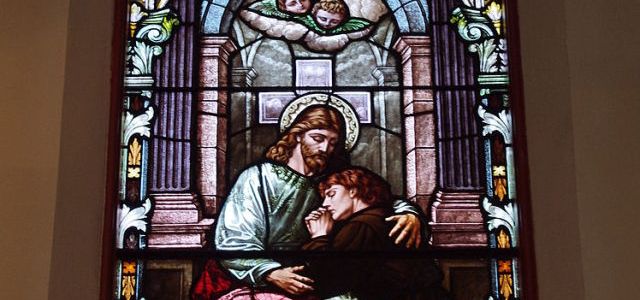
Learning to say “I Forgive You”

Struggling to Say It

Growing up, the words “I’m sorry” and “I forgive you” didn’t always come together. I think my parents, particularly when dealing with me and my brother, did their best to teach us how to get along and make things right when someone was offended. But one of the things that strikes me the most when looking back, is that repentance and forgiveness wasn’t necessarily modeled to us, at least not regularly and consistently for me to remember that as a pattern of family life.

I think that’s partly why, as an adult, it was really hard for me to say I was sorry, and even harder for me to say “I forgive you” after someone had apologized to me. This was especially true when it came dating and early marriage. I remember times, sitting in the car with my husband driving, when he had apologized for something and I just sat there, staying silent. I literally felt the heat of anger inside of me as I made him wait a long time for those words. Even when he pointed out my reluctance and that it ws hurtful to him, my mouth did not want to open. I still don’t fully understand why it was so hard for me to offer that to someone I loved, other than some selfishness in me felt it would be more just to make him suffer.

Confession and Forgiveness

Another piece of my journey in this area that’s been helpful has been the Sacrament of Reconciliation. Five years ago, as I neared the culmination of my conversion to the Catholic faith, I began to understand and deeply appreciate the value of examining my conscience-saying I was sorry, and literally, audibly, hearing forgiveness offered to me by the Priest, who is really standing in Jesus’s place. Trusting you’re forgiven is one thing. Hearing that mercy spoken to you out loud is certainly another. Confession has changed me, and continues to do so. I know now very deeply how it feels to know you are forgiven by hearing it said. I know how much it has the power to heal.

My husband had grown up in a home when repentance and forgiveness came easy, or readily, at least. And he couldn’t understand why it was so hard for me to offer forgiveness to him. I’ve had to work really, really hard over the years to say “I’m sorry” as soon as I understand I’ve caused hurt to someone, and to say “I forgive you” honestly and quickly after an apology is offered to me. We are now teaching this to our kids and modeling it intentionally with our own actions in and out of the home.

Because here’s the thing: Our entire faith is based on an ocean of unmerited grace. It doesn’t really matter what someone has done to me or how I’ve been offended. If I believe in Jesus and his sacrifice on the cross and his power over death, and his doing all of that to offer reconciling grace to me and everyone else who has ever existed or will ever exist, that significantly changes how much of a right I have to hold a grudge.

In some cases, offering forgiveness and also letting go or setting boundaries might be the appropriate choice. But I also think there is something to be said for the healing power of forgiveness not only for the person being forgiven but also for the person who forgives. Forgiveness can help heal the offender, but it also heals the offended. And if the Creator of the Universe has chosen to not only forgive us, but has suffered greatly to do it, then how freely should I open my arms to others and forgive them?

If we truly understand the former, then the latter isn’t even really a question.

Lent is a beautiful time of year in the Church for so many reasons. The continued call to conversion through almsgiving, fasting, and penance helps prepare our hearts for Easter in such a special way. If you haven’t been in a while, or even if you have, perhaps it’s time to go to Confession. To find a few quiet moments this Lent to examine your heart and say you’re sorry and turn yourself back to love.

And then, of course, to receive an absolute ocean of unmerited grace. A grace that has the power to fill us, and flood out into the whole entire world as we forgive others, too.

-Lorelei

Purchase Lorelei’s Books Here:

An Interview with Felicity about Her First Confession!

Felicity and I sat down for a few minutes after her First Reconciliation today (hooray!), and she shared a bit about what the experience was like for her!

You can listen to the interview via SoundCloud by clicking here, or the transcript from the interview is below. Enjoy!

BC8F1025-9CBB-4DE0-B267-376BD70FCA85

Mom: I, as your mother, did not have first confession until I was a grown up, so I have no idea what it’s like to go to first confession as a kid. And I thought maybe if you shared your thoughts a little bit, you might help another kid who is getting ready for their First Confession. So how were you feeling before you went?

Felicity: I was really nervous. And when I went in, I was scared and I didn’t know where to sit, so I chose to sit face to face. It really wasn’t that scary.

Mom: It wasn’t? What made you decide that you wanted to sit face to face?

Felicity: Because, well this was my first confession, and I just, I didn’t want to be scared.

Mom: And how did it feel when you were doing it? What were your thoughts in confession?

Felicity: It was a little scary when I was in there, because I didn’t know if she sheet that I had had everything on it, but really it did, and it went well.

Mom: And how did you feel after you were done?

Felicity: After, I felt really happy and excited.

Mom: So what would you say to any kid who’s getting ready for their First Confession?

Felicity: I’d say, if you’re scared, that’s normal. And, it’s really not scary. And it’s really great.

Mom: Why is it so great?

Felicity: It’s basically a way of getting rid of your sins, throwing them in the garbage, and letting the garbage truck take them away.

Mom: What does mom call confession? Do you remember what I’ve been calling it? The Saint Maker?

(Laughter)

Alright, anything else you want to say?

Felicity: Nope, that’s it.

Mom: Okay. Alright, thanks so much Felicity thanks for joining us on our first mini-interview on This Catholic Family!

Purchase Lorelei’s Books Here:

What’s The Deal with Catholic Guilt?

I think we’ve all seen or heard someone make a joke about “Catholic Guilt” at one point or another.

This article explores what Catholic Guilt is, really. And if it’s actually funny. Or, on the other hand, if it a misrepresentation of something meant for our good.

What is Sin?

It’s important to get on the same page about sin before we even attempt to talk about this issue. Let’s turn to the Catechism to get our definition.

1849 Sin is an offense against reason, truth, and right conscience; it is failure in genuine love for God and neighbor caused by a perverse attachment to certain goods. It wounds the nature of man and injures human solidarity. It has been defined as “an utterance, a deed, or a desire contrary to the eternal law.”121

1850 Sin is an offense against God: “Against you, you alone, have I sinned, and done that which is evil in your sight.”122 Sin sets itself against God’s love for us and turns our hearts away from it. Like the first sin, it is disobedience, a revolt against God through the will to become “like gods,”123 knowing and determining good and evil. Sin is thus “love of oneself even to contempt of God.”124 In this proud self- exaltation, sin is diametrically opposed to the obedience of Jesus, which achieves our salvation.125 

(emphasis mine)

Using this definition, I often break down the idea of sin to conclude it is any time where I choose to serve myself rather than another. It’s desiring my perceived good over my actual good. It’s refusing to love. And in refusing love, I am refusing God because God is Love itself.

Sin wounds my relationship with God, because I’m actively rejecting Him. It hurts my soul. It makes me sick.

When I think about sin now, I think about any one of us, if we gave in freely to our own passions, distorted from God’s good intent, might even find ourselves on earth in our own sort of personal hell.

Sin is serious business. But, thankfully, that’s not the end of the story.

My Protestant Practice

Before becoming Catholic, I didn’t spend a lot of time thinking about the ways I rejected  or blocked God (Love) out of my life. Some of the churches I attended would have a moment for such reflections. But it was usually just that, a moment. And, to be honest, in those moments I most often thought “meh- I think I’m doing pretty good, comparatively speaking.” I shake my head at my past self now. And I’m still not exactly sure who I was comparing myself to… those convicted of crimes against humanity? The people in pews beside me, as some sort of holiness version of keeping up with the Joneses? Just the general sense that, in the grand scale of humanity, I was doing okay?

And then the service would move on and I would move on and I continue along my merry way. I knew I could ask God for forgiveness, but as someone who had come from a Once Saved, Always Saved tradition (for much of my life), I didn’t have an ingrained sense that my confession mattered. I had ‘invited Jesus into my heart’ as a child. And if you are Once Saved, Always Saved, then the moment you say that prayer, it’s a done deal.

Now, you can read more about how I learned that perspective didn’t fit with my actual life experience in my Coming Home Network conversion story by clicking here, but suffice it to say, I had accepted Jesus as a child, then possibly crossed over into rejecting Him as a young adult before I made my way back through the Catholic Church.

I learned through that journey that my choices do matter. They have eternal impact. And yes, everything good I do is by the grace of God, but I’m not an automaton. God can work through me to show his love and healing to this world, but He needs my yes to do it.

And so I’d better pay attention to the areas in my life where I’m letting Love in, and also to the areas in my life where I’m not.


The Value in Examining Our Conscience

I worry about the fading of the concept of confession in general as the trees of Christian separation continue to branch farther and farther away from their historical roots. And I have personally found immense value in examining my conscience on a regular basis, followed by a good Confession.

But first, what is an Examination of Conscience?

An Examination of Conscience is a beautiful exercise we do as Catholics, where we take stock of our lives and our heart. We spend time praying about and thinking about the areas where we are letting God (Love) lead the way, and the areas where we are turning from Him (Love) and choosing to serve ourselves first. We take an honest look at where we are being selfish, or prideful, or fearful, or careless, or impatient, or any number of things.

There are many ways to examine our conscience. Click here for a link to some excellent resources that walk you straight through the entire process.

But we don’t just leave it there when we’re done. We aren’t meant to just acknowledge our shortcomings and sit around feeling bad about ourselves. We know we have the ability to make a change. We can grow in virtue and holiness. We can turn our “No” to God, into a resounding “Yes.”

Once we have examined ourselves, we are ready to make a Confession.

Confession: A Healing Sacrament

It’s no secret how much I love Confession.

Confession is so many things. But one thing it is not. It is not a rote recital of our wrongs just for the sake of checking an item off a list.

It is a Healing Sacrament. And for good reason.

When we go to Confession, we sit before a Priest, who is standing in place of Jesus for us. We share with him those struggles we identified in ourselves. And we receive, not only God’s forgiveness to us, but we also receive penance, our medicine to help heal the wounds created by our sin.

We leave Confession with the Grace of God to continue to say yes to Him. And if and when we fail, we know Confession is always there, to help us right our path. To help us to learn to love others better than we could on our own. To help sanctify us, and to flood us with God’s Amazing Grace so we can effectively live as His hands and feet.

Back to Catholic Guilt

Nothing about the Catholic Church desires for us to hobble around, eternally burdened by our shortcomings. And long story short, anyone who has been haunted by Catholic Guilt in their life, has taken these beautiful practices meant for our own good, for our own healing, and for whatever reason, allowed them to become distorted.

When I’m carrying some burdens inside my heart, I might know it’s time to go to Confession. So I just set up a time and go. I know I want to let as much of God (Love) into my life as possible, and if I can be honest with myself about when I’m not doing that, then I can experience healing and let His Grace help me make different choices.

There’s a huge difference between the conviction we need to make something right, and then doing something to heal what we’ve broken, and the notion of “Catholic Guilt.” Guilt, when left to its own devices and void of the connection to healing, can turn us inward and makes us focus dangerously on ourselves. And when we focus on ourselves, we are entering a realm that is unhealthy for our souls. We are entering the realm of sin. 

So, no, Catholic Guilt isn’t funny. It’s actually probably a sign that someone has experienced pain in some form or another inside the Church, and have not yet found their way to the healing. If we know people who struggle with this, or who have left the Church because of it, it is so vital that we live Grace in our own lives. Forgiveness in our own lives. The joy of healing in our own lives.

We have the opportunity to be an example to those who misunderstand our faith, to those who are seeking, and to those who might be confused. Let us be an example of the Church’s beauty as we seek, more and more each and every day, to choose Love.

-Lorelei


Purchase Lorelei’s Books Here:

What’s The Purpose of Penance?


This letter is free for you to read, but it wasn’t free for me to produce. If you’re interested in supporting the work of This Catholic Family, I would be honored if you would prayerfully consider upgrading your subscription. Or, you can always throw a little change in the tip jar here.

When a Catholic goes to Confession, several things happen. We come with contrition and confess our sins. We receive the absolution. Then, the Priest assigns us our penance. But while we may know what to expect, it’s also immensely important to understand why we are doing these things.

I’ve written extensively about why I absolutely Love Confession, but I haven’t written in-depth about penance and its purpose and value. This post is an attempt to do just that.

What is Sin?

At its core, sin is turning away from God. It’s an active decision on our part. It’s us saying “No, God, I won’t do things your way. I know better than you.” Sin can happen in big ways (mortal sin, which breaks our relationship with God) and in small ways (venial sin, which wounds it).

All sin is sickness for our souls.

What is Penance?

Penance is something for the confessor to do after Confession ends, on their own, and hopefully as soon as possible. Sometimes it’s a prayer or a series of prayers. Sometimes it’s something related to an issue the confessor struggles with. It could look many different ways, and could take varying amounts of time. Some of my personal favorite penances have been ones that directly related to an area where I struggle.

But, regardless of what penance looks like it is always, always, a way to repair the harm that sin has caused in our lives.

It is meant to help us turn our hearts back to God. Just as our sin was an active choice turning away from God, penance is an active choice turning back to God.

Do I have to do penance to be forgiven?

This is something that is often misunderstood, even by Catholics. Once the Priest offers absolution during Confession, we are forgiven. The grace is there because of Jesus. Not because of anything we can do. So, no, penance is not required for forgiveness to occur.

But then, if we’re already forgiven, why do we need it?

Medicine For The Soul

Just as sin wounds (or breaks) our relationship with God and makes our souls sick, penance is medicine that helps us turn our hearts back towards our Creator. Confession removes that sin from our shoulders. Penance helps us move towards a more holy future.

As such, whether our penance is prayer, or something specific to an area we struggle, we should not approach penance with the attitude of simply ‘checking something off a list.’

If we do penance with a disengaged heart, the purpose of penance isn’t served. Penance is a way to turn our hearts back to God, it’s a prescription for healing, and, much like any other medication, it’s up to us to use it. If we’ve gone to Confession with a truly contrite heart, it follows that we would want to continue on that path of obedience and progression towards holiness by following through on our penance as soon as possible, and by using that as a springboard to help spur us on towards a closer walk with God.

It’s a beautiful medicine we are offered, and it is to the benefit of our souls to take it.

-Lorelei


Purchase Lorelei’s Books Here:

Purchase Lorelei’s Books Here:

Laying Down My Rights

Just when ya think you’re in pretty good shape… something comes along and reveals the sin in your own life very clearly.

JP made a mistake this week. A very honest mistake. It ended up costing us $100. Which isn’t the most money in the world. But, it was enough to provoke a reaction in me that I am not proud of.

I got so mad about that $100. I thought some Not So Friendly Thoughts. I wasn’t very nice.

And the whole time I was having the reaction I had, I knew that the root of it all had to be some sin of my own.

I literally was having a conversation with myself in my head (not like a crazy person conversation, but a totally sane inner dialogue) that I knew I was reacting sinfully, and I needed to stop, and then the other part of me was saying I had a right to be angry and offended and to let him know how I felt.

There were a couple of realities at play here.

I know, of course, that my husband is allowed to make mistakes! Neither of our mistakes are going to consistently cost us $100, but this time it did. And that doesn’t change the fact that I have no right to insist on his perfection, because I could be the one making a mistake tomorrow that has a cost to him.

Also, I knew if I had made the same mistake he had, and he had reacted the same way I did (which, by the way, he never would have), I would have been extremely hurt. He wouldn’t have made me feel small. I knew that, and I still felt the desire to assume that I had a right to make my offended-ness known.

The Bigger Picture

Okay, so… here’s the thing.

Here is why I knew so deep down that my reaction was unacceptable, and sinful on my part.

Straight up Truth: My husband is Imago Dei. He is created in the Image of God. And that, in and of itself means he is to be shown dignity, at all times. And it means that he has immense value by virtue of his being God’s Image Bearer.

And I knew that, and I felt myself wrestling inside with knowing that reality and still wanting to claim some right of my own to be offended, and let him know it.

Here’s the other thing.

I have no right to respond in sin, because of my Christian faith.

I believe that Jesus, One who had never made a mistake, had never sinned, who had every. single. right. to claim offense, willingly, and with love, took every. single. sin. of every. single. person. from the entire history and future of the entire world upon Himself.

And he died on that cross, partly because of the sin I committed against my husband over this matter. My sin over this is one of the reasons He hung there. My sin is like one of the thorns pressing down upon His head, and piercing His skull, and causing Him pain.

Jesus never claimed his rights. He who had the most right in the world to be offended, took all of everything upon himself. He never for one moment has given us anything less than the utmost dignity. He never for one moment has given us anything less than perfect love.

Colossians 3 states:

12 So, as those who have been chosen of God, holy and beloved, put on a heart of compassion, kindness, humility, gentleness and [k]patience; 13 bearing with one another, and forgiving each other, whoever has a complaint against anyone; just as the Lord forgave you, so also should you. 14 Beyond all these things put on love, which is [l]the perfect bond of unity.

I know I was anything but compassionate, kind, humble, gentle, or patient over this matter. And I was slow to forgive. But the real kicker, is the part that says “Just as the Lord forgave you.”

And, at that, I have to humbly surrender. At that, I realize I have no rights. I have no claim to offense. And I need to extend the same grace extended to me, to others. Especially to my husband when he makes a mistake.

How Deep The Father’s Love

I am so thankful for the Lord’s forgiveness in my own life, but it is also so convicting right now. I am acutely aware how I tried to claim something I have no right to claim. And it came at the cost of giving my Imago Dei husband the dignity that is his.

I know I’ll be heading to receive the Sacrament of Reconciliation this coming weekend, for this, and other things. And I’ll be looking forward to audibly hearing that unmerited forgiveness from Jesus. I’m also looking forward to my penance. I suspect it might be something I can do to show my husband love and dignity. Which will be just the medicine I need.

One of my favorite hymns of all times is How Deep The Father’s Love For Us.

It’s just such a beautiful reminder of the most beautiful Truth. I can’t even grasp how much Jesus took upon himself on the cross. But I know it means my salvation.

And I know I can, once again, receive the forgiveness that is there for me through my faith in Him. And I can be thankful that He promises to shape me more into His likeness, as long as I continue to allow Him to work in my soul.

I am thankful that I know I don’t have to live in guilt. That I can pick up and move on and work towards better reactions in the future … but it just smarts a bit realizing you’re wrong. Humble pie doesn’t always taste super great.

And, finally, I would be remiss if I didn’t mention JP. Because I can also be thankful for a gracious husband, who witnessed my struggle, and accepted the apology of his Much Too Quick To Anger Wife, and for the example he sets of patience and grace within our own marriage.

Lorelei


Purchase Lorelei’s Books Here:

Why I Love Confession

One of the topics I get asked about most often by my Protestant friends is Confession. So here is a humble attempt to explain what the Sacrament of Confession means to me.

Let me start by saying I love Confession. Love it. It’s awesome. More on that in a moment.

And then, let me also start by explaining a bit about what Confession is not to me.

To me:

Confession is not a guilt-induced act that is forced upon me by a strict and rigid institution.

Confession is not my only means of being connected with God, nor is it my only means, in most cases, of being forgiven by God.

Background

My history with the idea of Confession, in any form, was rather shallow. I understood that I needed to ask Jesus to forgive me of my sins to commit to Christianity, but, honestly, I was a young kid and I didn’t really think much about what “sin” meant… not listening to my parents, spreading a rumor, being selfish… all things I knew were sin, but for the most part, I, personally, felt like I was doing pretty well overall. Also, many Protestant traditions believe that once you are a Christian, your past, present and future sins are forgiven. So I didn’t feel like there was a lot of motivation to think about my sin.

Also, growing up in different Protestant Churches, most of them would have a time of private confession at some point in the church service. It’s where the pastor or whoever was leading that part of the service would have everyone take a moment and think about their sin, and then pray for and thank God for His forgiveness.

To be honest, in my experience, nearly every time that happened whoever was leading the confession didn’t even give me enough time to begin to contemplate my own sin. The pause lasted for like 5 seconds. And… 5 seconds is inadequate for a true examination of conscience. So I usually just stood quietly and looked prayerful during that time. And still, I continued on not thinking much about my own sin.

I have since found out that the community confession time in many Protestant churches harkens back to the early Christians, but it isn’t really a full representation of what early Christians practiced. It’s more of a shadow of it. Though, I think most Protestants would agree that confessing one’s sins is important in some regard, the actual practice of it in many churches today doesn’t reflect the depth and purpose and history of Confession itself, or why it is important.

Sin

This is how I have come to understand sin. I have come to understand that God is offering, every moment of my life, to come alongside me and walk with me. Everywhere. And all the time. He never will leave me. Sin is where in my heart and my actions, I block God out of my life.

In Catholic Confession, prior to going to Confession, it is most appropriate to process through an Examination of Conscience. Many are based on the ten commandments, but there are others as well, for children, married people, single people, etc. It is a really thorough way to discover where I am not allowing God fully into my life. Even just the 1st Commandment examination… I reflect upon where in my life I am not putting God first. Where am I putting something or someone else in God’s place.

One thing I’m definitely not doing is  sitting around with my head in my hands in hopelessness over how sinful I am. It’s actually really helpful for me, and I can use those reflections to allow God into more of my life.

I’ve also come to understand sin as that which wounds our soul and our relationship with our Creator. God is there, all the time, but when I turn away from Him and do my own thing, it is bad for me… left unchecked, it will contribute to my walk with God becoming unhealthy over time… sick even. Many of humanity’s own classic tales reveal what happens when someone is overcome by sin in their own life. Ebeneezer Scrooge and his greed, the Beast and his lack of charity, the Grinch and his desire for revenge.

Sacraments

Catholics believe that Sacraments are ways that God makes tangible (something we can see, smell, taste, touch, or hear), something that is a spiritual reality. So, for example (briefly, because this is a whole ‘nother post), marriage is a Sacrament. It’s meant to be a tangible representation of Christ’s relationship with the Church. Something we can see, and, within the marriage itself, touch, that is meant to draw our minds towards heavenly truth.

Confession, is another Sacrament.

Confession Itself

This is where it gets good. This is the stuff.

I think it is easy for many to think about confession in a church service, or praying directly to God for forgiveness. Catholics also have a time of confession communally each Mass, and Catholics also can pray directly to God for forgiveness in most cases.

I also think it’s easy for Christians to acknowledge that we are to be the hands and feet of Jesus to the world around us.

When I walk into the confessional, I am walking in and talking to the Priest, who is acting as the hands and feet of Jesus for me. Instead of silently admitting my sins in private or at church, or to myself alone, I get to verbally share about the areas in my life where I am struggling to let God in. I verbally ask for forgiveness.

And then I audibly hear I am forgiven.

And that is huge. God knows we are both spiritual and physical. I love that this Sacrament exists, and I can hear the truth of my forgiveness time and time again, audibly, from someone who is representing Jesus.

But that’s not all. The Priest then spends a bit of time talking to me about some of my struggles, and prescribes penance. That word is one that may cause someone who isn’t Catholic to go… Yikes! Danger! Or What is that?

Let me explain what penance is. Just as unrepentant sin can hurt our walk with God, and even make our souls sick, penance is a sort of medicine that helps me to turn back to God in the areas in which I struggle.

Example. If someone hurt me and I am struggling to forgive them fully, my penance for that might be to spend some time praying for those people. Penance is simply helping me turn back to God and let Him into more of my life, in the areas where I am blocking him out through my actions.

And I leave the Confessional full of the Holy Spirit, and so thankful for God’s redeeming work in my life. I leave with joy, and I always look forward to going. It helps keep me tuned into and focused on my Savior, and helps me be more aware to walk more closely with Him. More than ever before.

Summing Up

Here is what, to Lorelei, Confession is.

Confession is one of the many ways that I can receive God’s grace.

Confession is a tangible representation of my forgiven and restored relationship with God.

Confession is a Sacrament of healing, and of helping me walk more closely with God.

And that, is why I love Confession. 🙂

What about you? How do you relate to the Sacrament of Confession? Drop us a comment below to share your thoughts!

P.S. If you found this post interesting, and would like to read more on This Catholic Family… hit up that follow button on the top left of our page, or follow us on Facebook. We’d love to have you back again!

(Note: This post was originally published on Protestant Interrupted, where I journaled my conversion process to the Catholic Church. However, since practicing Catholics should be receiving the Eucharist at least once a year during the Easter season, and since we must be in a State of Grace to receive Holy Communion, Lent is a time when many people receive the Sacrament of Confession. Thought this would be a good time to re-share my take on this amazing Sacrament.)

Purchase Lorelei’s Books Here:

Jesus, You Know Me

I recently went to Confession.

The theme of this one was how I’m feeling exasperated, and impatient. How I’m struggling to maintaing peace because the baby is at a demanding phase where she only wants Mommy. And she doesn’t sleep for very long at a time during the day. And it’s just wearing me out, which causes me to not handle other things as well as I could.

Father listened, and nodded, and smiled as I shared.

My penance (which has nothing to do with my actual forgiveness… but is more medicine for my soul that helps me continue to move toward God) was simple. And it was that I take an amount of time to just be alone, by myself, to listen, and be in prayer.

Oh how I needed that.

My eyes welled up with tears, because here was a Priest, speaking on behalf of my Savior, hearing the things I was struggling with, and seeing right to the core of me. Knowing, I just needed some rest. That I needed quiet. And stillness.

To not have the putter putter of my baby’s little vocal engine interrupt my thoughts- even for a little while. That this exercise in self-care would better refresh me and enable me to continue the important work of raising her that God has asked me to do by being her mommy.

It’s an important lesson for me. I am doing no one any favors by running myself dry. And, yes, while I step away for a while, the baby may cry. But her daddy knows how to take care of her and she will be safe and loved until I return. But to have that time… time where my thoughts are clear and I can think a few complete thoughts in a row… of course this is what is good for me. But I was too deep in it to see it for myself. And, of course, Jesus was able to use the Priest in the Sacrament of Reconciliation to remind me of what would be good for me. Goodness that would spread into goodness for all my family. Of course. Of course. Because Jesus knows me so well.

Time and again, I am so thankful for Confession. Because, time and again, Jesus meets me there and loves me and forgives me and equips me to continue the good work he has set out for me to do. Because He who knit me together in my mother’s womb knows me better than anyone. And He meets us. In the confessional, in our prayer life, in little and unexpected moments. And, He meets us through the words of a Priest, that cut right through to the heart of an issue, and give one tired momma permission to grant herself some rest.

Lorelei

Purchase Lorelei’s Books Here: